
“In what state of maturity are the technologies for the energy transition?” the report asks. Energy Insight #31 by Moeve. In this new study the company wanted to analyze the state of each of the technologies linked to the energy transition. The study highlights that technological maturity, by itself, does not guarantee the success of a solution. Its implementation also depends on factors such as economic profitability, the existence of infrastructure, market demand or institutional support.
In the group of fully mature technologies, the energy solar photovoltaic and windwhose global installed capacity grew by 11% in 2025 to reach 4.9 terawatts. According to the report, around 80% of the electricity generated through these sources is already cheaper than that produced with fossil fuels, consolidating them as the main pillar of the energy transition.
The biogas, especially biomethane, whose annual growth is around 20%. The study considers them a strategic tool to advance the decarbonization of industrial sectors that are difficult to electrify and reinforce energy independence. In Spain, the potential is especially high: the country has the fourth largest European potential, more than 100 TWh per year, and plans to go from 25 operating plants in 2025 to 46 in 2026.
The electric mobility It is another of the sectors that has consolidated its development thanks to the improvement of batteries and ultra-fast charging. In 2025, one in four vehicles sold in the world will be electric, driven mainly by China, Europe and the United States.
The artificial intelligence It is also among the mature technologies due to its growing implementation in the industry. Nearly 20% of Spanish companies already use it to optimize processes and improve decision making. However, its expansion has an energy counterpart: the electricity consumption of data centers could more than double to reach 945 TWh in 2030, becoming one of the main drivers of the increase in global demand for electricity.
At a second level are technologies that have already demonstrated their viability, but still face the challenge of commercial scaling. It is the case of the e-fuelswhose demand is growing especially in maritime transport. At the moment more than a hundred ships run on methanol and another forty prepared to use ammonia are under construction.
Also the energy storage is experiencing a moment of strong investment expansion. The sector captured 71 billion dollars in 2025, although the report warns that its commercial deployment remains insufficient to resolve the congestion problems of electrical networks and facilitate greater integration of renewable energies.
Something similar happens with the green hydrogen. Global electrolysis capacity approached 5 GW by the end of 2025 and there are already more than 500 projects under construction or with final investment decision adopted. The authors consider that its evolution is reminiscent of the first stages of growth that solar or wind energy experienced years ago.
nascent state
Technologies such as the blockchain, whose industrial application continues to be limited by regulatory uncertainty and scalability problems, quantum computing, still restricted to research projects although with the potential to reduce energy consumption in industries such as fertilizer manufacturing, or nuclear advancedespecially the merger, which despite attracting investments of more than $11 billion in 2025, continues to depend on pilot projects and a more flexible regulatory framework.
The report identifies three factors that determine the success or stagnation of a technology. The first is the technical advance, which allows us to overcome design limitations, as has happened with floating offshore wind. The second is the market demandwhich accelerates the adoption of those solutions capable of responding to new needs, such as the growing energy consumption associated with data centers. The third is the regulation. A stable legal framework and clear objectives are decisive in attracting private investment, while regulatory uncertainty can slow the development of emerging technologies. As an example, the study cites European regulations ReFuelEUwhich has allowed the consumption of sustainable aviation fuels (SAF) to triple in just one year.
Among the main risks, the report warns of the loss of European competitiveness against the United States and China due to more complex regulation and administrative slowness. They also point out the bottlenecks in electrical infrastructures, the shortage of large transformers and insufficient long-term storage capacity as obstacles to accelerating the transition.
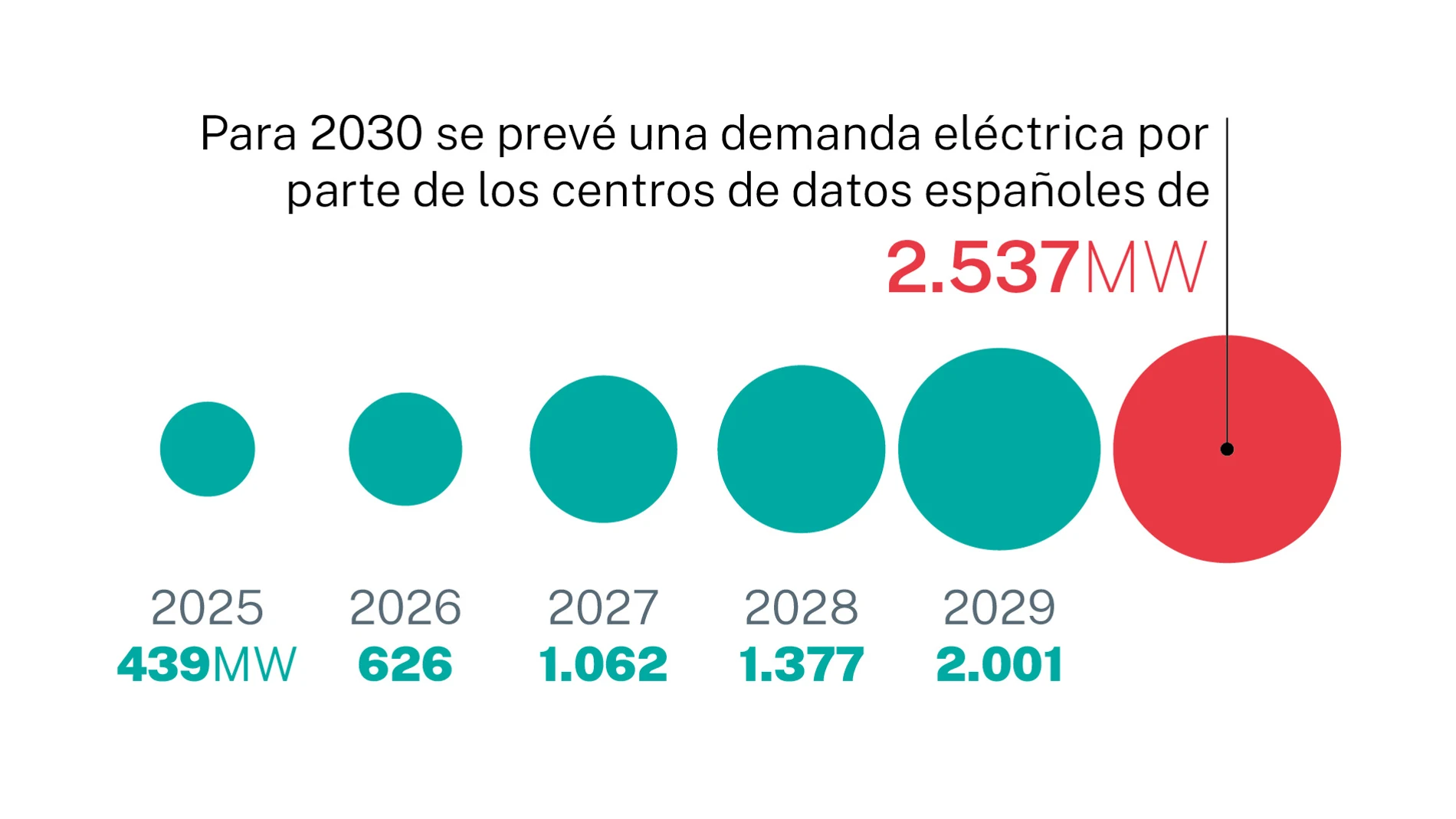
Faced with these challenges, the report identifies relevant opportunities for Spain. Besides of the potential of biomethane, highlights the expected growth of data centers, whose installed capacity will increase from 439 MW in 2025 to 2,537 MW in 2030. This expansion could mobilize nearly 67,000 million euros in investments, contribute more than 7,300 million euros annually to the GDP and generate about 16,000 jobs.
The main conclusion of the study is that the technological race of the energy transition is no longer just about innovating, but about getting solutions to the market quickly. To achieve this, he concludes, it will be essential to match technological development with stable public policies, public-private collaboration and open innovation that allow scientific advances to be converted into competitive industrial projects.