
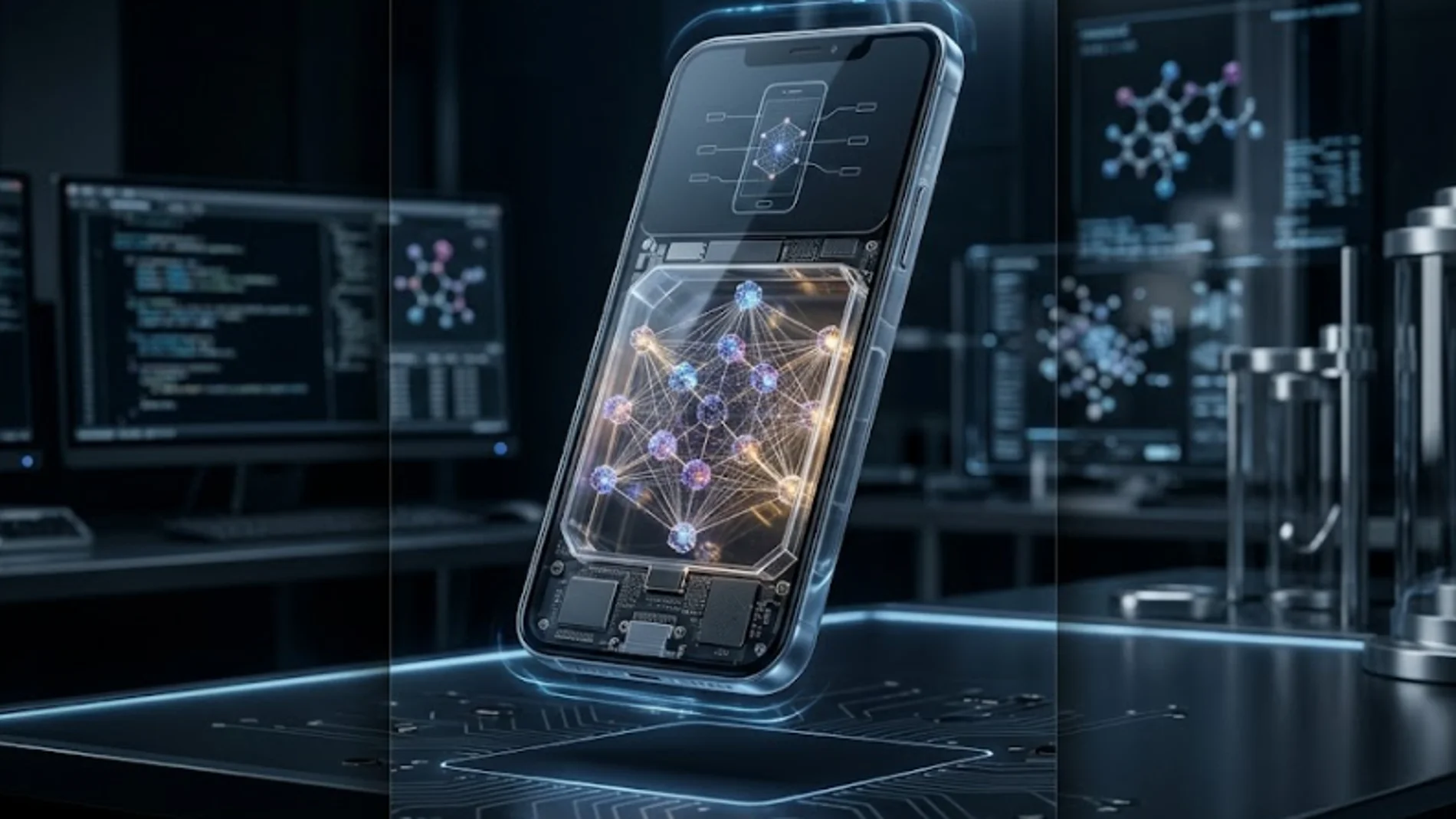
Every time we charge a mobile phone, connect an electric car or turn on a computer, we are using technology with more than two centuries of history. Modern batteries are much more sophisticated than those invented by Alessandro Volta in the early 19th century, but the fundamental principle remains the same: store chemical energy and release it when needed.
Now, a team of University of Queensland scientists led by Xiao Renshaw Wang has explored a radically different possibility. Instead of resorting to chemical reactions, they have studied how certain quantum effects could allow energy to be stored and transferred by taking advantage of collective properties of matter that do not exist in the everyday world. The study, published in the magazine Energy and AIdoes not announce the immediate end of batteries, but it does describe a mechanism that could inspire future generations of energy devices based on the principles of minimal physics.
Quantum mechanics is full of strange phenomena. One of the most surprising is that individual particles can behave collectively as if they formed a single system. Under certain conditions, electrons, atoms or molecules stop acting independently and begin to share common quantum states. It is a phenomenon known as quantum coherence.
Something similar to what happens in football. In a stadium full of people, each individual can move separately. But when thousands of spectators make a wave, a collective behavior appears that is impossible to attribute to a single person. The wave does not belong to a specific person: it is a collective phenomenon that emerges from the coordination of all of them.
Physicists believe that some quantum systems can behave in similar ways. Instead of storing energy in each particle separately, as occurs in a conventional battery through chemical reactions, the energy could be distributed in a collective state shared by many particles at the same time. The energy would no longer be “stored” in each spectator, but in the wave itself.
In a traditional battery, energy is accumulated through chemical changes. When discharged, those reactions reverse and release electricity, but Wang’s team explored another idea: What if energy could be temporarily stored in collective quantum states? According to the authors, certain quantum systems show a phenomenon called superabsorption. Instead of absorbing energy proportionally to the number of particles present, the assembly can capture it cooperatively and much more efficiently.
This concept has given rise to an emerging field known as quantum batteries. The name can be misleading because it is not simply a conventional battery built with quantum materials. The difference is deeper. In theory, a quantum battery could take advantage of phenomena such as entanglement and coherence to charge fasterstore energy in a different way or transfer it with a higher efficiency than that allowed by equivalent classical systems.
Does this mean that batteries will disappear? No. At least not in the foreseeable future. Quantum batteries are still an experimental concept. Most jobs are done in extremely controlled systems and on very small scales. Furthermore, quantum phenomena are extraordinarily delicate.
Interaction with the environment tends to destroy quantum coherence, a problem known as decoherence that constitutes one of the great challenges of quantum technologies. For that reason, Transforming these results into commercial devices will likely require decades of research.
So why is it important? Because it expands our way of thinking about energy. For centuries we have stored energy in fuels, reservoirs, mechanical springs, capacitors or chemical batteries. All these systems essentially obey the rules of classical physics and quantum mechanics opens up new possibilities.
In the same way that quantum computers exploit properties that do not exist in traditional computing, future energy technologies could take advantage of collective phenomena that are impossible to reproduce with conventional devices. They may never completely replace current batteries. What the new study suggests is that, in In the quantum world, there may be ways to store and manage energy that we are still only beginning to understand.