
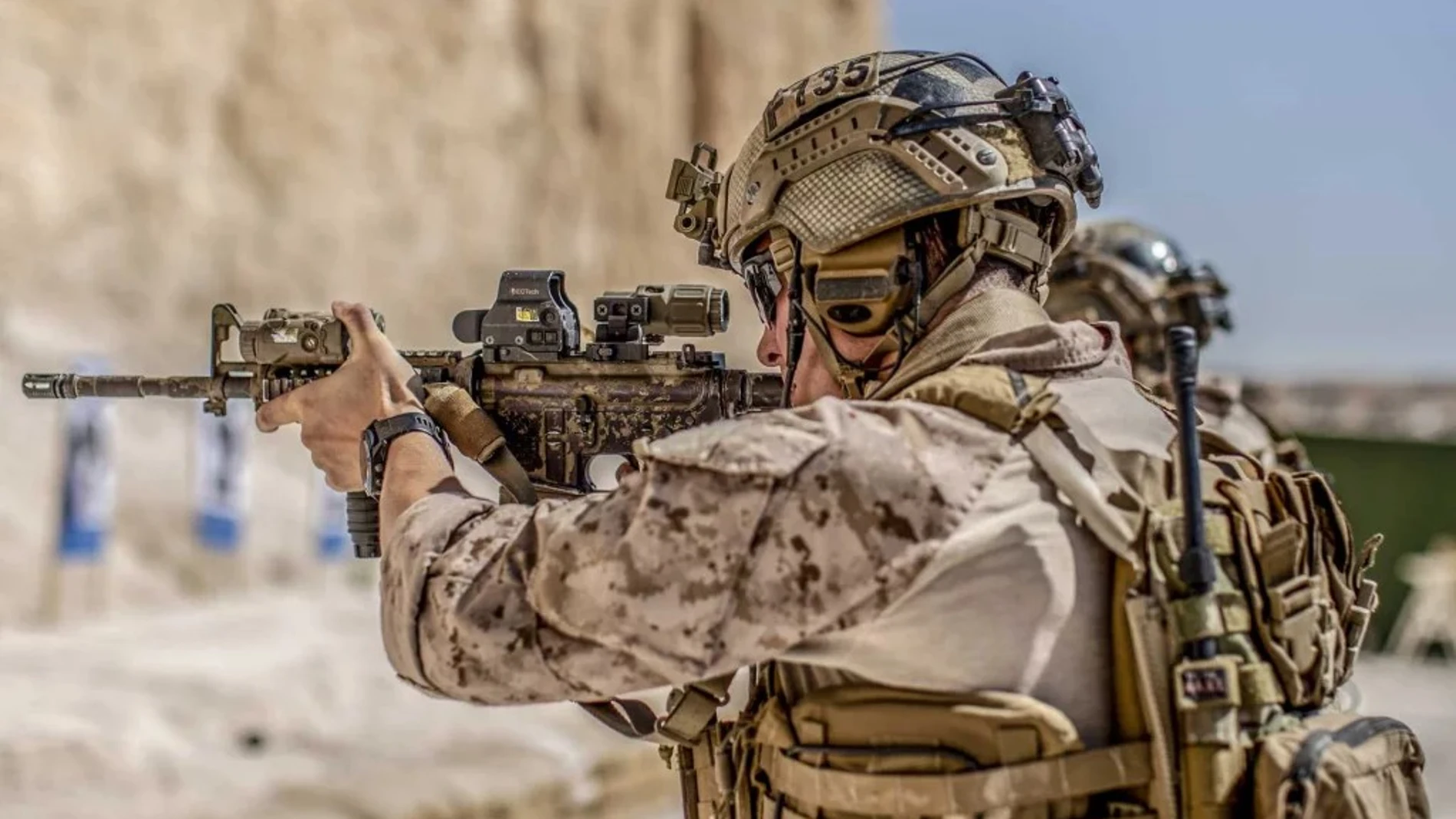
The United States special operations forces have launched a program to modernize one of their best-known weapons, the M4A1 carbinewithout replacing it with a completely new model. According to Army Recognition, the project is called HICARstands for Hypervelocity Improved Capability Assault Rifle or Hypervelocity Improved Assault Rifle, and is intended increase the effective range of this weapon from about 300 to about 600 meters.
The M4A1 is a carbine, that is, a shorter and lighter variant of an assault rifle. It is designed to be manageable in confined spaces, vehicles, urban operations or special missions, although This shorter length usually implies less projectile exit velocity and, therefore, less useful range than a weapon with a longer barrel..
The HICAR program is not about changing the caliber or abandoning the M4 family of weapons. Instead of moving to larger ammunition, such as the cartridge 6.8×51mm of the new rifle XM7 of the US Army, United States Special Operations CommandUSSOCOM for its acronym in English, wants to preserve the current ecosystem of the 5.56×45 mm NATO. This will allow us to continue using chargers, accessories, optics, suppressors and much of the logistics already deployed.
New experimental ammunition and a reinforced M4A1 upper assembly
The new ammunition developed by the program is called M855A1+. It is an experimental cartridge 5.56mm designed to work at a much higher pressure than usual, some 82,000psiin front of the 62,000psi approximations of the M855A1 standard. The aim is for the bullet to come out of the barrel much faster, better maintain its speed in flight and go further with sufficient energy.
The problem is that such demanding ammunition cannot simply be fired from a conventional M4A1. As the pressure inside the weapon increases so much, wear on the bolt, the barrel, the extractor, the gas system and the rest of the parts increases. For this reason, HICAR also focuses in developing a reinforced upper setthe part of the weapon that includes the barrel and other critical components, maintaining the lower frame of the M4A1.
The technical challenge is considerable because the special forces do not want to lose one of the great advantages of the M4, its compact size. The request requires cannons between 11 and 12 incheslow weight and compatibility with chargers PMAGstandard rails and suppressors already used. High levels of precision, reliability, corrosion resistance and operation in extreme environmental conditions are also required. As stated by the lieutenant colonel Alan Wood to The War Zone, The challenge is to balance more speed and energy on target with safety, reliability and real usefulness for the mission.
The calendar cited by Army Recognition foresees that companies present their proposals before June 8, 2026, that the selected suppliers are notified on June 29 and that live fire tests will be held on September 15 and 16 at Fort Moore, Georgia.
The project does not yet imply that the weapon will be widely adoptedbut it does show a clear line of modernization. The USSOCOM seeks to make the most of the M4A1 platform, increasing range and punch and avoiding the logistical cost of changing weapon families.