
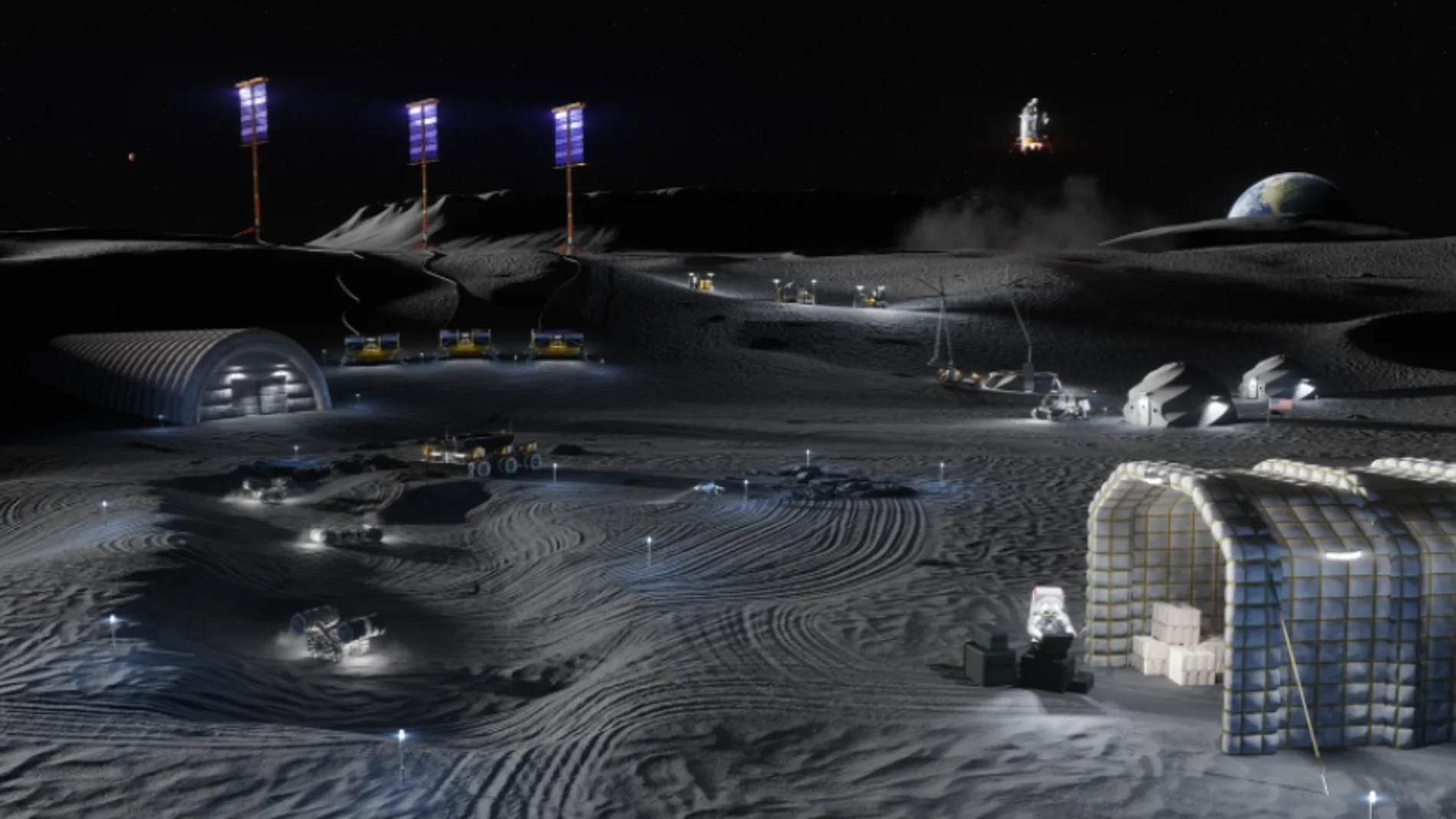
For much of the 20th century, reaching the Moon was a matter of speed. The United States and the Soviet Union competed in a technological race where the important thing was who arrived first. On July 20, 1969, when Neil Armstrong descended from the Eagle module and placed his foot on the lunar regolith, the goal seemed accomplished. They had won. And then something strange happened.
After six manned missions and twelve astronauts walking on the lunar surface, humanity stopped going. The Moon went from global obsession to historical relic. For more than fifty years, the traces of the Apollo program remained intact under a windless sky. But Now NASA wants to return. And this time he doesn’t intend to plant a flag and walk away. You want to build a foundation.
The US space agency has just presented new details of its “Moon Base” program, an ambitious project that seeks to establish a permanent human presence near the lunar south pole. The difference with respect to the Apollo program is radical: those missions lasted just a few days; The new strategy aims to create stable infrastructure, permanent vehicles, energy systems and logistics networks capable of sustaining astronauts for long periods. NASA Administrator Jared Isaacman summed up the change in philosophy with a simple phrase: “The goal is to stay.”
The choice of the lunar south pole is not coincidental. For years, images sent back by orbital probes revealed something unexpected in that region’s permanently dark craters: water ice. AND In space, water is worth almost as much as fuel. It can be drunk, used to make oxygen, and even split into hydrogen and oxygen to make rocket propellant. In other words: the south pole could become a “space gas station.”
But building a lunar base involves solving enormous problems. The Moon has no protective atmosphere. Temperatures can range from more than 120 degrees below zero to over 100 plus. Cosmic radiation hits the surface directly. Lunar dust is also extraordinarily abrasive: during the Apollo missions it got into suits, instruments and lungs.
That’s why NASA is designing something that looks less like a camp and more like a small robotic city. According to the statement, the program consists of three stages, Moon Base I, II and III and will begin construction this year and will have the collaboration of the European Space Agency and its Korean counterpart.
Between 2026 and 2029, automatic missions aimed at testing technologies will arrivetransport cargo and map the terrain. According to the agency, this first stage will include more than twenty robotic landings and dozens of tons of equipment.
One of the most striking elements will be the new lunar vehicles. NASA has already awarded contracts to develop rovers capable of moving autonomously on the surface even before the arrival of astronauts. Some will function as pressurized vehicles; others will act as cargo or scientific exploration platforms.
Although the Moon has virtually no atmosphere and a conventional drone could not fly there, the agency plans to use small jumping vehicles capable of moving using controlled impulses. These systems will explore craters, slopes and regions too dangerous for astronauts. NASA believes they will help delineate the future extent of the lunar base, which could cover hundreds of square kilometers.
“The lunar base will be the first outpost of the United States and humanity on another celestial world – said Isaacman -. Each mission, manned or unmanned, will be a learning opportunity as we return to the lunar surface, build the infrastructure necessary to remain there and Let’s master the skills required to live and operate in one of the most demanding and dangerous environments imaginable. We anticipate that the lunar base will span hundreds of square kilometers, with different resources that will contribute to the goal of establishing a permanent lunar presence.” The agency is also studying compact nuclear reactors to provide energy during the very long lunar nights, which last approximately fourteen Earth days.
But behind the scientific discourse there is also a strategic dimension. NASA knows that the United States is not the only country looking towards the Moon. China is developing its own international lunar station project together with Russia, and several governments already consider the satellite as a future scientific, industrial and geopolitical platform. That’s why Some statements from the agency have a tone with many possible interpretations: “The United States will never abandon the Moon again,” Jared Isaacman.