
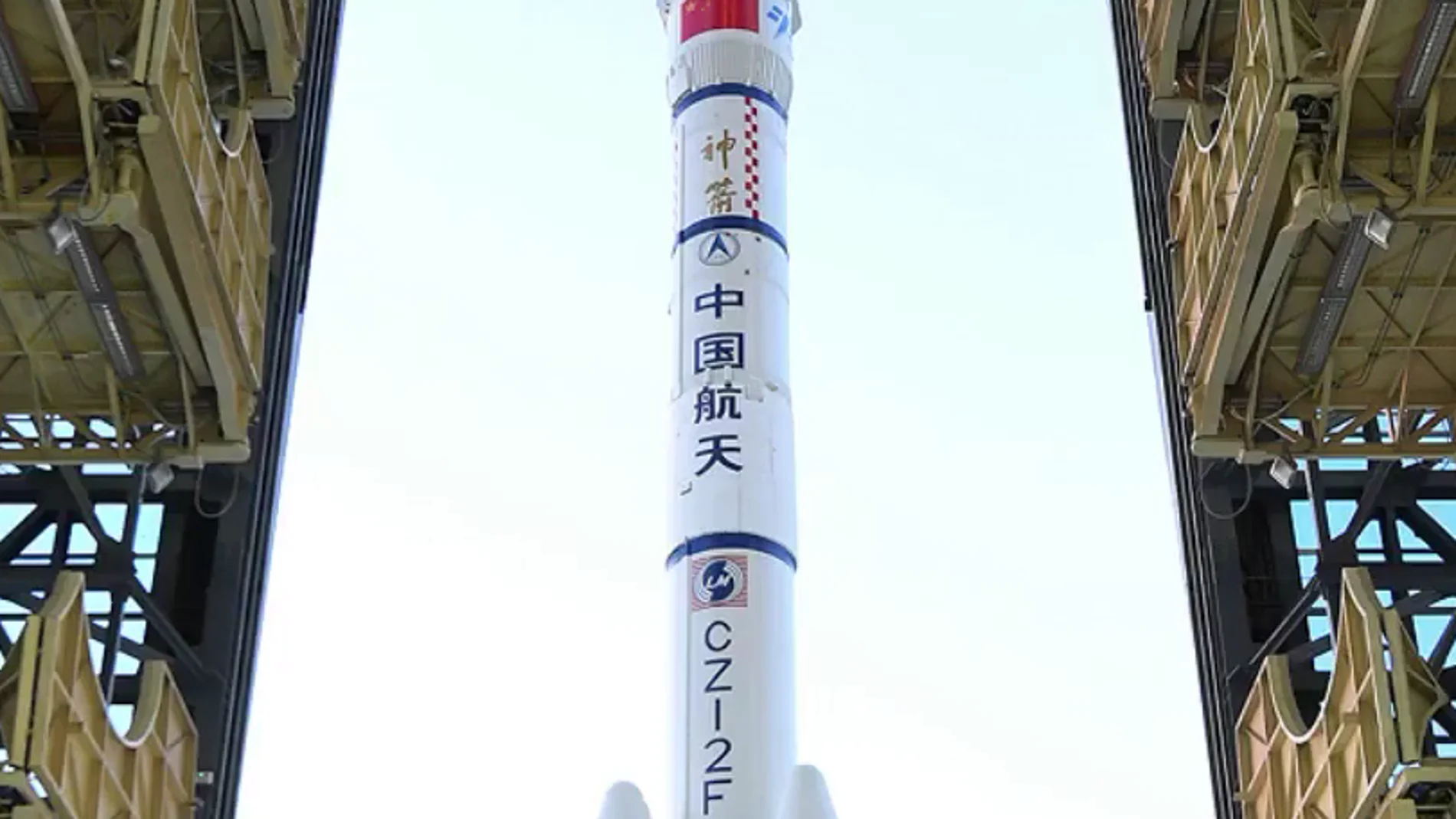
While much of the world continues to look at the Moon as the next great space objective and Mars as the next goal of humanity, China continues to build something less spectacular, but perhaps more important in the long term: a permanent human presence in orbit. And tomorrow it will take a new step in that direction with the launch of the Shenzhou 23 mission, the next manned relay to the Tiangong space station.
At first glance, the mission may seem like just another rotation of astronauts. Three taikonauts (combination of taikong, space in Chinese and naut or navigator) will take off from the Jiuquan space center, aboard a Long March 2F rocket, to spend approximately six months on the Chinese space station. But behind this apparent routine lies something much more ambitious: China is trying to convert space into a continuous, stable and scientifically useful work environment.
The inevitable comparison is the International Space Station (ISS). However, Tiangong represents a different philosophy. While the ISS was conceived as A major international project led by the United States and Russia, the Chinese station is essentially the result of an autonomous strategy. An own orbital laboratory, developed step by step over more than a decade. And Shenzhou 23 arrives at a particularly symbolic time.
In recent months, the Chinese space program has clearly accelerated its schedule. The previous mission, Shenzhou 22, even had to be brought forward and launched without a crew after a problem detected in another capsule docked at Tiangong. That forced China to demonstrate something crucial for any modern space program: rapid response capacity in case of emergency. Now, with Shenzhou 23, the focus is once again on science.
According to Chinese state media, the new crew will carry out experiments related to advanced materials, rare earth alloys and biological studies in microgravityincluding research on “artificial embryos” and complex cellular systems.
It may sound abstract, but the logic behind these experiments is very concrete. Space allows us to study phenomena that are impossible to isolate on Earth. Without gravity, for example, cells behave differently, fluids circulate differently and certain materials crystallize with purer structures. Is a kind of extreme laboratory where everyday physics stops working the same. And that has very real applications, in the first instance.
“The mission – he points out the statement – will use zebrafish embryos, mouse embryos and “artificial embryos” derived from stem cells to explore the establishment of a spatial embryonic research system ranging from lower vertebrates to higher mammals. In the field of space materials science, their research will focus on the production of advanced materials, including high-performance rare earth permanent magnets and high-entropy light alloys, and on the study of how to regulate their performance.” In total, a hundred experiments in a laboratory 400 km away from Earth.
Because China’s true objective no longer seems to be limited to maintaining an orbital station: everything indicates that Tiangong is being used as a training platform for future lunar missions. And that is the true second instance. In fact, the Chinese space program has been accumulating discrete but important milestones for months. The gigantic Long March 10 rocket (designed for manned lunar flights) has already passed key tests. Validations of Mengzhou, the ship that should take Chinese astronauts to the Moon before 2030, are also advancing.
In that context, Shenzhou 23 functions almost as an intermediate piece between two eras: that of the space station and that of lunar exploration. One of the most interesting aspects of The mission is that it could include a record orbital stay within the Chinese program. Sources linked to the space program They suggest that one of the astronauts will remain in orbit for more than a year, something essential to study how the human body responds to prolonged stays in microgravity. And there appears one of the great challenges of modern space exploration: the human body.
Radiation, loss of muscle mass, alteration of the immune system or even psychological changes resulting from isolation remain enormous obstacles to any long-duration mission. Before thinking about Mars, space agencies need to understand what exactly happens to humans after months or years away from Earth.. China wants to obtain that information itself.
Something less visible, but equally important, is also changing: the geopolitical dimension of space. Tiangong is no longer just a Chinese station. It currently hosts international experiments and the country has begun to progressively open its space program to collaborations with other states. Future foreign astronauts are even scheduled to participate in missions to the station.
That transforms the meaning of Shenzhou 23. It is not just a manned launch: it aims to be one of the greatest achievements of any space power is not to reach space once, but to turn it into something routine, like an orbital railway line. If everything goes according to plan, the crew will take off tomorrow at 5:00 p.m. peninsular time from the Gobi Desert and reach Tiangong a few hours later. through automatic coupling. From there a new stage of experiments, maintenance and daily life in orbit will begin.