
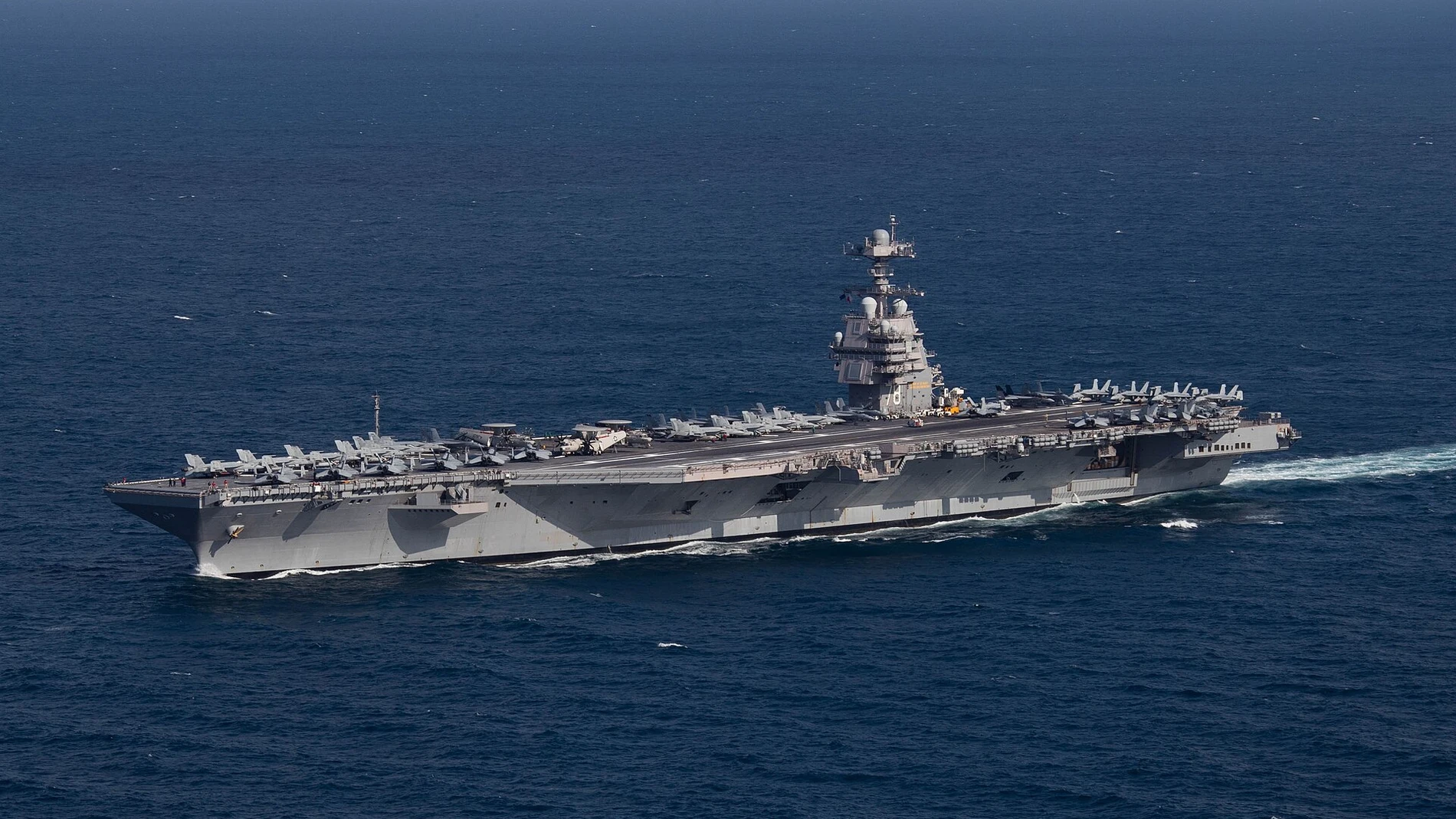
The United States Navy want to check if the USS Gerald R. Fordthe largest nuclear-powered aircraft carrier in the world, can also act like a floating nuclear power plant. The idea is that its nuclear reactors not only power the ship itself, but that they can send electricity to shore facilities during port calls.
In practice, the test will consist of taking advantage of the aircraft carrier’s propulsion system to temporarily supply energy to military bases and, if necessary, also to civil infrastructures affected by natural disastersreports The War Zone.
The initiative was mentioned on May 14 by the acting secretary of the Navy, Hung Caoduring an appearance before the Armed Services Committee of the House of Representatives. According to the media, Cao assured that the Navy wants to demonstrate this summer in Norfolk that a nuclear aircraft carrier can export electricity to a land base.
It will not be a completely unprecedented use of a military ship, since the USS Lexington supplied electricity to the city of tacoma between 1929 and 1930, and the US even operated a floating nuclear power plant, MH-1A Sturgisin the area of Panama Canal between 1968 and 1975. But doing so with a Ford-class aircraft carrier will mean an important leap for the power available and for the possible military and civil applications of the system.
How it will work
The nuclear propulsion of the USS Gerald R. Ford, which measures 337 meters in length and displaces more than 100,000 tonsuses two reactors A1Bmore modern and with greater electricity generation capacity than the A4W of class aircraft carriers Nimitz. The idea of ground electricity supply is based on this excess generation capacity.
When an aircraft carrier is docked, it usually draws electricity from the dock to cover part of its needs. What the US Navy is now proposing is reverse that flowso that it is the ship itself that sends electricity to shore through its electrical system and a specific connection to the port network.
The electrical systems of a military ship work with voltages and frequencies that must be adapted and synchronized with those of a terrestrial network Therefore, before a real test, conversion equipment, protection systems and mechanisms capable of isolating possible failures must be validated. For now, the Navy has not publicly detailed what that connection system will be like.
The military interest of the idea is that many bases located in advanced locations or with limited infrastructure They depend on diesel generators, which requires maintaining a constant supply of fuel. A docked nuclear aircraft carrier could reduce that dependency during the time it remained in port. Additionally, the concept fits with the Pentagon’s goal of having more resilient and distributed power sources for bases that could be attacked in a conflict.
All this has a regulatory aspect to take into account. The nuclear reactors on U.S. warships are under Navy jurisdiction, but connecting them to civilian networks will likely require coordination with the Navy. Nuclear Regulatory Commission and with the corresponding state authorities.
The idea also raises operational and technical questions. If the aircraft carrier becomes tied to shore power supply tasks during its stops, it could reduce its availability for rapid deployment and make planning your maintenance and training cycles even more complicated. Furthermore, its reactors are designed to propel the ship and power its own systems, not to function as a stable power plant connected to a land grid, so it will have to study what impact these operations will have on the useful life of the nuclear plant.