
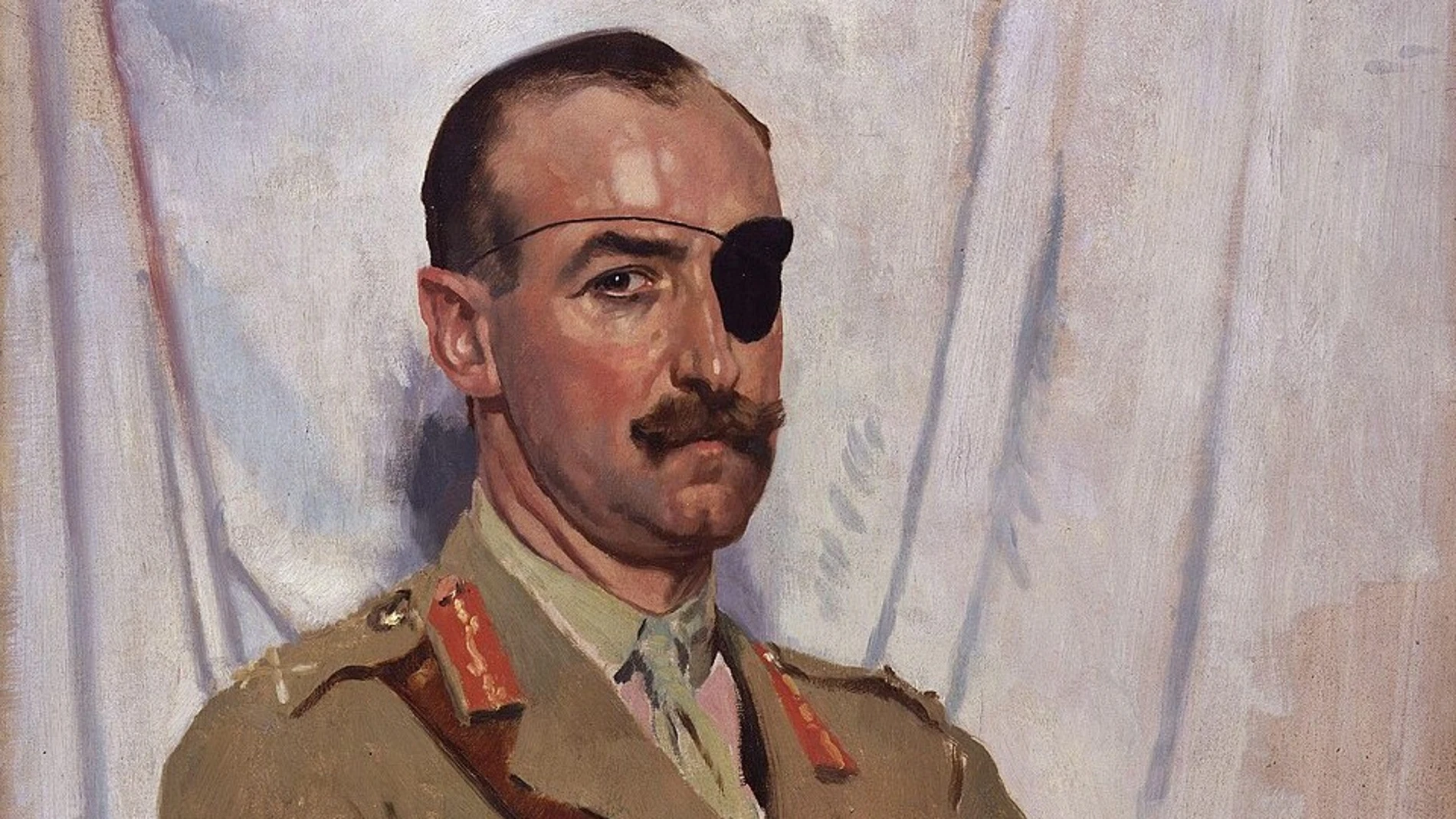
There were men who waged war, and others who seemed made to survive it. But none like Adrian Carton de Wiart, the British aristocrat who lost an eye, a hand, was shot in the head, abdomen, leg and hip, escaped from an Italian prison, survived plane crashes or shipwrecks… and still wrote in his own handwriting, with disconcerting phlegm: “Frankly, I enjoyed the war.”
If a novelist had created such a character, his editor would probably have asked for moderation because it seemed completely implausible: too many lives within one. But Adrian Carton de Wiart existed and the twentieth century seems to have insisted on throwing him against all its hells.
He was born in 1880 in Brussels, into an aristocratic family linked to European diplomacy. Everything suggested a refined, calm, even elegant existence. Oxford, receptions, embassies. However, young Adrian felt an irresistible attraction to danger. When the Boer War broke out, he abandoned his studies and enlisted in the British Army under a false identity. Barely had the century begun, he had also begun his long combat with death that would last more than forty years.
In Somaliland, during the British colonial campaigns in Africa, a bullet shattered his face and he lost his left eye. Many would have considered his military career ended there, but he fixed it by putting on a black patch that had become one of his identifying marks and returned to the front as if nothing had happened.
Then came the First World War and, with it, the trenches, mud, steel and industrialized carnage that devoured entire Europe. He was wounded again and again. A shot pierced his skull; another reached his hip. He was later hit in the leg and ankle. During a battle, an explosion destroyed several fingers on his left hand. As he would say years later, the doctors did not act quickly enough and he himself had to tear off his damaged fingers. The scene seems straight out of a wild adventure novel, but it perfectly defines Carton de Wiart’s personality: an improbable mix of physical resistance, absolute contempt for pain, and a recklessness close to madness.
Return to the front
Despite his injuries, he continued to return to the front. The soldiers who fought with him spoke of a man who seemed to move between bullets with a supernatural calm. A British officer would recall years later that he gave the impression that danger exerted an inexplicable magnetism on him.
In the First World War he received the Victoria Cross, the highest British military decoration, for acts of extraordinary bravery. By then, his body was already an extensive map of scars. But the most extraordinary was yet to come. During World War II he was sent to Yugoslavia with a very delicate diplomatic and military mission. The plane he was traveling in crashed in the Mediterranean. Carton de Wiart, who had already survived practically everything, swam to shore and was captured by Italian troops.
Any other man would have interpreted this as the inevitable end of their adventure. Locked up in a high-security prison camp, he spent months planning his escape. He dug tunnels, organized escapes and finally managed to escape disguised as an Italian peasant. He traveled many kilometers trying to reach freedom before finally being captured again. Even his enemies seemed to watch him with a mixture of exhaustion and admiration. There was something disconcerting about Adrian Carton de Wiart: not even tragedy could break his good humor.
When he spoke about the war he did not do so with epic solemnity or sentimentality. His memoirs titled in English “Happy Odyssey” are full of dry irony, almost comical observations and a naturalness that is astonishing today. Perhaps because he belonged to a generation formed by a fierce idea of duty, or perhaps because he had lived with death for so long that he ended up losing his fear of it.
Winston Churchill, who knew many extraordinary men in an era filled with giants and monsters, had a deep admiration for him. And it was no wonder. Wiart’s Carton seemed to condense in a single body all the violence of the twentieth century: colonial wars, European trenches, secret operations, military prisons, plane crashes and collapsed borders of a burning continent.
But behind that almost legendary figure there was also something deeply human: a constant need for movement, action and intensity, as if peace were too boring and silent for him.