
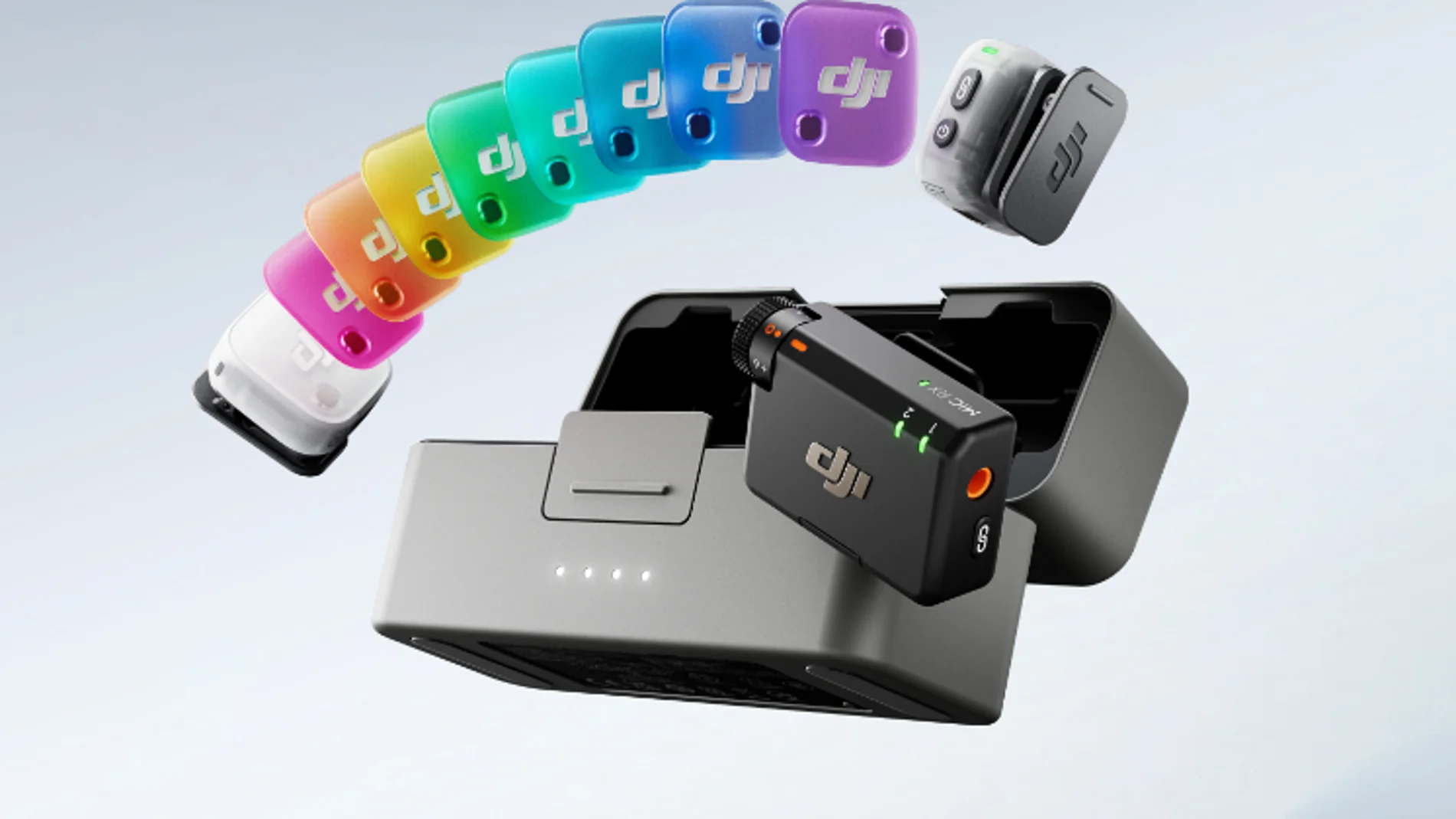
It’s not strange. Sound and color go hand in hand, at least in physical terms. Both are transmitted through waves, both need a medium to “translate” them (the eye and the ear) and, without them, the world would be very boring, a monotony of senses, so to speak. And with the new Mic Mini 2, DJI has decided to unite what the electromagnetic spectrum decided to separate: color and sound. But let’s start at the beginning.
There was a time when wireless microphones were exclusively professional tools: black boxes, bulky receivers, cables hidden under clothing, and prices closer to a camera than an accessory. DJI has been trying to dismantle that idea for some time, but with the new Mic Mini 2 has taken a curious step: converting audio into something also visual.
The Mic Mini 2 are tiny even by today’s standards. Each transmitter weighs only about 11 grams and works as a microphone and transmitter at the same time.eliminating much of the usual complexity of this type of systems. DJI maintains here the philosophy of the previous model: that recording good audio is almost as simple as taking your phone out of your pocket. But this time there is a detail that changes the focus of the product quite a bit: the color.
Instead of hiding the microphone or trying to make it go unnoticed, DJI seems to assume that many creators no longer want to hide the technology, but rather integrate it into their aesthetic. The Mic Mini 2 incorporate interchangeable magnetic covers in different shades – blue, green, yellow, violet or orange – and even some special editions designed by the Chinese-American illustrator Victo Ngai.
It’s a small change, but interesting. For years, technological design tended toward the invisible: black headsets, black microphones, black cameras. DJI proposes the opposite: accessories that are part of the creator’s visual identity. On TikTok, YouTube or Instagram, where the personal image is part of the content, that makes a lot of sense.
And it’s not just aesthetics. The extremely small size also helps the microphone stop feeling “technical.” It can be magnetically attached to clothing and is much less invasive than other more cumbersome professional systems. And, as is customary, there are several ways to “wear it”: with a clip system, with magnets and attached to an element.
In sound, DJI maintains the essentials: 48 kHz/24-bit recording, two-level noise cancellation and various voice profiles (“Standard”, “Rich” and “Bright”) designed to slightly modify the final tone depending on the environment or type of content.
We are not looking at a studio microphone nor does it pretend to be, some (the most fanatics of quality and seekers of sound climates) may miss the 32 bits. But perhaps that is precisely the key to the product: DJI seems to have understood that most creators today are not looking for absolute perfection, but rather a balance between quality, simplicity, usage time and portability.. And in that balance the Mic Mini 2 fit very well.
The system It can reach up to 400 meters away and the total autonomy, using the charging case, is around 48 hours. In addition, it integrates directly with DJI’s Osmo ecosystem, allowing you to record without additional receivers on some of the brand’s devices, such as its drones, cameras or stabilizers.
The interesting thing is that DJI seems to be doing something similar with audio to what happened with wireless headphones years ago: transforming a technical tool into an everyday accessory. One that shows where the aesthetics of sound are going. We will soon see how What are now covers that add color to the microphone become surfaces that can be modified from the applicationjust like we do now with clock faces.