
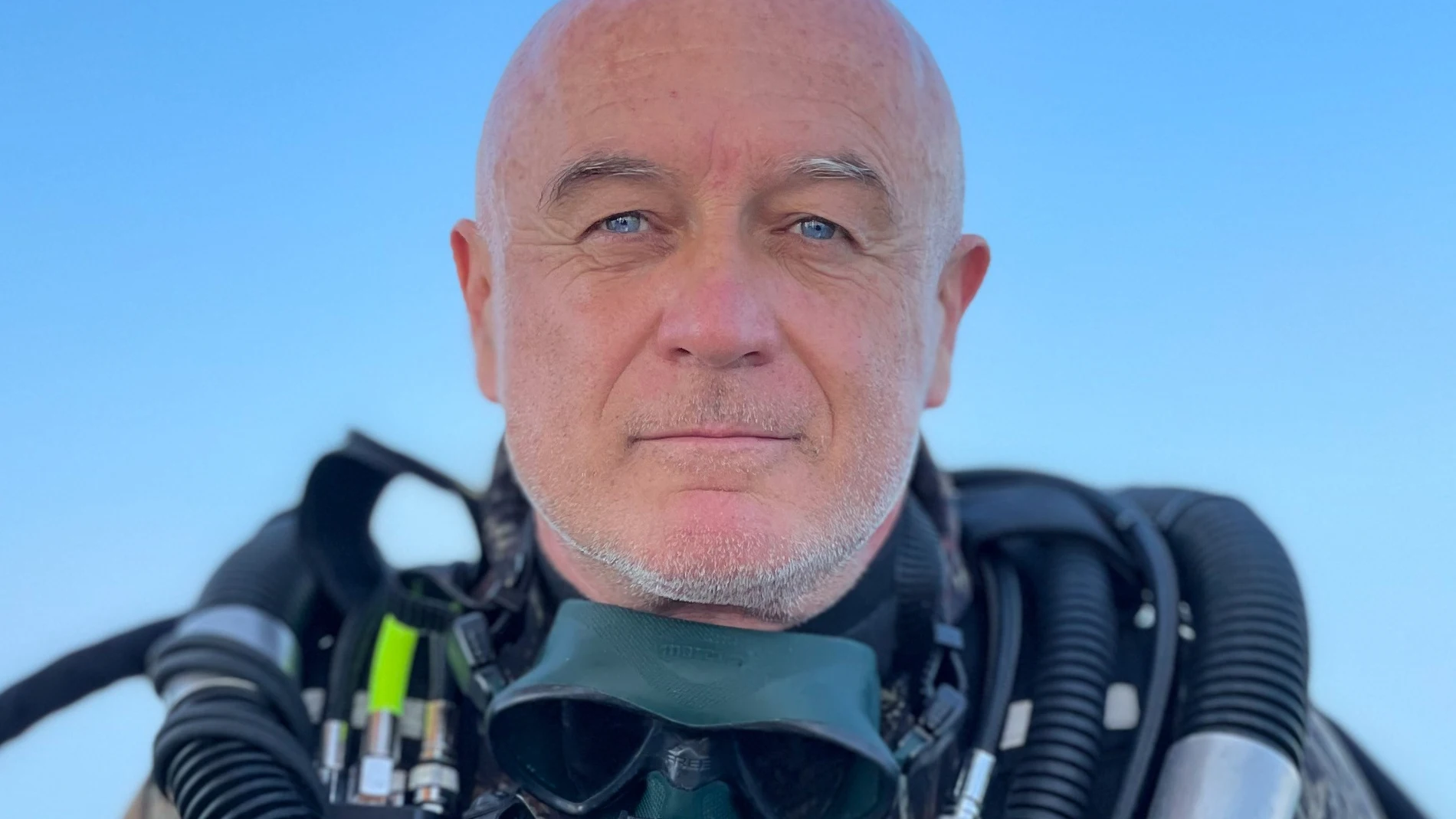
Manu San Félix has been linked to the island of Formentera and the Mediterranean Sea all his life. A marine biologist by training, he decided to make a living more than 30 years ago by opening a diving center. Then it came National Geographic and the aspiration to turn Vellmarí into what it is today: an association dedicated to conservation and focused especially on restoring the Posidonia meadows, the plant responsible for the appearance of the sea that the Balearic archipelago is so fond of.
What is so special about posidonia?
It is a plant that arrived in Formentera 100,000 years ago. It helps the formation of beaches and prevents erosion; It is a lung that releases oxygen. Posidonia meadows are more effective at removing CO₂ from the atmosphere than the Amazon for a simple reason: they do not rot. In addition, nearly 600 species live in them.
They have invented and seem to have successfully invented a way to replant through cuttings and seedsNo? The data made public by the association speaks of more than 86,000 plants since 2021 and a success rate of 93%
Yes, there are a few of us who have started planting. It’s like agriculture. There are other projects that are being planted and, over the years, a system is sure to be unified.
Does the plant have a lot of rhizome?
A lot. It is an extraordinary plant with a great capacity to conquer the seabed.
Throughout these years there has beenn united public organizations, but also many private companies. In this replanting project they work together with the MSC Foundation. What do you think companies contribute to projects like yours?
We are an NGO and we have a very ambitious and difficult project: protect 30% of the Mediterranean to recover local fishing, which is the basis of our culture and our way of life. To do this we need, first, to be supported by institutions, that like what we do, and also by companies with a purpose, that have that sensitivity (as many citizens have), to take care of the planet. There will be some who want a return of image, which seems logical and reasonable to me, but many others do not want anything in return; just help. And they have executive and economic capacity.
The plantations are made in Formentera, but seen the success I don’t know if they plan to expand to more places.
This year we are going to start in Ibiza and look at Mallorca and Barcelona. What we want, and what we have been doing since we began to have confidence and success with the methodology, is to open it, export it and try to encourage more people and entities to implement it. In the end, this is not about what Vellmarí does; It is going to generate a campaign to spread throughout the Mediterranean.
In recent decades, 34% of the grasslands have been lost. How do you see the Mediterranean in 10 years?
I am a born optimist and I am convinced that we are going to be successful with our Reserve 30 campaign, with which we want to protect 30% of the Mediterranean, recover local fishing and take care of those landscapes, species and ecosystems that give us so much, starting with enjoyment and happiness. I hope that in 10 years I will see a Mediterranean that looks more like how it was in 1940, for example, than how it is now.
In all the years you’ve been there, what have you seen that worries you the most? Or, conversely, what do you think is improving?
The question is very good because there are two ways of looking at it. We are talking about the Mediterranean, but it is somewhat applicable to the entire planet. If you look at how it is, it is devastating; hurts. I always insist that we should not fall into apocalyptic messages, but when you are objective and tell what is happening, it sounds like this: apocalyptic. However, on the other hand, we know what we have to do to reverse the situation. I think it is a simple thing and quite common sense: it is about seeing how we live, something that has cost human beings centuries in terms of comfort, health and life expectancy, but without leaving that mark that we have left in the last 30 or 50 years, which is when the great change has occurred. Now we can think about how to live this way, but without leaving that mark, which not only goes against nature and the planet, but against ourselves. Not doing so would be unwise. I think it is time to take another step as a civilization so that we can continue living as well as we do now, but without falling into the contradiction of destroying the place where we live to achieve it. That’s absurd.
A few years ago, measures began to be taken to avoid anchoring in Posidonia meadows. Are you seeing tangible results?
This answer completes the previous one. Right now everything is making your heart sink, but there has been a change. It has not yet reached nature, but it has reached society. The United Nations has put protection on the table and 186 countries have said yes, we have to protect 30% of the sea. This exercise of reflection, of understanding that we must change, is already on the table. And then that has reached companies. When I arrived here, to Formentera, more than 30 years ago, it was unthinkable for a company to pay attention to what a marine biologist says or an NGO from Formentera does. It is a message of hope: we are close to making that change.
From a diving center, Vellmarí ha transforming into a conservation center. What has that process been like and what motivated it?
Well, it’s a personal question. I finished my Biology degree at the Complutense University more than 30 years ago. As a marine biologist it was very difficult to make a living, almost impossible. As I was already an advanced diver, this training allowed me to come live in Formentera and open a small family business. As time went by I had, and have, the privilege of working for National Geographic. This has allowed me to make a pivot from a family business to an NGO. I think you have to have ambitions to put important solutions on the table, because there are serious problems. And that has been the ambition: to grow with a project for the Mediterranean. When someone does something they look for a reason, an interest. I, personally, want to do what I do because I believe it is good for society, for everyone and for myself. I think about what we will leave to future generations. I am 61 years old and I would like to see that Mediterranean recovered, that Mediterranean as it was 40, 50 or 60 years ago. And I think it is possible to do it. If we achieve it, it will be good for everyone: from an economic point of view, for fishing and tourism; from the quality of life and for our way of living day to day.
At the center you do a lot of environmental education activities for children. Do we need more environmental education for adults?
Completely. My generation had two of the greatest environmental educators. I am what I am because of them. I only feel admiration, respect and devotion for Jacques Cousteau and Félix Rodríguez de la Fuente. Educating is very important because you change the future for the better. It is utopian, but if right now we managed to educate all the children on the planet, many of the problems we have (and I’m not just talking about conservation, I’m talking about respect, human rights and so many other things), would disappear. This world would be better. We must educate children and young people, but we must also reach adults. I believe that the media, carrying these messages, are also educators. And then there is an aspect that I really like: children educate their parents, and we take that into account. We know that many little ones are going to say: “Hey, dad, mom…”. It’s a way to reach adults.
Last year he discovered a coral. How does one feel when that happens?
In reality it was a team effort, although it was my turn and that’s why I discovered this specimen. The project Pristine Seas of National Geographicwhere I have worked for 18 years, is a great idea from a great person, who is Enric Sala. We travel to places on the planet to protect them, with the goal of protecting 30%. On one expedition I found what turned out to be the largest known coral colony and when it was made public the response was incredible. Thousands of visits were counted. It was something crazy. I never thought that conservation news could have such an impact. You conclude that nature matters to people and that we need positive news. Nature is full of them and they give us happiness. We live much better, but life is hard. Nature gives us peace and joy, and we still have a lot to know and discover in the ocean.