
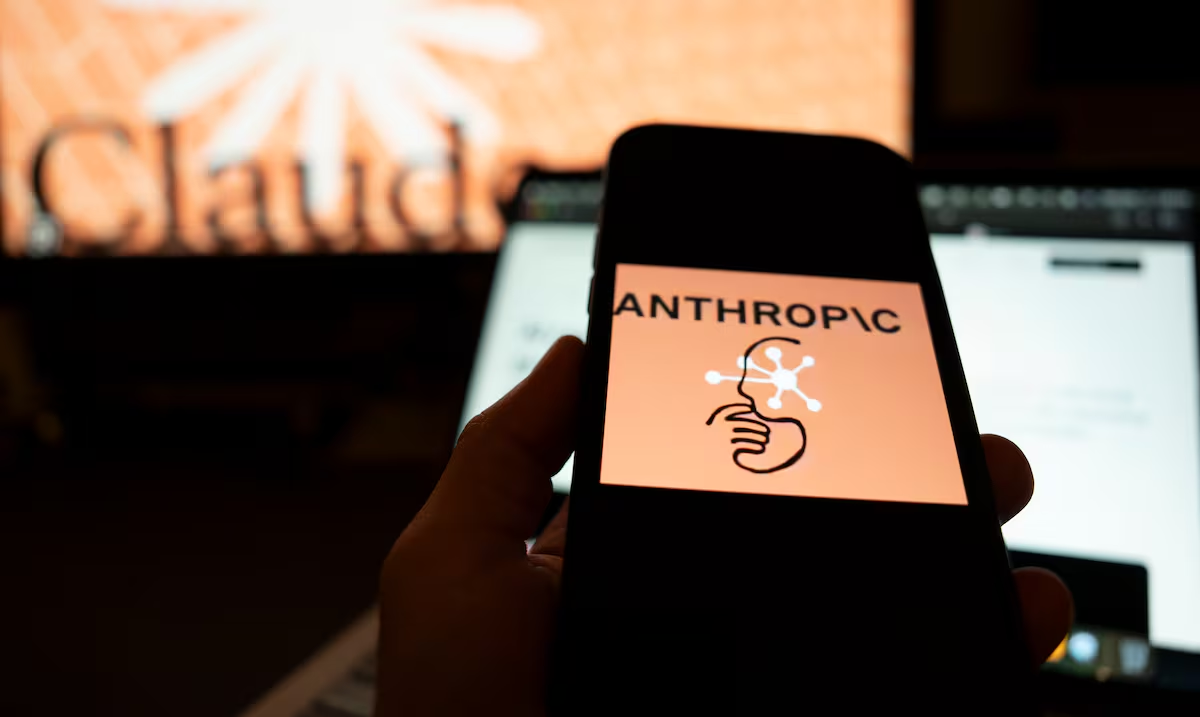
A new court hearing in Washington This Tuesday will reactivate the dispute between the Pentagon and the company of artificial intelligence Anthropicwhich for now has been limited to participate in defense projects, since the Administration of the president of USA, donald trumpclassified it as a “risk” for national security.
An Appeals Court in the US capital will hear arguments on the Pentagon’s decision to classify Anthropic as a possible “risk to the supply chain”a measure that can block federal contracts and limit its presence in projects related to defense.
These are the keys to understanding a case that has opened a debate that goes beyond a single technology company and fuels the discussion about the role that AI companies should play in military programs.
1. The beginning of the battle
The dispute began last February, when the Secretary of War, Pete Hegsethannounced that the Pentagon would designate Anthropic as a “risk to the supply chain”a figure used by the US Government to restrict suppliers considered problematic for national security.
According to US media and the company itself, the conflict arose after Anthropic tried to maintain restrictions to prevent its AI model from being used in mass surveillance of US citizens or in fully autonomous weapons.
The company sued the Pentagon in March and Hegseth defended the government’s position, saying that “American fighters will never be hostages to the whims of Big Tech.”
2. What does Anthropic argue?
Anthropic, founded in 2021 by former OpenAI researchers including Dario and Daniela Amodei, focused on security and control, maintains that the Pentagon’s decision was arbitrary and that the administrative process did not respect basic legal guarantees contemplated in federal legislation.
The technology company said, at the beginning of the dispute, that “I had no other option” He had to challenge the grievance in court and sued the Pentagon federally, arguing that the designation jeopardized the rights of freedom of expression and due process.
Finally, the company maintains that the case marks a historical precedent regarding the limits of government power to restrict the scope of artificial intelligence providers.
3. The judicial path
The litigation has progressed through different levels of the judicial system with files open both in Washington and in California.
In its first phase, the case was presented before the Federal Court of San Francisco, where Anthropic requested an injunction to stop the immediate application of the Pentagon’s designation as “risk to the supply chain”.
In that instance, the judge allowed a partial temporary blocking of the measure while the underlying arguments were analyzed, considering that there were indications of possible administrative retaliation and violations of freedom of expression.
Subsequently, the case was transferred to federal courts in the capital, where the core of the litigation remains and in this jurisdiction, the Pentagon was authorized to provisionally maintain the designation, noting that the Executive has a wide margin of discretion. “discretion” when he invokes reasons of national security.
4. A new hearing in Washington
This Tuesday’s hearing corresponds to the oral arguments phase of the appeal process that pits Anthropic against the War Department.
This is not a final trial, but rather an instance in which lawyers from both sides will present their arguments before federal judges.
The judges will have to evaluate whether the Pentagon acted within its powers by classifying the company as a possible strategic risk to federal and military technological infrastructure.
5. What is at stake
The conflict between Anthropic and the Pentagon has been described by analysts and local media as a case that could mark the extent of government oversight over artificial intelligence companies that work with the public sector.
According to information from the Washington Post, executives from the technology and defense sectors have warned that the case could have a direct impact on federal contracts for companies that develop artificial intelligence.
Among them, executives linked to companies that already work with the Pentagon have indicated, on condition of anonymity, that a designation like “risk to the supply chain” It could generate uncertainty in future tenders and in the continuity of agreements already signed.
The process is closely followed by the sector due to the possible effect on future tenders and public-private alliances and as well as possible restrictions to develop tools in the military field.