
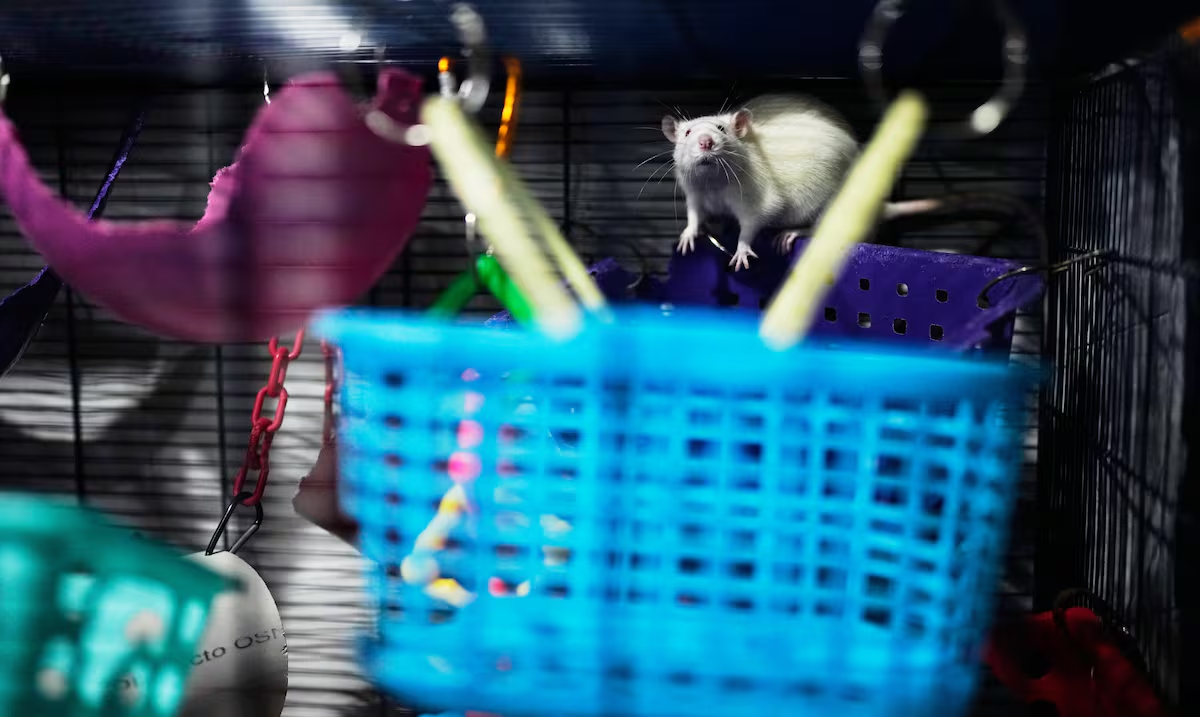
Three albino rats jump from small hanging baskets in a huge cage installed in an enclosure Buenos Aires in front of a group of people. Other rodents hide in tunnels or look for the applesauce that their caregiver offers them through the bars.
Dozens of curious people came on Sunday to Ratapaloozaone of the two events that Team Rats organized every year to promote the adoption of rodents raised in vivariums or that have been used for research in scientific laboratories.
Members of Team Ratas took advantage of the event to set up stalls selling keychains, mugs, stickers and hair clips with figures of rats and mice. The money raised is used to cover the veterinary and feeding expenses of the rodents, which they take into their homes before putting them up for adoption.
Break down stigmas
María Gabriela Aponte held Camamberto, one of the three rats she adopted. The three specimens, all males, were raised in a vivarium intended for the maintenance of laboratory animals under strictly controlled conditions.
The young woman also has seven females “in transit” for whom she wants to find a family. At his stand he sold vegan food, as well as pins and stickers in the shape of rodents.
Aponte told The Associated Press that these types of events serve to break down the stigmas surrounding these animals, which many people would never keep as pets. “People don’t have much idea or have a very specific perception of what a pet is. Rats are very intelligent and sweet.”
Laura Müller came with her 9-year-old son from the city of La Plata, 70 kilometers to the south, because they are contemplating the possibility of having a rat in their house. “He is vegan and discovered this on social media. We came to find out the requirements to adopt.”
The leader of Team Ratas, Dominique Verdier, explained to them that it is necessary, among other things, to have a veterinarian who specializes in this type of animals, a spacious cage with accessories for their entertainment, which must be placed in a space frequented by family members. In addition, owners must take the animals out of their habitats for at least one hour a day to interact.
Growing network
Team Ratas is the leading network in Argentina and Latin America for the relocation of laboratory rats and mice, which would be sacrificed if they do not find a foster home.
It all started in 2016, when Verdier adopted two rats because a friend told her that at the university where they had been used to carry out a series of studies, they were no longer necessary.
Currently, the rodent shelter network that it created is made up of 90 transit homes in Buenos Aires and nearby towns that house hundreds of animals from 11 vivariums and laboratories. In the last 10 years it has rescued more than 8,000 specimens and given up about 3,000 for adoption. The organization’s Instagram account has more than 60,000 followers.
Verdier keeps 37 rodents—mostly albino rats—in large cages set up in his home.
The leader of “Team Ratas” noted that the rodents received by the organization “do not transmit diseases because they did not have contact with the street nor are they inoculated with viruses and bacteria.”
The rescued rats and mice, as specified, come from vivariums that have surplus animals, specimens that have already passed their reproductive stage and are no longer useful or animals subjected to experiments that are harmless to themselves and human beings. This is the case of rodents that have received vitamins or proteins that modify their metabolism, making them unsuitable for further research.
“Several laboratories prefer to euthanize the animals and others instead tell me ‘take them, we don’t want to sacrifice them,’” Verdier said days ago while holding his rat Carlota in his bedroom. The little rat climbed onto her shoulders and then sought refuge near her body, while the young woman remained sitting on the bed.
Support from the field of science
Veterinarian Silvina Díaz, coordinator of the Livestock Technician at the University of Buenos Aires (UBA), was in favor of rehoming these rodents, as long as they are healthy, and pointed out that it is a common practice in Europe.
Díaz, a researcher at the National Council for Scientific and Technical Research (CONICET), directs the Experimental Neurogenesis laboratory, where the nervous system of rats and mice is studied.
She has not donated animals to Team Ratas because, due to the type of research she conducts, the animals must later be euthanized with an overdose of anesthesia. “But it seems perfect to me that they do this task of rehoming animals in families that can give them a good life and I am interested in (the vivarium technicians) knowing that Verdier eventually receives them and can contact her.”
Díaz organized a three-day event in September 2025 at the UBA Faculty of Pharmacy and Biochemistry to promote topics related to the use of laboratory animals, including their rehoming.
“I can assure you that most of the animals we have in the vivariums are healthier than the dog I have at home, they are not in contact with pathogens,” said the veterinarian. “The world is moving at a slower pace and we are slower and we should not demonize the Dominiques who appear; if there were any legislation in our country that specifically contemplated this situation it would be much better.”
He noted that in Europe and the United States the rehoming of animals for research use is contemplated by law.
In Argentina, keeping rats or mice as pets is allowed, as long as they are not wild. The law on wildlife—which does not expressly mention “rodents”—establishes regulations for the preservation of “animals that are free and independent of man.”
Verdier says she is used to the criticism she receives on social media. “If people see a dog shelter, they may admire it and on the other hand, when I mention Ratapalooza they say ‘what you’re doing is stupid’. And I say that I’ve been doing this for ten years and it continues to grow.”