
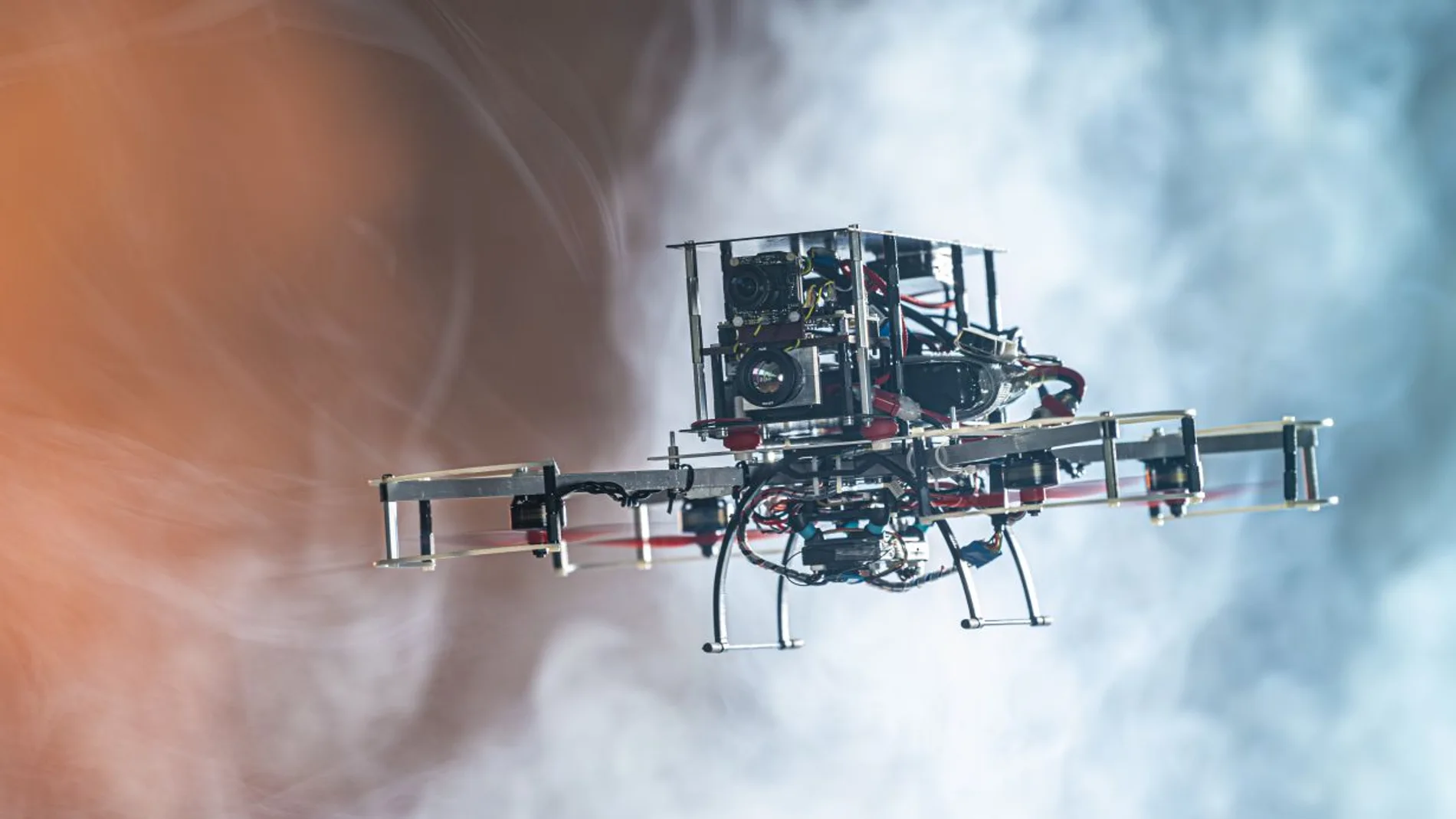
Drones are no longer just a concern in the military field, but also in civil environmentsas you well know in Germany. In recent years, many drone sightings have been recorded in sensitive locations and In 2025 alone, the Federal Criminal Police Office reported more than 1,000 suspicious incidents. Faced with this situation, a team of researchers from Germany has developed a new drone interceptor that uses metal chains to entangle their rotors and shoot them down in mid-flight.
The concept has been created by scientists from Karlsruhe Institute of Technology (KIT) and adapts the physics of the traditional South American bowler to modern technology, replacing the former’s balls with chains that are easy to tangle.
The South American boleadora is a hunting weapon that dates back to more than 5,000 years and was initially used by the indigenous people of the Patagonia. It consists of two or three heavy ballsusually made of stone, bone or metal, joined by leather strips. The hunter made them spin to gain speed and threw them towards the animal. so that they would wrap around his paws and fall.
The proposed system for short-range interceptions works firing thin, light metal chains at approaching UAVs. Once the chains reach the target, they wrap around the body and rotors of the drone. In this way, they prevent the propellers from rotating and force the aircraft to stop flying.
‘We used a well-known physical principle, similar to that of the boleadora used by shepherds in South America, and adapted it specifically to defense against drones.’has pointed out Claus MattheckPhD and distinguished senior researcher at KIT Institute of Applied Materials.
It is a low-cost interception system that does not need explosive projectiles. ‘Instead of balls attached to strings, we used fine chains, which proved to be superior in simulation calculations‘, explains Mattheck.
‘Upon contact, the chains They wrap around the body and rotors of the drone. As a result, the rotors lose mobility and the drone crashes,’ he adds.
The team believes this approach could offer a simpler and potentially safer alternative to conventional anti-drone systems. According to the researchers, existing counter-drone technologies are often too expensive, rely on complex systems and face deployment limitations.
To evaluate the drone interceptor, engineers carried out computer simulations and analyzed how metal chains behaved between three and four millimeters thick when colliding with drone models.
Their calculations looked at factors such as geometry, friction and motion dynamics to determine how effectively the chains could wrap around a drone’s rotors during flight. ‘We verified the fundamental suitability of the method using these computer simulations’says Mattheck.
‘A particular advantage of chains as projectiles is that, when falling, pose less risk of collateral damage than a compact projectile of the same mass. Additional verification was carried out experimentally by firing tests at the Sternenfels Ballistic Center,’ a statement said.
Researchers now aim to expand field testing to evaluate the interceptor over a wider range of operating conditions. If future trials are successful, the team believes industrial partners could make the concept a reality.