
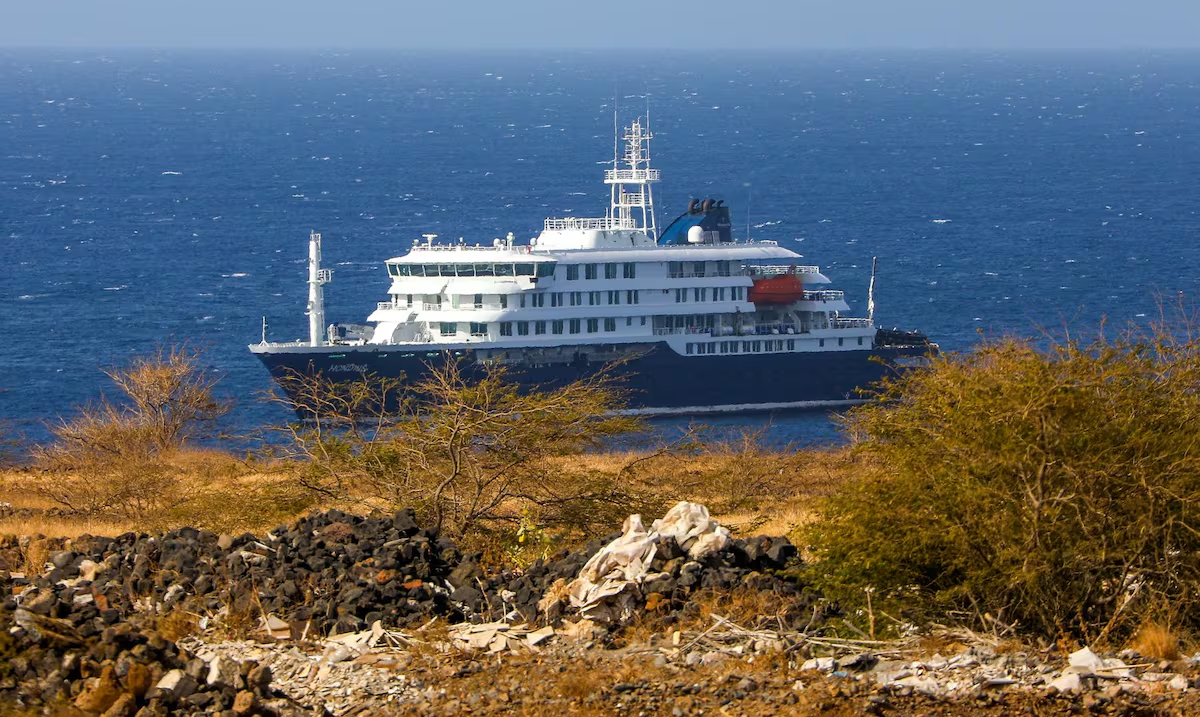
Madrid – Why should people who have been on the MV Hondius ship have a 42-day quarantine? It is a period much longer than that recommended for SARS-CoV-2 responsible for covid (14 days at the beginning), for Ebola (about 21 days) or severe acute respiratory syndrome -SARS- (10 days), but the one that best fits the historical origin and the literal meaning of the word ‘quarantine’.
The reason: the longest quarantines depend on the known time between contagion and the appearance of the first symptoms, and usually correspond to diseases in which the incubation period is very long, when the initial symptoms are not very clear or decisive and the disease is especially dangerous.
This was explained to EFE by researcher Alfredo Corell, professor of Immunology at the University of Seville (southern Spain), who has stressed that the epidemiological behavior of the hantavirus – including its ‘Andes’ variant – is very different, and that the incubation period is “very variable” and can range between one and six weeks (42 days), as is being seen with already repatriated passengers and some showing symptoms and giving positive results in the first tests.
1/16 | With masks and plastic gowns: this is how passengers get off the cruise ship with a hantavirus outbreak. Passengers began disembarking Sunday from the hantavirus outbreak-affected cruise ship anchored off the Spanish island of Tenerife in the Canary Islands, hours after arriving there as evacuation plans were put in place. – Ramon de la Rocha
The immunologist has assessed the protocols that have been established and their execution, the disembarkation and repatriation of all passengers to their countries of origin “with the highest safety standards”, he has defended that the maximum alarm levels have been established “not because the virus is very contagious, which it is not, but because it is very lethal”, and he has questioned the laxity with which some of the passengers will be treated in their countries and that strict quarantines will not be imposed.
“The alarms are working”
In his opinion, the differences can cause a loss of confidence in institutions or international organizations, but he recalled that the World Health Organization “proposes” the most appropriate protocol, but each country decides what it does.
Corell has insisted today that contagion only occurs through close contact (“very close”, he pointed out), and has pointed out as examples sharing a room (or cabin) with the sick person; intimate or very close contact; caring for a sick person without adequate protective measures; handle sheets, clothing or fluids that could be contaminated; or healthcare without adequate personal protective equipment.
On the contrary, it is not close contact or crossing paths with a person who may be infected or briefly sharing a space, pointed out Alfredo Corell, who has captured these situations in an educational and informative drawing to clarify that hantavirus infection is not usually accidental but requires that this close connection be prolonged or intimate.
1 / 13 | Inside the MV Hondius: this is what the cruise ship affected by the hantavirus outbreak looks like. The Dutch-flagged MV Hondius, a cruise ship carrying nearly 150 people, remains off Cape Verde after three passengers died and several others became seriously ill in a suspected hantavirus outbreak. – The Associated Press
“The alarms are demonstrating their effectiveness, that they work,” the immunologist has stated. He has stressed that strict surveillance during the quarantine is what will prevent any case from escaping and that the quarantines are “very justified”, and he has also warned of the possibility that in the case of this virus there are “super-contagators” and that people with very mild symptoms are capable of infecting several people.
More concern for those who disembarked earlier and without control
But the professor has insisted that the transmission rate of this virus – the number of people infected from an infected person – is less than 1, and has observed that the rate of the latest variants of the virus responsible for covid is 15 and that of measles is 18.
In his opinion, the trickle of positive cases that is occurring “is not at all strange; what must be avoided is that these people infect others”, and he has assured that what really worries him are not the people who have disembarked in Tenerife, in the Spanish archipelago of the Canary Islands, and have been repatriated to their countries, but the passengers who disembarked on the island of Santa Elena and are neither located nor controlled, and who could also not have felt symptoms because they were incubating the disease and infecting people around them.
Alfredo Corell has highlighted the importance of words in crises like this, and in that sense he has stressed the importance of differentiating “isolated” (as most of the cruise passengers and other people who have been in contact with them already are) from “admitted”; not to confuse people suspected of having had some type of contact with “patients”; and not to increase the alarm if in the coming days more positives come out among the people who are already controlled.
Outbreaks of this virus are usually resolved in three ‘jumps’ (from the rodent to the person; from one person to another person; and from this person to other close contacts), the professor specified, and concluded that “a fourth jump must be avoided at all costs” to corroborate “that we are almost at the end of this outbreak.”