
The energy and digital revolution of the 21st century has a cost that rarely appears in discourses on sustainability. A report by the Institute of Water, Environment and Health of the United Nations University (UNU-INWEH) warns that the extraction of critical minerals, essential for manufacturing batteries, electric vehicles, renewable energy and artificial intelligence infrastructure, is transferring a heavy environmental, social and health bill to some of the most vulnerable communities on the planet.
The study, titled “Critical minerals, water insecurity and injustice”, warns that Demand for these resources has tripled between 2010 and 2023 and could quadruple by 2050. Just to meet the goals of the Paris Agreement, global lithium demand would need to increase nine-fold by 2040.
“Technological disruptions are necessary and useful. But we must be aware of their unintended consequences,” emphasizes Kaveh Madani, director of UNU-INWEH, who points out: “You cannot speak of an ecological, sustainable and fair transition if it simply transfers environmental damage from the rich to the poor.”
Water, first victim
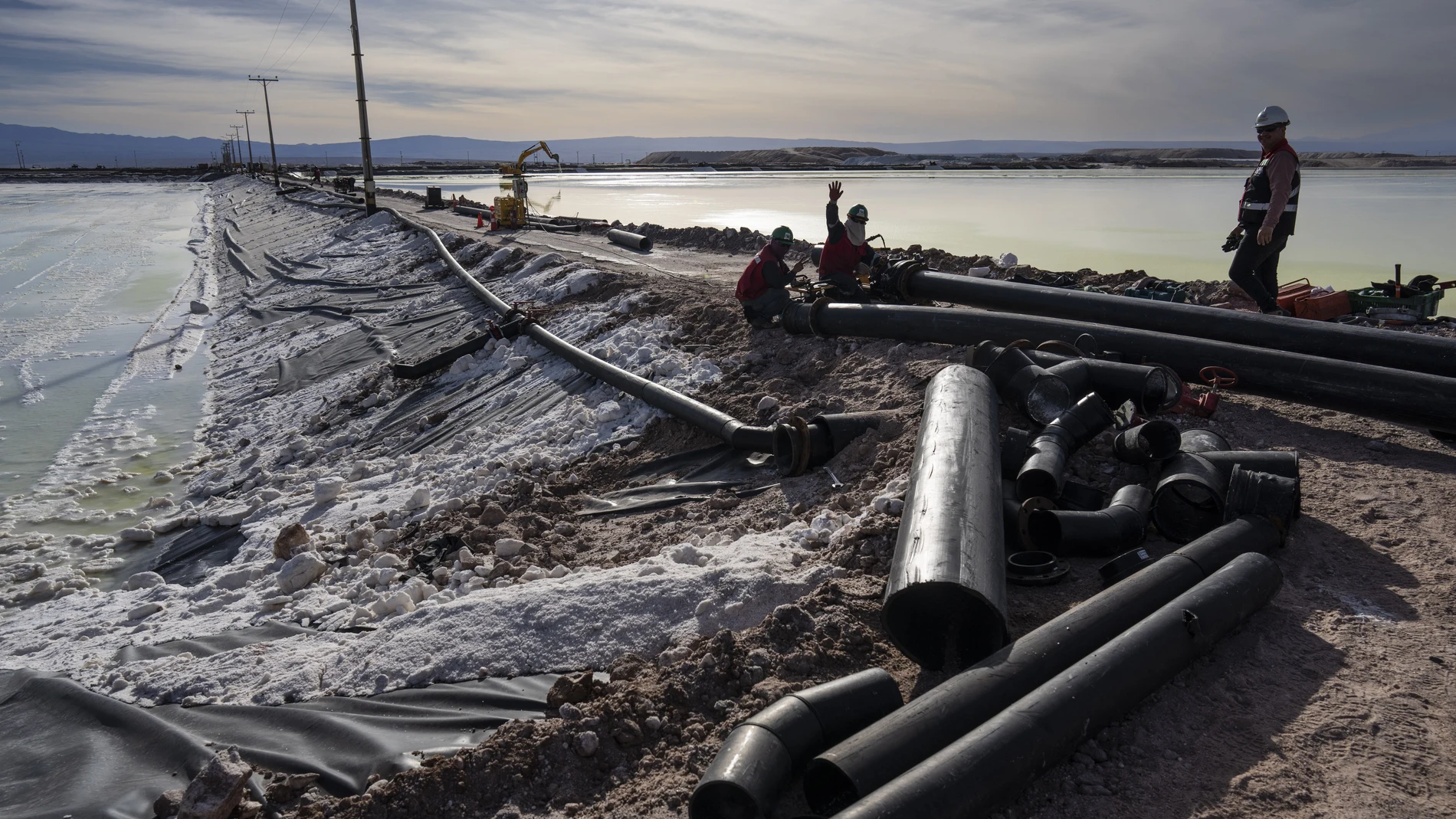
Lithium production is especially intensive in water resources. About 1.9 million liters of water are required to obtain a single ton. In 2024, global lithium production—about 240,000 tons—consumed approximately 456 billion liters, equivalent to the annual drinking water needs of 62 million people in sub-Saharan Africa.
In the Salar de Atacama, in Chile, lithium extraction represents up to 65% of regional water consumption. Between 1990 and 2015, the water table dropped by up to nine meters in the areas near the brine wells. Similar situations are repeated in Bolivia, Argentina, the Democratic Republic of the Congo and even in the United States.
“Water insecurity is not a side effect, but a systemic consequence,” warns Madani.
Communities sacrificed
The report reveals that 54% of mining projects linked to the energy transition are located in indigenous territories or in their immediate vicinity. Besides, 16% of the world’s reserves are located in regions already under severe water stress.
In the Democratic Republic of the Congo, responsible for more than 60% of global cobalt production, The human impact is devastating. 72% of the inhabitants near the mines report skin diseases, while 56% of women and girls suffer from gynecological problems. Nearly 30% of farms employ minors, some as young as seven years old.
“The transition to green energy is one of the most important undertakings of our time,” says Abraham Nunbogu, lead author of the report. “But the communities that carry out the excavations, breathe the dust and lose access to drinking water are excluded from its benefits,” he adds.
Mountains of toxic waste
Rare earth mining generates waste on a colossal scale. Each ton produced leaves behind about 2,000 tons of toxic waste. In 2024 alone, global production generated 707 million tons of waste, enough to fill about 59 million garbage trucks.
The oil of the 21st century
The UN compares these minerals to “the oil of the 21st century.” Africa is home to 30% of the world’s reserves, while the Lithium Triangle—Argentina, Bolivia and Chile—concentrates more than half of global lithium.
However, mineral wealth does not necessarily translate into prosperity. In the Democratic Republic of the Congo, where more than 80% of production is controlled by foreign companies, 73.5% of the population lives on less than $2.15 a day.
“If we do not correct governance deficiencies, we will have built the clean economy of the future on the same injustices of the past,” warns Nunbogu.
A truly just transition
The report calls for mandatory international standards, strict controls on water use and pollution, greater recycling of batteries and electronic components, as well as binding agreements that guarantee real benefits for affected communities.
The energy transition is essential. But, as the rector of the UN University and undersecretary general of the United Nations, Tshilidzi Marwala, recalls, a transformation that worsens poverty and restricts access to drinking water “is not progress towards the Sustainable Development Goals, but a step backwards.”
The challenge is not to give up clean energy, but to ensure that its cost does not fall, once again, on those who have contributed the least to the climate crisis.