
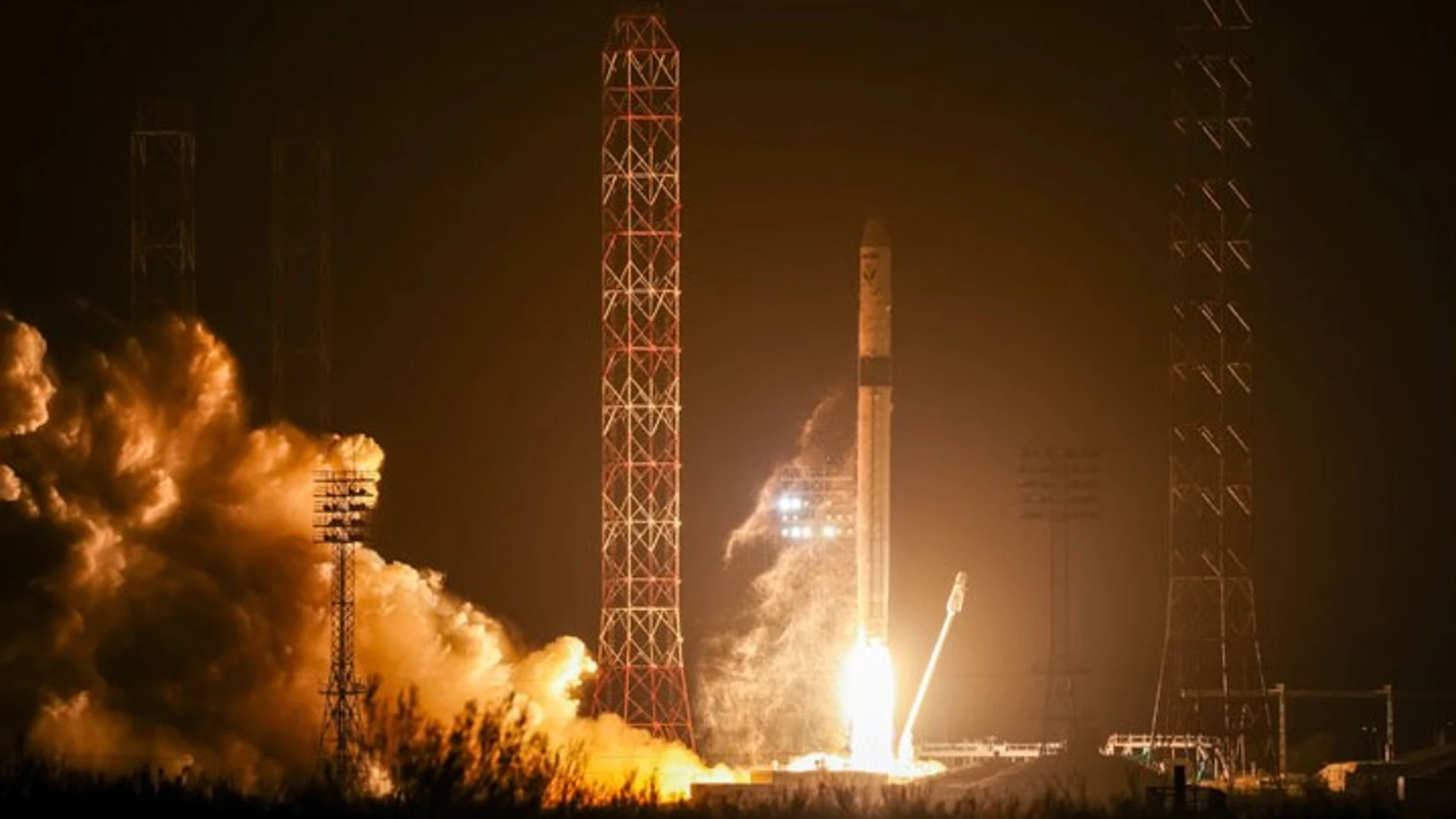
After a long season without good news, the Russian space program can now give one. Last Thursday, Roscosmos successfully launched its new low-cost rocket for the first time, the Soyuz 5. He did it from one of the launching ramps at the Cosmodrome. Baikonurin Kazakhstan, at 8:00 p.m., Spanish peninsular time. The test consisted of a brief suborbital flight that was uneventful.
‘The first test launch of the new Soyuz 5 rocket has been a success!’, noted the Russian space agency in a message on Telegram. In another publication, Roscosmos added that ‘Soyuz 5’s first and second stages worked as plannedand a mock-up was launched towards the calculated suborbital trajectory, followed by re-entry into an area of the Pacific Ocean previously closed to maritime and air traffic.’
Soyuz 5, which has been in development since 2017was ‘designed to replace middle class vehicles Zenith manufactured in Ukraine and provide to Russia a first stage booster for a future superheavy rocket‘, according to RussianSpaceWeb.com.
Roscosmos waits ‘that the low-cost vehicle complements the Angara rocket family for national needs and makes Russia competitive again in the international launch market’adds the media.
The Soyuz 5 gained more importance as a national symbol after the start of the invasion of Ukraine in February 2022, a country that is a powerhouse in rocket design and manufacturing. Historically, Russia has used the industrial and engineering capabilities of its current enemy, a dependency that has become a strategic problem with the war. With the Soyuz 5, of Russian design and manufacture, Moscow wants replace the Zenit family, developed in the Soviet era in Ukraine and operational between 1985 and 2017.
However, It is not clear that the new rocket will attract international customers. Russia has lost most of its space alliances due to the invasion of Ukraine and Soyuz 5 does not seem to represent enough progress to reactivate any of them.
The rocket is comparable in size and payload capacity to the Falcon 9the emblem of SpaceX. Soyuz 5 can carry about 17 tons to low Earth orbit, in front of the 22.8 launcher company Elon Musk. But the Falcon 9’s first stage is reusable, while the Russian vehicle is completely disposable.
Soyuz 5, also known as Irtyshis a middle class rocket with two main stagesto which can be added a higher stage for missions to higher orbits, and among 59 and 65 meters highdepending on the cap used, 4.1 meters in diameter and a takeoff mass of about 530 tons. Uses liquid oxygen and naphthyl as propellants, with an engine RD-171MV in the first stage and RD-0124MS in the second. It is designed to operate from Site 45 of Baikonur and its main purpose is cover Russian medium-lift launches and serve as a technological base for future super-heavy systems.
The successful launch of Soyuz 5 comes five months after the setback suffered by Roscosmos when, at the end of November, a takeoff of the Soyuz 2.1a left the launch ramp unusable Site 31 of Baikonur, used for launches to the International Space Station. It should be noted that Roscosmos uses the designation ‘Site’ for all types of cosmodrome facilities, not just the launch pads. The Russian space agency reported in March that it was already repaired and operational again.
Beyond this incident, Roscosmos closed 2025, as well as 2024, as the year with the fewest launches since 1961a clear symptom of the paralysis of the Russian space program, which has received the first good news in years with Soyuz 5.