
The robotics pioneer who helped launch the Roomba vacuum cleaner is now betting that one day you can replace your beloved dog or cat with a stuffed robot that follows you around your home and adapts to your daily habits.
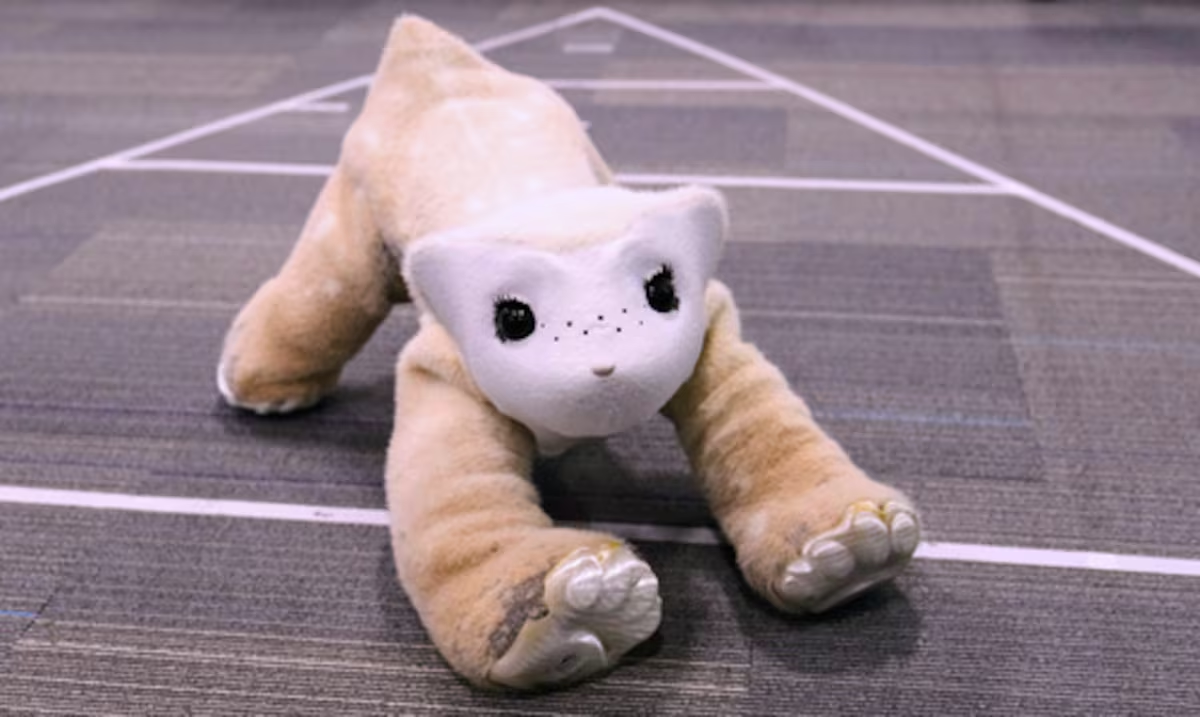
Colin Angle presented on Monday a four-legged prototype of that artificial pet, called “Family.”. Imagine a creature the size of a bulldog, with doe eyes and bear cub ears and paws, stretching out in greeting and inviting you to pet its touch-sensitive faux fur.
“We chose a form factor that is not a human, not a dog, not a cat, because we wanted to get away from all those preconceived ideas”said Angle, who runs the startup Familiar Machines & Magic and before that was long-time CEO of Roomba maker iRobot.
This type of realistic machine, powered by the latest artificial intelligence technology, would not have been possible when Angle co-founded iRobot in 1990 or launched the first Roomba in 2002.
It is not the first time that an attempt has been made to build a domestic robot similar to a pet. Japanese electronics giant Sony, for example, introduced a small plastic robotic dog called Aibo in the late 1990s and rebooted the concept in 2018. But Angle believes Familiar accomplishes something that “just hasn’t existed before.”
“The challenge is to make something that’s not a toy to watch,” Angle says in an interview with The Associated Press. “It’s about having something that you want to hug, that you want to caress. When he is happy, he makes you happy. And it’s big enough or mobile enough to follow you to the kitchen or drag you off the couch and go for a walk.”
According to Angle, the robot will make emotive sounds similar to those of an animal, but will not speak. But, imitating a real pet, it has audio input “ears” and an artificial intelligence system capable of understanding and learning from what is said to it. It benefits from advances in generative artificial intelligence powered by chatbots like ChatGPT and can gradually adapt its behavior as it learns from the people around it.
“I couldn’t have done this six months ago,” Angle said.
Angle led iRobot for a quarter century and turned Roomba into the first widely adopted home robot. Intense competition, especially from China, later threatened its success. Angle stepped down as CEO and president in 2024, after Amazon abandoned its plan to buy the Massachusetts company.
Familiar Machines was born soon after and remained in “stealth” mode in Woburn, Massachusetts, until Monday, when Angle brought one of his Familiar prototypes to New York for The Wall Street Journal’s “Future of Everything” conference.
It might take a while for Angle to start selling the machines, but one of the target groups is retirees, who are past the peak age for pet ownership.
“Not because people suddenly stop enjoying pets, but the fear and obligation to take care of them are such that people are very reluctant to have new pets at an advanced age”says Angle.
Although most robot engineers draw inspiration from science fiction, the idea of a familiar has deep roots in folklore, from a witch’s cat and a wizard’s owl to the companion animals in Philip Pullman’s fantasy novels “His Dark Materials.”
“It’s an archaic, old word,” Angle says. To his surprise, he could also search it.
Angle has brought together a number of leading robotics advisors, including Marc Raibert, pioneer of robotic locomotion and founder of Boston Dynamics, maker of the quadruped robot Spot; and Cynthia Breazeal, inventor of the Kismet robotic head and later the Jibo desktop speaker robot, first attempts to provide robots with social expressions.
Many did research together at the Massachusetts Institute of Technology and share skepticism about the current fad for sleek humanoid robots designed to walk and move like people but still can’t do much useful physical work.
One of those advisors is Maja Matarić, a computer science professor at the University of Southern California who 25 years ago co-founded the field of social assistance robotics, with the goal of designing robots that could provide social and emotional support to people.
When he first saw Angle’s prototype, he said he “immediately got on the ground near it and had to hug it and pet it, then started playing with it to see what it would do.”
Whether people perceive the robot as adorable and not creepy will be key. Matarić said decades of research into human-robot interactions have shown that a “friendly, personalized and vulnerable robot is much more attractive and lovable than the alternative.” It could be especially useful in nursing homes or as emotional support for mental health, he said.
Matarić stated that AI advances have also made it easier to extend the impact to the general population.
This story was translated from English to Spanish with an artificial intelligence tool and was reviewed by an editor before publication.