
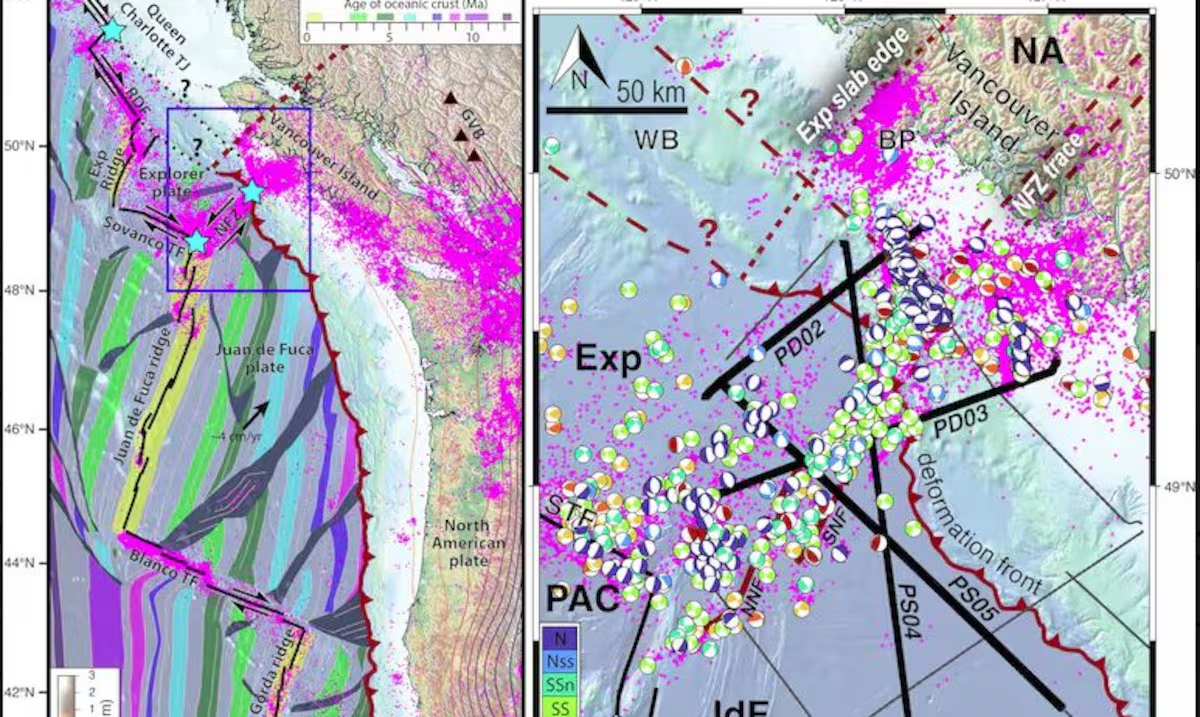
An unprecedented geological discovery put the international scientific community on alert: the ocean floor is in full fracture beneath the surface of the Pacific Northwest. Researchers from the Cascadia Seismic Imaging Experiment (CASIE21), whose findings were recently published in the journal Science Advancesconfirmed that the tectonic plates Juan de Fuca and Explorerwhich slide under the North American plate, are in full process of active fragmentation. This area, vital for the tectonic balance of the region, does not collapse suddenly, but rather gradually tears in an event that experts describe as a critical geological phenomenon.
“This is the first time that we have a clear picture of a subduction zone in the process of disappearing“explained Brandon Shuck, an associate professor at Louisiana State University and lead author of the study. To illustrate the complexity of the process, the researcher compared the dynamics of the plates to a prolonged railroad accident. “Instead of collapsing all at once, the plaque is slowly disintegratingcreating smaller microplates and new limits. So instead of a big accident, It’s like watching a train slowly derail.car by car,” Shuck said in dialogue with ScienceDaily.
The study, which integrates deep penetration seismic images with catalogs of regional seismicity, details how large cracks fracture the Juan de Fuca plate. According to scientific analysis, there is a fault approximately 75 kilometers long that actively fractures the terrain. Although the process raises concern about possible geological repercussionssuch as earthquakes or eruptions, scientists maintain that the fracture expands extremely slowlyestimated on a scale of millions of years. “It hasn’t come off completely yet, but it’s close to doing it“Shuck warned, detailing that the lack of seismic activity in certain areas, despite the crack, confirms that some fragments have already separatedso they stopped producing volcanic or seismic stresses as they are not linked to the main board.
1 / 13 | Various countries demonstrate in favor of the planet as part of Earth Day. Millions of people around the world paused Wednesday, at least for a moment, to celebrate Earth Day. -Carolyn Kaster
The research also explains the tectonic life cycle: historically, Subduction zones act as geological engineswhich means that when an oceanic ridge approaches a trench, the young, warmer and buoyant lithosphere, resists subduction. This phenomenon is what drove the fragmentation observed in Cascadia. Suzanne Carbotte, a scientist at the Lamont-Doherty Earth Observatory, said that although knowledge about plate slowing existed, never been seen with such clarity. “These new findings help us better understand the life cycle of tectonic plates that shape the Earth,” said Carbotte, emphasizing the importance of integrating this data into seismic risk models for the Pacific Northwest.
The report emphasizes that, although this tear is a geological odditydoes not immediately alter the risks of tsunamis or large earthquakes in the region. However, it allows us to understand how ancient tectonic fragments, such as those found in Baja California, were formed through similar processes. Fragmentation, marked by a network of deep faults that penetrate into the mantle, functions as a segmentation system.
The imminent termination of subduction in this specific area is a reminder that the earth’s configuration is dynamicsince it transforms continents and the seabed continuously but imperceptible to human scale. The monitoring of these faults and their interaction with regional seismicity remains the scientific priority for anticipate future changes in crustal structure.