
«Sometimes we believe that innovation consists of applying the most sophisticated technology and it has to go through artificial intelligence or whatever is at its maximum. hype», reflects David Cenicerosentrepreneurship specialist TheCircularLabthe first circular economy innovation center in Europe, created by Ecoembes in 2017, located in Logroño. “But many times it involves revisiting processes,” explains the expert, “understanding very well the origin of the problem and proposing implementable solutions.”
This is precisely the spirit of TheCircularLab. Study, test and develop solutions linked to ecodesign and packaging recycling, from its conception to its final recovery. “The difference is that we do not innovate by looking at ourselves», summarizes Ceniceros. “We open the doors for other currents of thought, other forms of work and other visions to enter.”
Since its launch, the center has promoted more than 300 projects together with a network of more than 250 collaboratorsbetween companies, public administrations, technology centers and specialized organizations. More than 5,000 people have participated in their workshops or workshops and around 150 students and graduates have gone through its young talent programs.
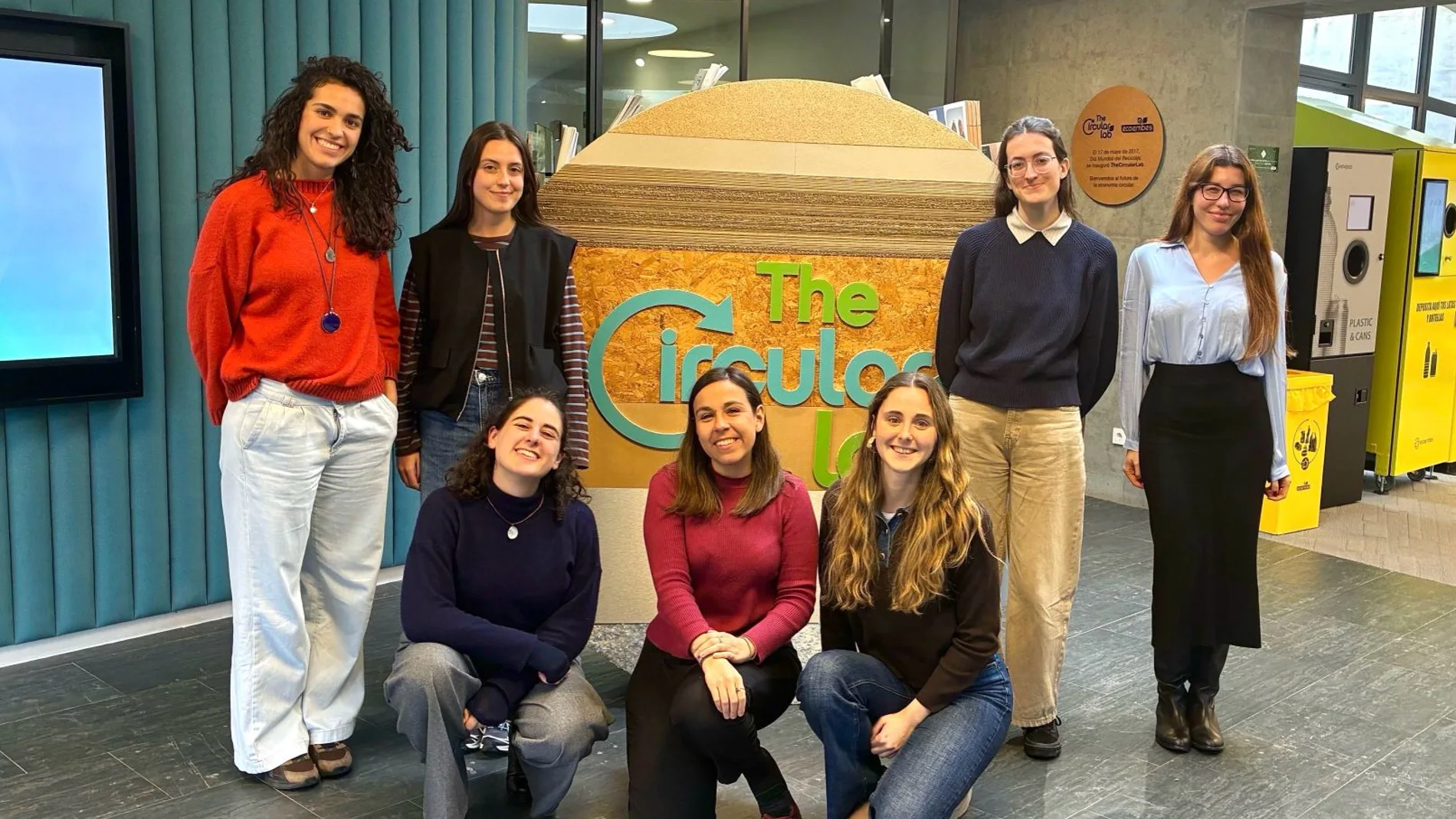
young people like Claudia VelezIndustrial Design and Product Development engineer, who together with five other members of the Ecoembes CircularTalentLab program, have developed a key idea that, in the future, could revolutionize the operation of blue containers. “We thought ‘what if they had a mechanism that allowed the cardboard to be crushed inside to clear the mouth of the tank?'” Claudia asks.
The idea arose within the XVI edition of this program, whose objective is to fill this gap by bringing together emerging talents from different areas to address circular economy challenges. “They look for fresh, innovative profiles that give a different vision,” he says. Adela Martineza biologist with a master’s degree in Bioinformatics, also on this team. Along with both there were engineers, marketing, design, law and sustainability profiles, represented in Judith Sandiumenge, María Molina, Iraide Sánchez and Elsa Rivera.
Ceniceros emphasizes that “it is about linking that vision of entrepreneurship and innovation with real problems, and building solutions that can be implemented.” For its part, Manuela Quiciosproject mentor and collection area professional, reports that “when a department identifies a need, it poses a real challenge that it has encountered in its daily work.”
Afterwards, he adds, “a multidisciplinary team of young people is formed who understands the problem, carries out an ideation phase and, for three months, they work in our facilities to arrive at a minimum viable product.”
In this case, the problem was clear: “Sometimes the container is not full, but Unfolded boxes generate large empty spaces that obstruct the mouth of the tank. This prevents other citizens from correctly recycling their containers and the trucks fill with “air” reducing the efficiency of collection.
The need arises from a change in habits: more online shopping, more parcels and more bulky boxes arriving in the blue container. The team worked in two lines. On the one hand, an awareness campaign called «Everything fits, crush your box» with videos, posters, press releases and a guide for town councils. On the other, a technical solution: a lever system activated by a pedal at the bottom.
“It is a movement that all citizens are used to, because other containers already use it to lift the lid,” argues Claudia. When you step on it, a Internal structure helps redistribute cardboard and flatten boxes inside. Therefore, the engineer describes that “it is completely manual, since our tool could not use any external energy source.”
This system is still in an initial phase. “It is the first prototype of prototypes,” Adela admits. «First we wanted to validate if something like this could work. Innovation is also that: trial, error and draw conclusions to develop something bigger in the future».
The awareness part, on the other hand, has already been tested in Lodosa, Navarra, with the collaboration of the local government. They qualitatively measured the folding before and after the campaign and observed 32% improvement in box folding by the population in just a few weeks. «It worked pretty well. Furthermore, the mayor told us that people knew what we were talking about, that they had seen the posters and commented on the videos,” says Adela.
With CircularTalentLab, not only young professionals learn: for Manuela, the learning was mutual. “You are in your daily work life and, sometimes, you have prejudices about certain things,” he admits. «But when young people arrive, with clean minds and new ideas, you learn other ways of looking at the problem».
After each challenge, Ceniceros concludes that “Ecoembes strengthens the idea that environmental innovation is not born from a single perspective, but from many connected perspectives.” And thus, promoting a network of collaborators and young people who come with new questions about everyday problems can mean that, if carefully observed, they end up becoming sustainable solutions.