
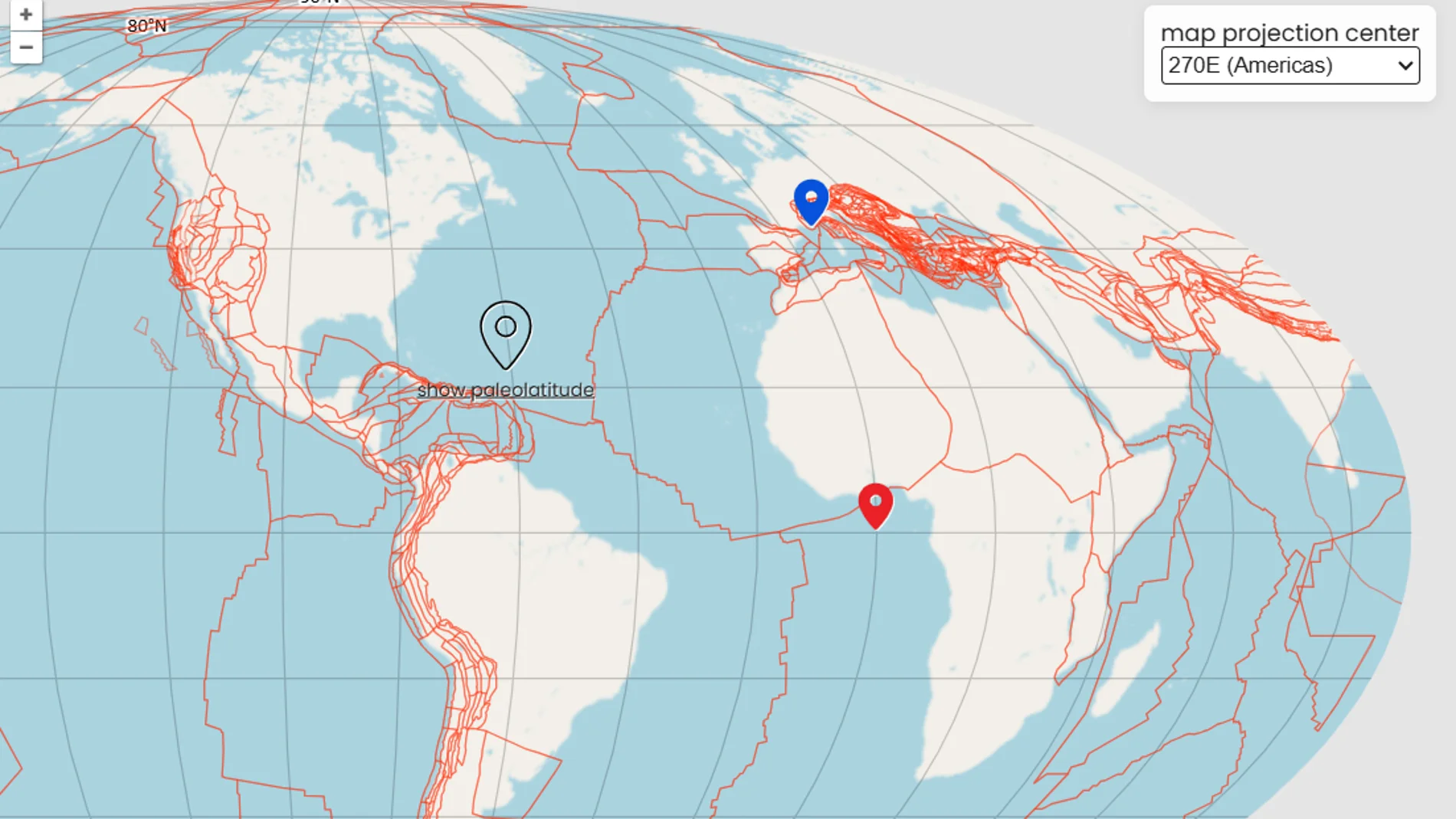
For centuries, imagining Earth’s deep past was an exercise in abstraction. Maps, fossils, reconstructions and tectonic plates. Thanks to this, geology allowed us to go back in time and create past maps of the location of the continents. Now, for the first time, we can write down our home address and see it traveling back millions of years and locating it in the past world. The project was born at the University of Utrecht, and has something of an elegant trick: He does not rebuild our home, but the place where it was. Because what moves is not the landscape… it is the continents.
The tool, called Paleolatitude.org, allows you to calculate what latitude any point on the planet was at up to 320 million years ago, when the Earth was very different and the continents formed the supercontinent Pangea. And that’s where the interesting part begins. QBecause latitude is not just any data. It determines the amount of sunlight, the climate, the ecosystems. Knowing where a rock was in the past is, in reality, knowing what world it lived in.
That explains why, in some places in Europe, scientists have found fossils typical of tropical environments. It’s not that the entire planet was a scorching desert. The thing is that that piece of land was, literally, in another part of the world.
The tool, which allows us to go back from 320 million years ago to about 4 million years in the pastworks like a “geological time machine.” To do this, a location is entered and the result shows how its position has changed over hundreds of millions of years. At different times, that same point may have been a tropical seabed, a volcanic region, or an area covered by ice.
Behind it there is something more sophisticated than a simple animation. The model used, a global paleogeographic reconstruction, incorporates the movement of tectonic plates, even those that no longer exist and have been “swallowed” by the interior of the planet.
That allows something that until now was extremely difficult: reconstructing not only when something happened in Earth’s history, but where exactly it happened. This tool introduces an uncomfortable and fascinating idea at the same time: The most stable place in our lives (our home, our street or our city) has never stopped moving. It has crossed oceans, it has changed hemispheres, it has experienced climates that would be unrecognizable to us today. And it will continue to do so.