
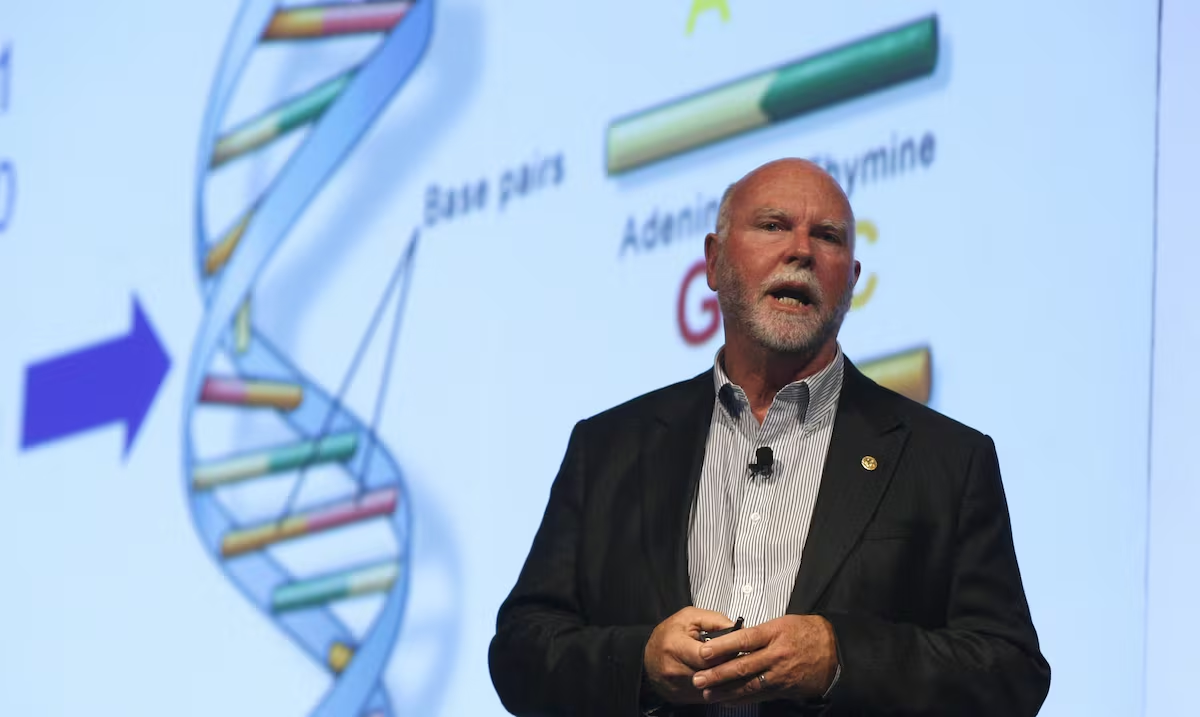
The American scientist Craig Venterworld pioneer of genomics and one of the main promoters of the complete human gene sequence, has died in San Diego (United States) at 79 years old after a complication of cancer of which he had recently been diagnosed.
He J. Crag Venter Institute (JCVI)which the American scientist founded and still directed, has confirmed his death on the website of this institution, dedicated to non-profit research and the advancement of the science of genomics, the understanding of its implications for society and the communication of these results to the scientific community, the public and policy makers.
The researcher was awarded the Prince of Asturias Award for Scientific and Technical Research in 2001, along with other pioneers of the human genome (John Sulston, Francis Collins, Hamilton Smith and Jean Weissenbach), recognition for his fundamental role in sequencing and mapping the human genome, leading private research through Celera Genomics.
Venter, the JCVI notes on its website, was a visionary scientific leader whose work helped define modern genomics and advanced the field of synthetic biology, driving scientific and technological change by creating interdisciplinary teams, encouraging bold ideas and faster methods, and insisting that discoveries must have a real impact on the world.
He was also a strong advocate throughout his career for strong federal funding for science and for collaborations that accelerate progress between government, academia and industry.
Over the course of his career, Craig Venter helped move genomics from slow, gene-by-gene discovery to scalable, data-driven science, and then helped take the next step: demonstrating that genomes could be designed and built.
At the National Institutes of Health, he helped pioneer gene discovery using ‘expressed sequence tags’ (ESTs), enabling the rapid identification of large numbers of human genes and accelerating genome mapping efforts.
“Craig believed that science advances when people are willing to think differently, to act decisively and to build what does not yet exist,” said Anders Dale, president of JCVI, on the Institute’s website, and he valued that his leadership and vision transformed genomics and contributed to promoting synthetic biology.
In the field of synthetic biology, Craig Venter and his teams achieved a milestone by building the first self-replicating bacterial cell controlled by a chemically synthesized genome, demonstrating, the JCVI has stressed, that genomes can be digitally designed, built from chemical components and “activated” to control a living cell.
The researcher was also dedicated to scientific discovery on a global scale, and thanks to the Sorcerer II Global Ocean Sampling Expedition, his teams used metagenomics to reveal extraordinary microbial diversity, reporting the discovery of millions of new genes and expanding the known universe of protein families; a work that deepened the understanding of the ocean microbiome and its role in planetary systems, the same American Institute has highlighted.