
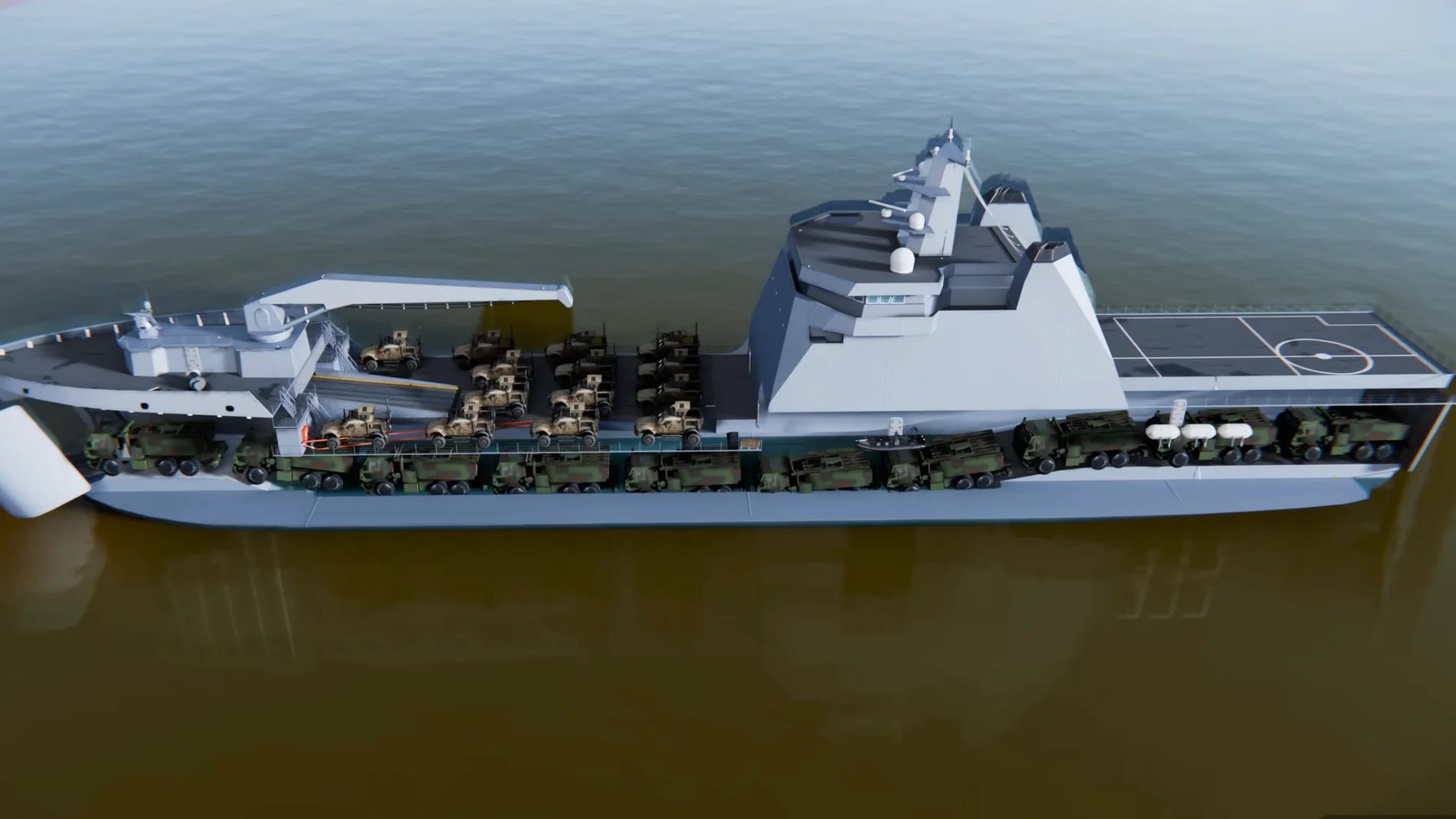
Landing ships do not have the elegance of an aircraft carrier or the mystery of a submarine, but they do have a cruder quality: they are machines designed to approach the coast when no one else wants to do so and they do so not through stealth, but just the opposite: exposure, protected by armor and speed. In that territory, between logistics and risk, moves the new design that the US Navy has recently revealed: the future class of medium landing ships, known as the McClung-class Medium Landing Ship.
For decades, the United States’ amphibious strategy has revolved around large platforms capable of large-scale force projection. But the world has changed. In scenarios such as the Indo-Pacific, with dispersed archipelagos, guarded coasts and missiles capable of hitting targets hundreds of kilometers awayconcentration turns into vulnerability. The answer, at least in part, is dispersion.
This is where this new ship comes in. Smaller, more austere, but also more flexible. Its design is somewhat reminiscent of the old LST (Landing Ship, Tank) of World War II.: robust hull, bow prepared to beach directly on the coast, ability to unload vehicles and troops without the need for a port. But beneath that almost retro appearance lies a completely contemporary logic.
The McClung is not designed for large assaults, but for something more subtle: move small units between islands, resupply forward positions, sustain distributed operations. It is, in essence, a ship for a less visible war, where mobility and redundancy matter more than spectacularity.
Its profile is based on the design of the Damen Shipyards Group’s landing ship LST-100 (Landing Ship Transport 100), a commercial platform with an operational range of approximately 3,400 nautical miles (about 6,300 km). The ship is capable of carrying out landing operations and can carry more than 800 tons of cargo, including vehicles, embarked personnel and long-range fire extinguishing systems. Measuring approximately 100 meters in length, the LSM configuration also incorporates a flight deck to support unmanned aerial systems operations, enhancing its utility in dispersed maritime environments.
The idea is that they are numerous, relatively cheap and, above all, expendable in strategic terms: losing one does not compromise the entire operation. Faced with the paradigm of “few assets, very valuable”, another emerges based on “many assets, sufficiently capable”. A logic that is not exclusive to the naval field and is also seen in drones, satellites or autonomous systems. And there is another interesting detail: simplicity.
In an era dominated by extremely complex systems, these ships seem to be betting on the opposite: less dependence on sophisticated infrastructure, more ability to operate in imperfect conditions. Less technological glitz, more practical toughness.