
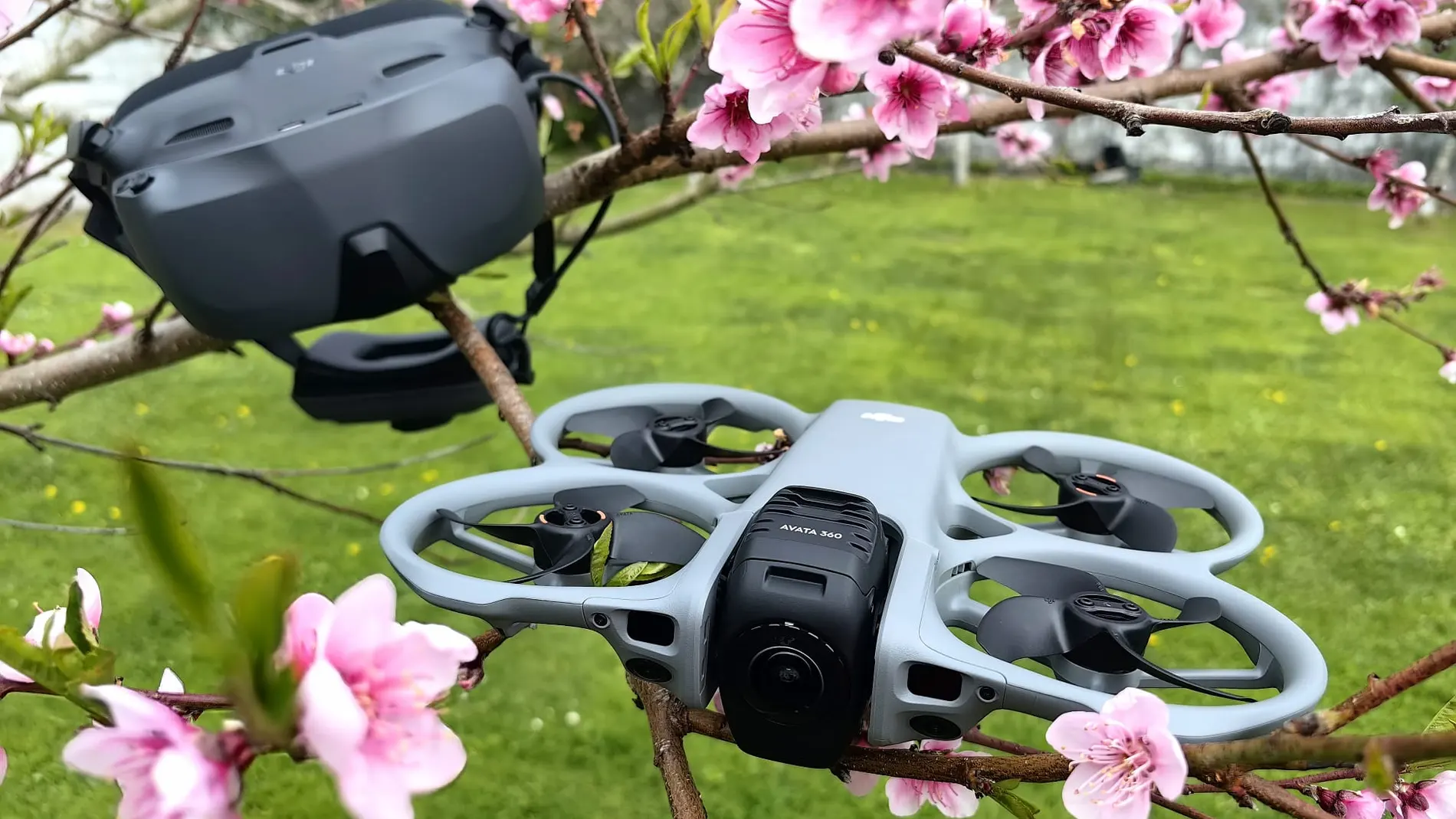
Flying an immersive drone, one in which the glasses allow us to be “the eyes in the sky”, has something unique: the world is no longer where we left it. One takes off from the ground, with one’s feet still, but After a few seconds the body begins to react as if it were suspended in the air. It is not a metaphor: the stomach shrinks on the descents, the breath stops on the tight turns, and for a brief moment, but very real to our senses, the world stops being off the screen and becomes a place that is crossed. And that is precisely where the DJI Avata 360 finds its natural terrain.
We have already talked about DJI’s latest drone and it was clear that the manufacturer did not simply want to make a better drone. He wanted to make a more intense experience. And that is noticeable from the first contact. The Avata 360 is not a device that is controlled from the controller, it is one that is piloted “from within”. With the FPV glasses (acronym for first person vision), the environment disappears and what remains is an immersive screen where each movement of the drone is translated into an almost physical reaction of the user.
The key is how it balances these two worlds that, until recently, seemed incompatible: the freedom of FPV flight and the controlled stability that DJI has become renowned for. Here You don’t have to be an expert pilot to feel that sensation of grazing speed or millimetric turning between obstacles. The assistance system turns complex maneuvers into intuitive gestures, smoothing the learning curve without eliminating the emotion. It is, in a way, a democratization of vertigo.
The design accompanies that idea. Compact, protected, with faired propellers that invite you to fly near surfaces without that constant fear of rubbing against something and losing control. It is not a fragile or distant drone: It is an object that seems to ask for proximity, almost complicity with the environment. Flying between trees, crossing structures or descending close to a wall stops being crazy and becomes a tangible possibility.
And then there is the image. DJI has been perfecting this section for years, but here it introduces an interesting nuance: It is not just about capturing well, but about capturing how does it feel. The result is videos that do not only seek sharpness or dynamic range, but rather that immersive quality that makes those who watch them have the feeling of being inside the tour. It’s less of an aerial postcard and more of a subjective experience.
However, it’s not all impulse and emotion. The Avata 360 also reveals its limits when pushed outside its natural habitat. It is not the ideal drone for long leisurely photography sessions or for long-range flights. His terrain is different: intense, short routes, designed more to be lived than to be planned in detail (this is key to getting the most out of it).
It is also true that it demands something from the user: a certain willingness to let go. Because, although technology does a lot of the work, the experience still depends on that connection between movement and perception. It is not a passive device, it is a dialogue. You have to know how to carry it and the first flights are very, very different from the images we get from flight 6 or 7.
The funny thing is that, when I took off my glasses, the sensation was very strange (something was missing) and I can only compare it to that perception that we have after spending a couple of hours with ice skates and we take them off. Or, put another way, Learning to fly the Avata 360 has nothing to do with taking your feet off the ground.
As far as specifications are concerned, It touches 65 km/h, very high for a 455 gram drone. Stays in the air for about 23 minutes and the battery charge lasts almost the same (I recommend always having an extra one ready). Living up to its name, it also records and photographs in 360º and its detection system, complemented by LiDAR and an infrared sensor, is professional. The Sportlight Free option, for instant video sharing, works wonderfully and makes work in the field much easier.
It is a solid drone and in minor accidents it remains scratch-free. It is not a device that should be treated lightly, no matter how ironic it may sound in flight. It records in 8k and its sensor is 64 MP. This, to be honest, is an indicator: If we are looking for a drone to obtain the best images, I would lean towards the Mini 5 Proalso from DJI. But if what we want is immersion, for the images to exceed the visual sense, the best bet is the Avata 360.
Verdict:
Right now, for €459, the Avata 360 is the best 360 drone on the market, which means in the world. Due to speed, battery, flight system and, mainly, because few like this can be enjoyed.