
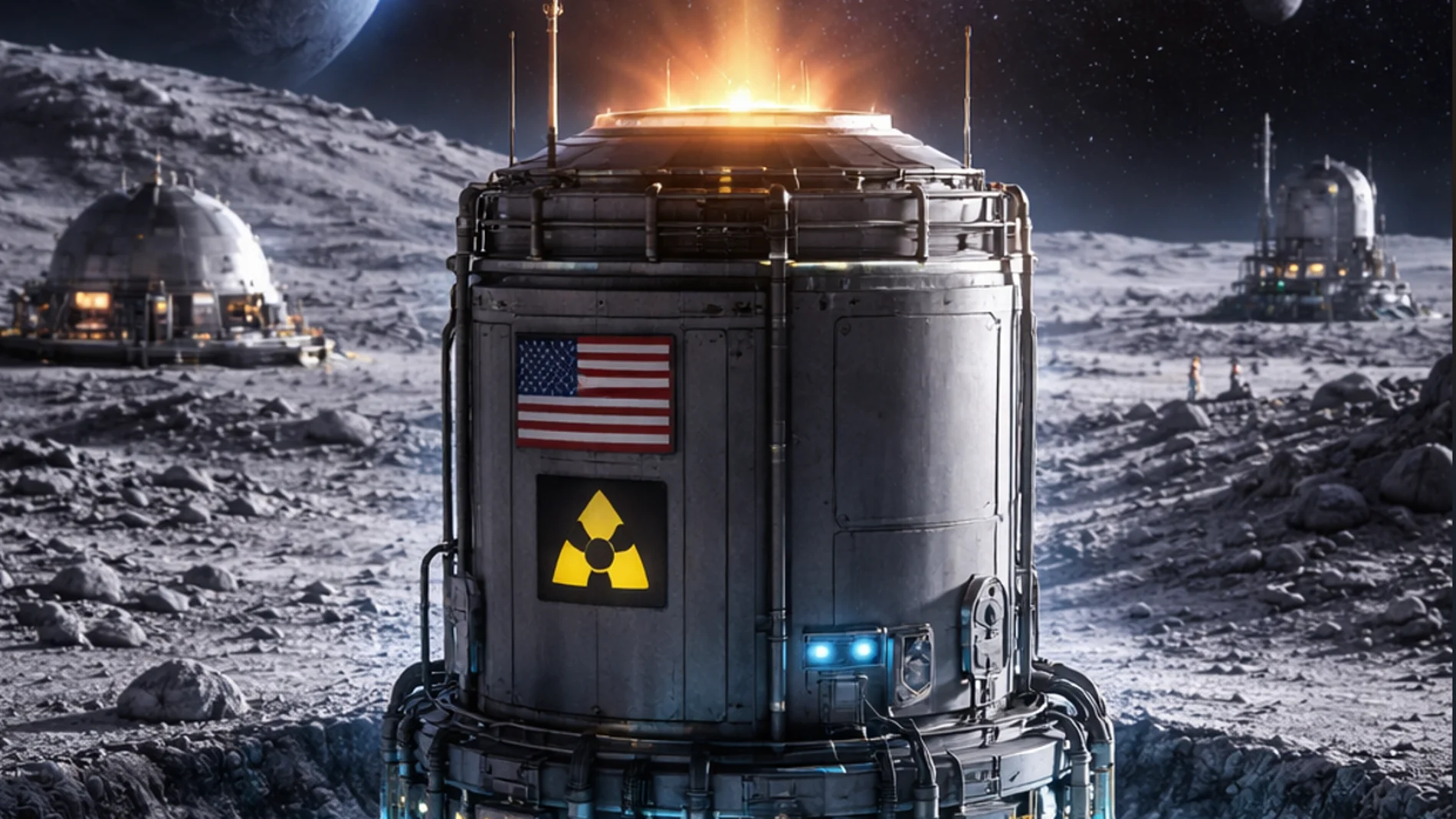
The idea sounds like science fiction, but it is beginning to be written in official documents: The White House wants NASA to accelerate a plan that, until recently, seemed distant: installing nuclear reactors on the Moon. The 6-page document comes from the Executive Office of the White House.
This is not an isolated occurrence, nor a symbolic gesture. It is, rather, the recognition of a very specific problem: if humanity wants to stay on the Moon (not visit it, but inhabit it) You will need a constant, reliable power source capable of surviving extreme conditions. And that is where nuclear energy stops being an uncomfortable option and becomes an almost inevitable solution.
Because the Moon is not a kind place with electricity. During the lunar day, which lasts approximately two Earth weeks, solar panels can operate relatively normally. But when night falls (another two weeks of total darkness) the temperature plummets to −170°C, and solar energy generation becomes impossible. It’s a prolonged blackout in one of the most hostile environments imaginable.
A nuclear reactor, on the other hand, does not understand dawns or shadows. It can provide continuous power for years, regardless of sunlight or weather. And that completely changes the rules of the game: It allows you to maintain inhabited bases, power life support systems, extract resources from the lunar soil and even produce fuel for future missions.
“The United States will lead the global development and deployment of space nuclear energy for exploration, commerce and defense – the document states -. Government agencies will establish profitable alliances with private sector innovators to achieve near-term objectives, including: includes the safe deployment of nuclear reactors in orbit starting in 2028 and on the Moon starting in 2030.”
The plan under discussion does not speak of large nuclear power plants like those on Earth, but rather of compact reactors, designed to be transported and deployed on the lunar surface. Autonomous, robust systems, capable of operating without constant intervention and with multiple layers of security. A kind of “energy heart” that beats silently under the lunar dust. This idea does not come from nowhere. It is part of a broader strategy linked to the Artemis program, with which the United States seeks to establish a sustained presence on the Moon over the next few decades. In this context, energy is not a technical detail: it is the condition that makes everything else possible.
But there is something more behind this urgency. The White House’s request also reflects an increasingly evident geopolitical dimension: space, and in particular the Moon, is becoming a new arena of international competition. Countries like China are developing their own plans to build lunar baseswhich adds pressure not to be left behind. Hence the rush. And the deadlines.
“NASA will, within 30 days of the date of this memorandum, initiate a program to develop a space reactor medium power with a lunar fission surface power (FSP) variant ready for launch in 2030, and an option for a space variant intended for a nuclear electric propulsion (NEP) demonstration,” the document states.
On that board, a nuclear reactor is not just a technological tool. It is a declaration of intent. It means permanence, autonomy and control of critical infrastructures outside of Earth.
Still, the challenge is enormous. Designing, transporting and installing a reactor on the Moon involves solving complex technical problems: from the safe launch of nuclear material to its operation in an environment with radiation, abrasive dust and extreme temperatures. All of this, moreover, under the scrutiny of a part of public opinion that continues to view the word “nuclear” with a mixture of fear and distrust.
Perhaps the most suggestive image is not that of the rocket taking off, nor that of the astronaut stepping on the lunar surface, but that of a small reactor, buried under regolith to protect it, generating electricity continuously.