

The United States Navy has announced that it has successfully tested the new guidance kit JDAM-LR for free fall pumps. It is the new version of the system developed by Boeing in the 90s that allows correcting the trajectory of a conventional bomb and convert it into a precision guided munition by adding a tail section with control surfaces, inertial navigation and GPS. The variants existing until now added a maximum range of up to 72 kilometersbut JDAM-LR he uploads it to the 555 kilometersmaking it a low-cost alternative to cruise missiles.
The new system not only offers that capability, but has a model that allows use the pump for air mining functions. The announcement was made this week during the symposium Sea-Air-Space of the Navy League, which concluded Wednesday in National Harbor, Maryland, and marks a major advance in US naval aviation capabilities.
The evolution of JDAM
JDAM-LR is the third iteration of the system. The first, JDAMwhich entered service in 1999, added the guidance kit, control surfaces to modify the direction and had a range of about 28 kilometers. In 2015, JDAM-ER incorporated a wing kit that increased both its maneuverability and range, reaching the 72 km. To far exceed these capabilities, JDAM-LR has a small turbojet engine developed by Kratosalong with deployable wings of Ferra Engineeringwhich extends it to more than 550 km.
On Monday, Navy officials confirmed that the ammunition traveled distances of more than 370 kilometers during tests. This is a notable improvement over air-to-surface weapons such as missiles. Harpoon and SLAM-ERwhich normally reach between 260 and 278 kilometers.
Although, for practical purposes, the systems Joint Direct Attack Ammunition o Joint Direct Attack Munitions offer a new type of ammunition, they are mounted on existing bombs. Standard JDAM can adapt to 227, 454 and 907 kilo pumps such as Mk 82, Mk 83 and Mk 84respectively, in addition to specialized variants BLU. JDAM-ER and JDAM-LR, on the other hand, are mainly associated with the 227 kilo Mk 82.
JDAM-LR tests
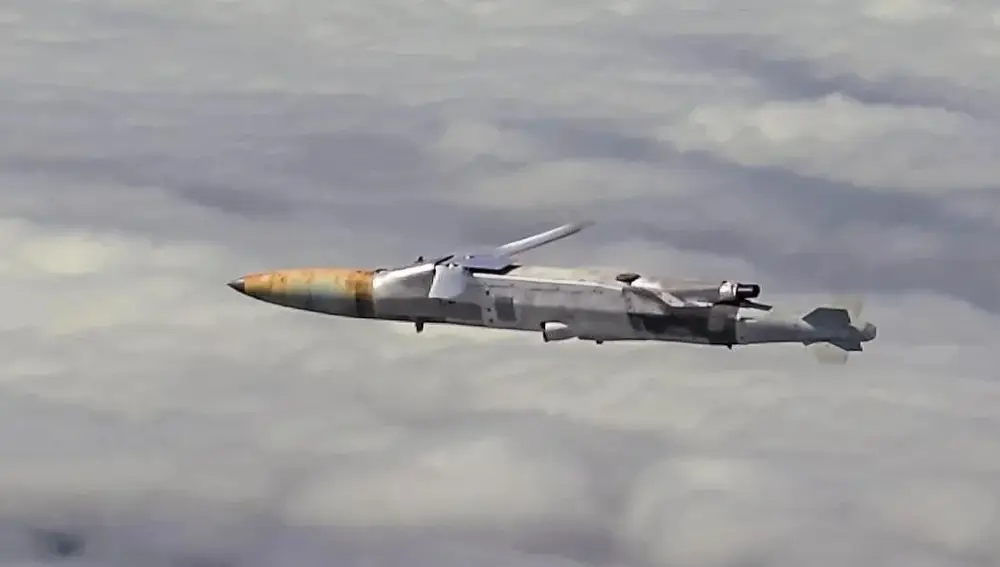
The Navy conducted its tests at the Point Mugu Maritime Firing Range in California using a F/A-18 Super Hornet. On April 1, the munition flew approximately 370 kilometers in 34 minutes and impacted just meters from the intended target, according to Boeing.
A second test, carried out on April 3, evaluated a different flight profile which included altitude changes and maneuvers. Both tests confirmed safe aircraft separation, stable flight and precise navigation to the target.
‘As forward-deployed Naval Air Forces continue to rely heavily on JDAM systems, the program recognizes a critical need to provide the fleet with greater remote launch range. “This new capability allows pilots to engage targets from significantly safer distances, maintaining a tactical advantage in contested environments,” said Captain Sarah Abbottresponsible for the Precision Strike Weapons program (Precision Strike Weapons), in a statement about the tests of NAVAIRthe United States Navy Naval Air Systems Command.
This long range allows aircraft attack without entering areas defended by the opponentreducing the risk for pilots and platforms. Additionally, the new weapon can rapidly introduced into service using existing aircraft with the ability to launch JDAM.
Mined from the air
In addition to strike missions, JDAM-LR also allows aerial mining operations. Its mining variant, called QuickStrike Long Rangeuses a Mk 82 bomb equipped with sensors capable of detecting ships.
Traditional minelaying operations typically require aircraft to fly low and slowly, making them vulnerable to enemy defenses. JDAM-LR increases the distance from which mines can be deployed and facilitates survival.