
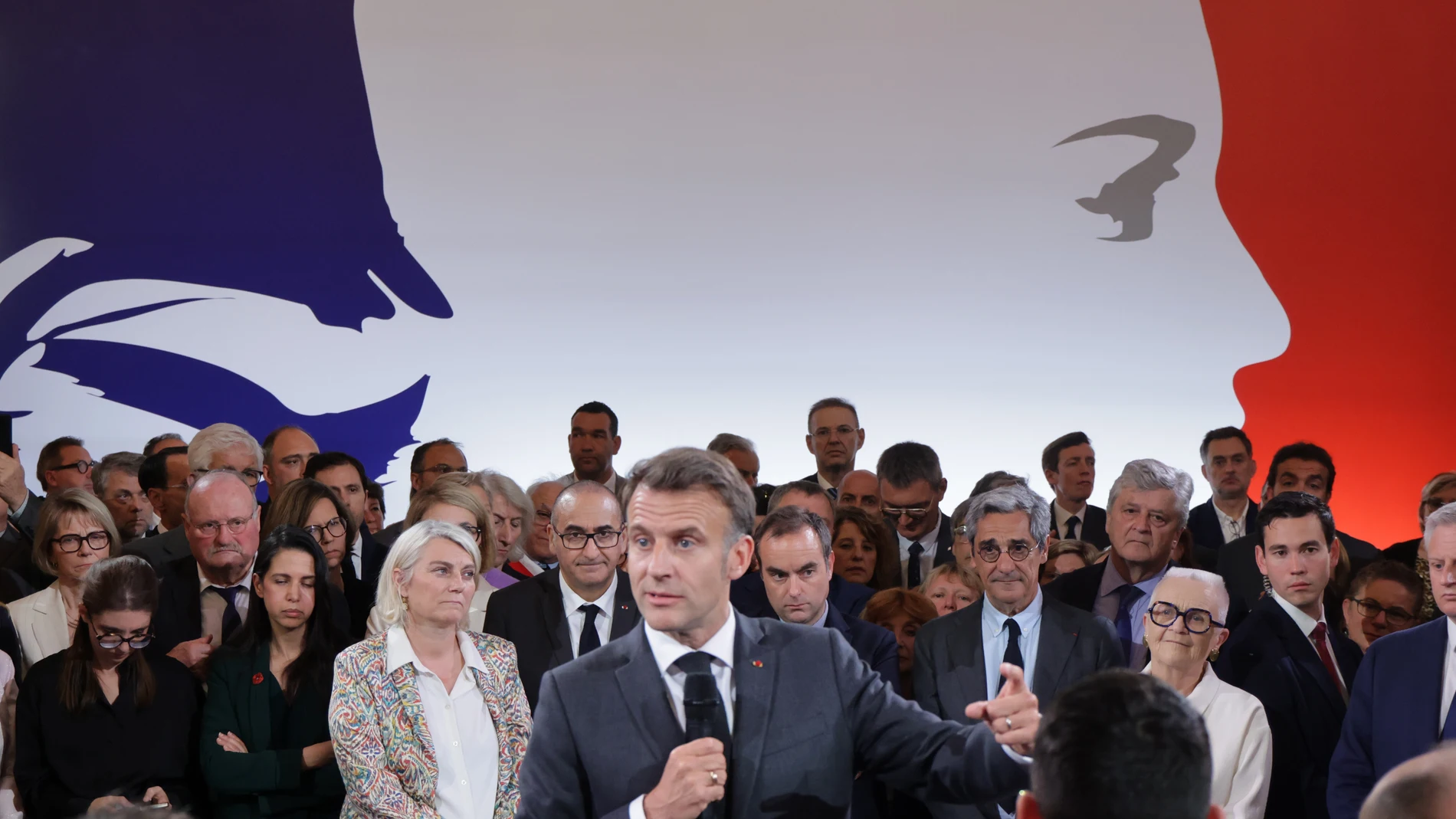
There are political movements that have continuity beyond their founders and others that do not. Macronism must clear up this mystery and the next presidential elections will decide if it is definitively buried after Emmanuel Macron or if you have a replacement that projects you into the future. It is a question that appears frequently these days in the French press because it is a decade since the creation of En Marcha, the political party invented by Macron to jump to the Elysée when he was still Minister of Economy of the socialist president. François Hollande, once he confirmed that he would not run for re-election in 2017 due to his low popularity.
As a campaign artifact it was an undisputed success at that time. The slogan “neither left nor right” It was well received even among those who most disbelieved in the center. France opted for a young, pro-European, dynamic president with a drive for reform to put a stop to Marine Le Pen. Macron managed to peck left and right to widen the margins of its hypercenter leaving both The Republicans and the Socialist Party in the UVI and France ended up becoming a tripolar political space: a Macronist center and two extremes embodied by Le Pen and Jean Luc Mélenchon. It was a configuration with which he weathered multiple crises that he has had to manage during his two mandates: the “yellow vests”, the health crisis, the energy crisis derived from Ukraine, the Trump years and the turn to the international board.
The Europeans of 2024
In his second term, he arrived eroded and his unpopular pension reform did the rest so that would lose the European Championships in 2024 and made his great internal miscalculation: dissolving the National Assembly and convening legislative elections that gave birth to an ungovernable France with a succession of fleeting prime ministers and the persistent threat of the motion of censure.
The candidates to take over from Macronism have a dilemma when it comes to managing the legacy of this decade, taking into account recent years in which Macron, already with a parliamentary minority, has dedicated himself more to his duties on the international stage than to the mundane affairs of the average Frenchman. Along the way, En Marcha changed its name several times. It was renamed La República en Marcha to accentuate its republican character in its ideological battle with the National Regrouping when the “cordon sanitaire” to the extreme right began to weaken and now it has been renamed Renaissance and is no longer even in the hands of Macron, who appears as honorary president.
The party is now under the control of Gabriel Attalwith whom the president has no relationship after being his most faithful squire. Caught by surprise as prime minister by that parliamentary dissolution dictated by Macron, of which he was not even warned, the former prime minister emancipated himself, achieving be elected at the head of the group in the Assembly and then the party in 2024.
Now he is preparing his way to the presidential elections, looking out of the corner of his eye at the steps of the other names that compete for that same political space, but with other acronyms. This is the case, above all, of Macron’s first head of government, Edouard Philippe, who founded his own party, Horizons, with which he now intends to run for the presidency.
Macron’s relief
They are not the only names that will compete to take over from Macron, who for a year has been openly criticized for taking distance on some issues, but in a way calculated to preserve that diminished sector that still votes center.
Since its founding in 2017, one of the most common criticisms made of the Macronist movement is its lack of local roots, despite some successes in the recent municipal elections, in Annecy and Bordeaux. This lack of implementation has sometimes led to strengthening the distrust of rural France towards a president with a character that has not helped to mitigate that distrust either. Macronism has always been perceived urbanite, of good class, and condescending to the problems of the countryside.
On the occasion of this tenth anniversary, the 33,000 members of the Macronist formation today have been invited to share their most notable memories and events are being organized these days in each of the local committees. A few days ago, Macron himself sent an enthusiastic letter to the members of Renacimiento, on the occasion of the tenth anniversary of the creation of the party, then called En Marcha.
In this letter, the President of the Republic makes a glowing assessment of this political decade and urges his followers to maintain the momentum started in 2016. “We continue forward! We do not give up!” Although this momentum, with several scars in a decade, It no longer sounds so natural or credible.