
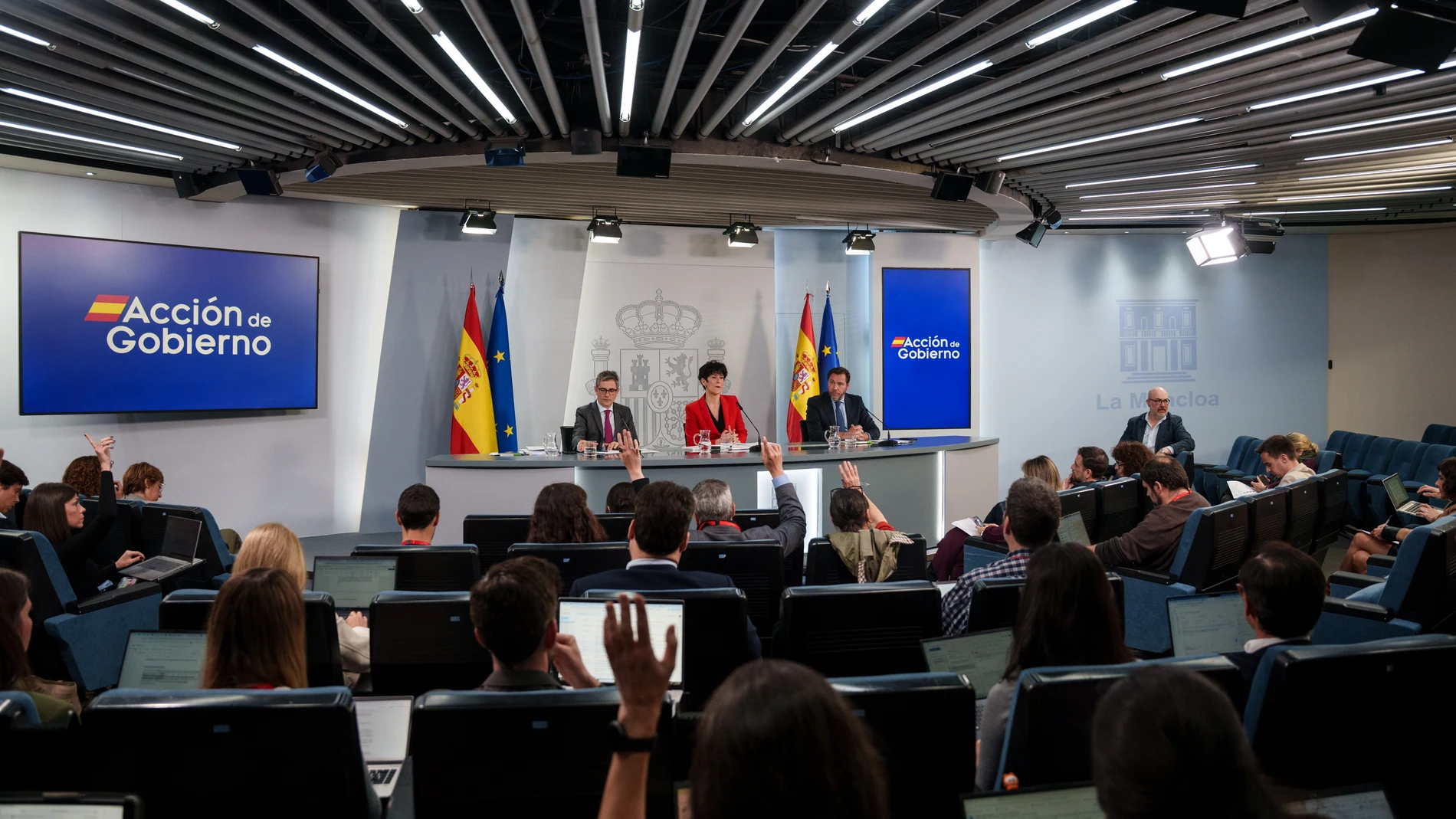
Pedro Sanchez He was not in Spain yesterday. But it didn’t matter. His cabinet came out against the judge Juan Carlos Peinado at the press conference after the Council of Ministers after prosecuting his wife, Begoña Gómez for the alleged commission of four crimes. Sánchez, who is immersed in his fourth official trip to China accompanied by his wife, limited himself to asking the Justice Department to “do justice.”
But the rest was provided by his most political ministers: Félix Bolaños, Óscar Puente and Elma Saizthe spokesperson for the Executive. The three vehemently defended Begoña Gómez and criticized, under the protection of their right to freedom of expression, the order and the instruction of the head of the investigative court number 41 of Madrid.
All three insisted that the case is a textbook example of political persecution. Bolaños, head of Justice, reaffirmed that the order embarrassed a good part of the judiciary despite the fact that the country’s main association of judges described it as “unacceptable” that same opinion and, by extension, that of the Government.
Moncloa’s clash with the judges is total. And the truth is that the person behind this position is the president’s chief of staff, Diego Rubio. He is the one who coordinates the argumentative strategy of the president, and of the entire Executive, to point out Peinado.
But this point is not new. It has been going on for two years, when Peinado decided to investigate Sánchez’s wife. It is worth remembering that the president of the General Council of the Judiciary, Isabel Perelló, already had to come out to defend the defendants from the accusations of “lawfare» from the president.
The CGPJ criticizes the fact that judges are “generally” questioned and accused of having “political biases.” But the logic followed by the president’s cabinet, put together by Rubio, is that The Executive can criticize the judges, just as the judges criticize the Government.
“Just because there is separation of powers does not mean that the powers cannot interact,” explains a government source.. It matters little that the Council of Europe’s Action Plan to strengthen the independence and impartiality of the Judiciary advises taking measures to ensure that members of the executive and legislative branches respect the authority of the Judiciary.
The ministers who appeared yesterday admitted that the name of Juan Carlos Peinado arouses “indignation” in the socialist cabinet. The anger is total. The hard core of the Executive sought for months for some instance of the Judiciary to overthrow the judge: whether it was the governing body of the judges that Bolaños addressed last year to denounce irregularities in the investigation, the Supreme Court or the Provincial Court of Madrid.
In the Government it is assumed that the case against Begoña Gómez was opened only because of who she is and did not seek anything other than the fall of the socialist leader at any cost. Neither more nor less.
So much Begoña Gómez as Pedro Sánchezwho was also interrogated by Peinado in Moncloa, filed a complaint against him for prevarication. But both complaints were dismissed by the Superior Court of Justice of Madrid.
So the strategy that the Executive undertook then, coordinated by Diego Rubio, was to discredit the cause. And attack Peinado directly, whose bias for having a daughter was questioned, Patricia Peinado, who has made a career in the PP as Councilor for Sports and Festivals in the Pozuelo de Alarcón City Council (Madrid). The sources consulted in the hard core of Moncloa wonder “if it is normal” that public positions have such a strict regime of incompatibilities while the judge’s daughter swelled the ranks of Genoa.
The Begoña Gómez case caused a real political storm that two years ago led the President of the Government to withdraw five days from public life to “reflect” on his continuity at the head of the Government. An unprecedented move that put the country on edge and that helped him prepare his strategy of resistance at all costs, which he warned his deputies and senators as soon as the political course began.
That crisis marked a before and after that still resonates strongly every Wednesday in the control sessions, in which the PP asks the president to resign for being “surrounded by rot.”
Peinado’s investigation expanded over the months: from the first suspicions about alleged irregular awards and Gómez’s mediation in the rescue of Air Europa, it was examined the chair of Competitive Social Transformation of the Complutense Universitythe development of software linked to the institution and the hiring of Cristina Álvarez as an advisor; which has been the last focus of battle.
Peinado’s decisions have generated an intense dispute between the Prosecutor’s Office and the defense, who criticize his “erratic” procedure and reproach him for the lack of foundation in his resolutions. Since Pedro Sánchez is president, the debate on the grievance from the Executive to the separation of powers has only grown.
In that period, the President of the Government has placed people influenced by his power in some of the most important institutions in the country. This situation represents a breach of their independence. Perhaps one of the most affected – and highlighted – is the Sociological Research Center, directed by José Félix Tezanos, a former member of the federal executive of the PSOE.
But at some point the Constitutional Court, the State Attorney General’s Office, the Court of Accounts, the Council of State, Renfe, RTVE, the Efe Agency, Hispasat and Correos were added to this list. Some of the most juicy representation positions abroad were also not spared, such as the Spanish embassies to the OECD, the UN and UNESCO.
In truth, the president and his team have been provoking the Judiciary all this time, removing its bias and portraying it as a political actor with intentionality. Sánchez himself has already hinted that the opposition – especially the PP – has a direct connection with a good part of the judiciary and that, he reasoned, allows those responsible for Genoa and some of its “plumbers”, such as the Madrid president’s chief of staff, Isabel Diaz Ayusoplay with the “marked cards.” The cannon shots do not stop.