
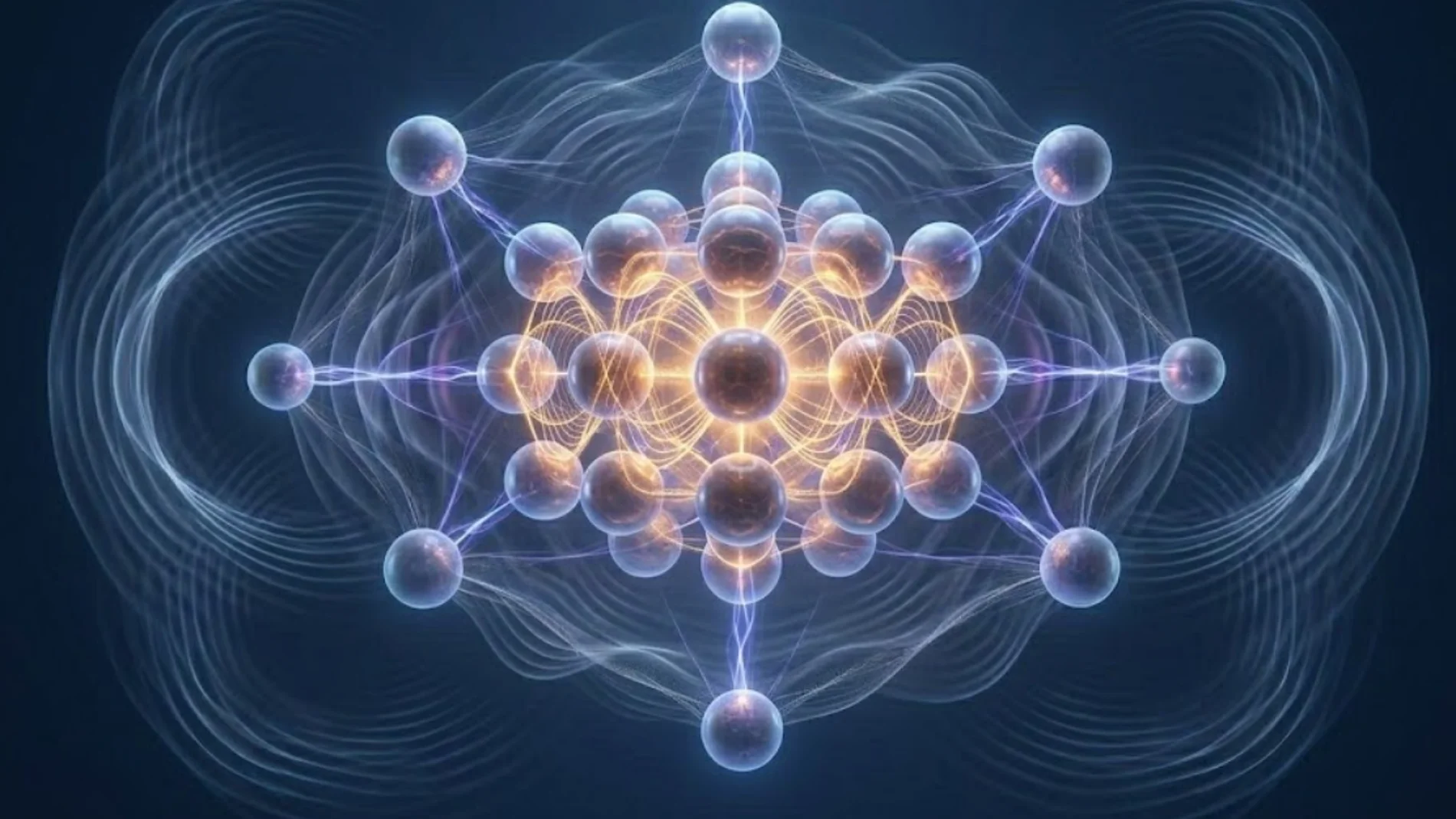
There are scientific laws that are not discussed. Not because they are dogmas, but because they work too good. Among them, few are as elegant and apparently unbreakable as Newton’s third law: for every action, there is an equal and opposite reaction.
You push the water, as you swim, and you move forward. A rocket rises because it expels gases in the opposite direction. Two skaters separate on the ice because they push each other. It is a law of balance, almost of moral symmetry: nothing happens without compensation. For more than three centuries, that idea has survived intact. Until now. A new experiment with “time crystals” (a strange form of matter that repeats itself not in space, but in time) has begun to show behavior that, at least in appearance, breaks that fundamental symmetry. The results have been published in The Physical Journal Letters.
To understand why this is so strange, it is worth clarifying the first concept. A normal crystal, such as ice or diamond, is a structure that repeats in space: Its atoms form ordered patterns. A time crystal, on the other hand, repeats a pattern… but in time. It oscillates, moves, beats with an internal regularity. It does not need a constant “push”. Its rhythm emerges from the system itself. It is, in a sense, an unwound watch.
For years, these systems only existed under extreme conditions, near absolute zero or in highly controlled quantum experiments. But the new work led by Mia C. Morrel of New York University changes the scenario: They have created a visible, manipulable… almost everyday time crystal. And that’s where the problem begins.
The experiment is, in appearance, simple. Scientists use an “acoustic levitator”: a device that generates sound waves capable of trapping small particles in the air, as if floating in small invisible bowls of pressure. At these points they suspend tiny spheres of light material. It is at that moment when something unexpected happens.
The particles begin to interact with each other not through direct contact, but through the sound waves they scatter. It is as if each one generates small invisible waves that affect the others. But Those interactions are not symmetrical.: a particle can influence another particle more than it receives in return. That’s where the third law begins to break down.
In Newton’s classical world, forces are reciprocal: if A pushes B, B pushes A with the same intensity and in the opposite direction. But in this system mediated by waves, that reciprocity is broken. Physicists call it “non-reciprocal interactions.”
“Imagine two boats of different sizes approaching a dock – explains Morrell as an example -. Each one generates waves that push the other, but to a different extent, depending on their size.” That is exactly what happens here, but with sound.
And it is this asymmetry that allows something even stranger: the particles begin to oscillate spontaneously and sustainably, generating a periodic pattern over time. That is, they form a visible time crystal. At first glance, all this seems like scientific heresy. But the reality is more subtle… and more interesting. Newton’s third law has not ceased to be valid. What happens is that its application conditions have become more delicate than we thought.
In simple systems, where the interactions are direct and local, the action-reaction symmetry is maintained. But when forces are mediated by complex fields such as waves, fluids or even information, these non-reciprocal behaviors can appear. It’s not that the law fails. The thing is the scenario has changed. The most interesting thing about this experiment is not only that we can see a time crystal with our own eyes, floating in the air. It introduces a disturbing idea: that movement, balance, and causality may be more flexible than textbooks teach.
These systems could help understand everything from active materials to biological networks, where interactions are not perfectly symmetrical either. They could even have applications in sensors or advanced computing. But beyond technology, there is something deeper. For centuries, physics has searched for symmetries: laws that work the same everywhere, at all times, in all directions. This type of discovery does not destroy that search, but it does add a nuance that we were unaware of.