
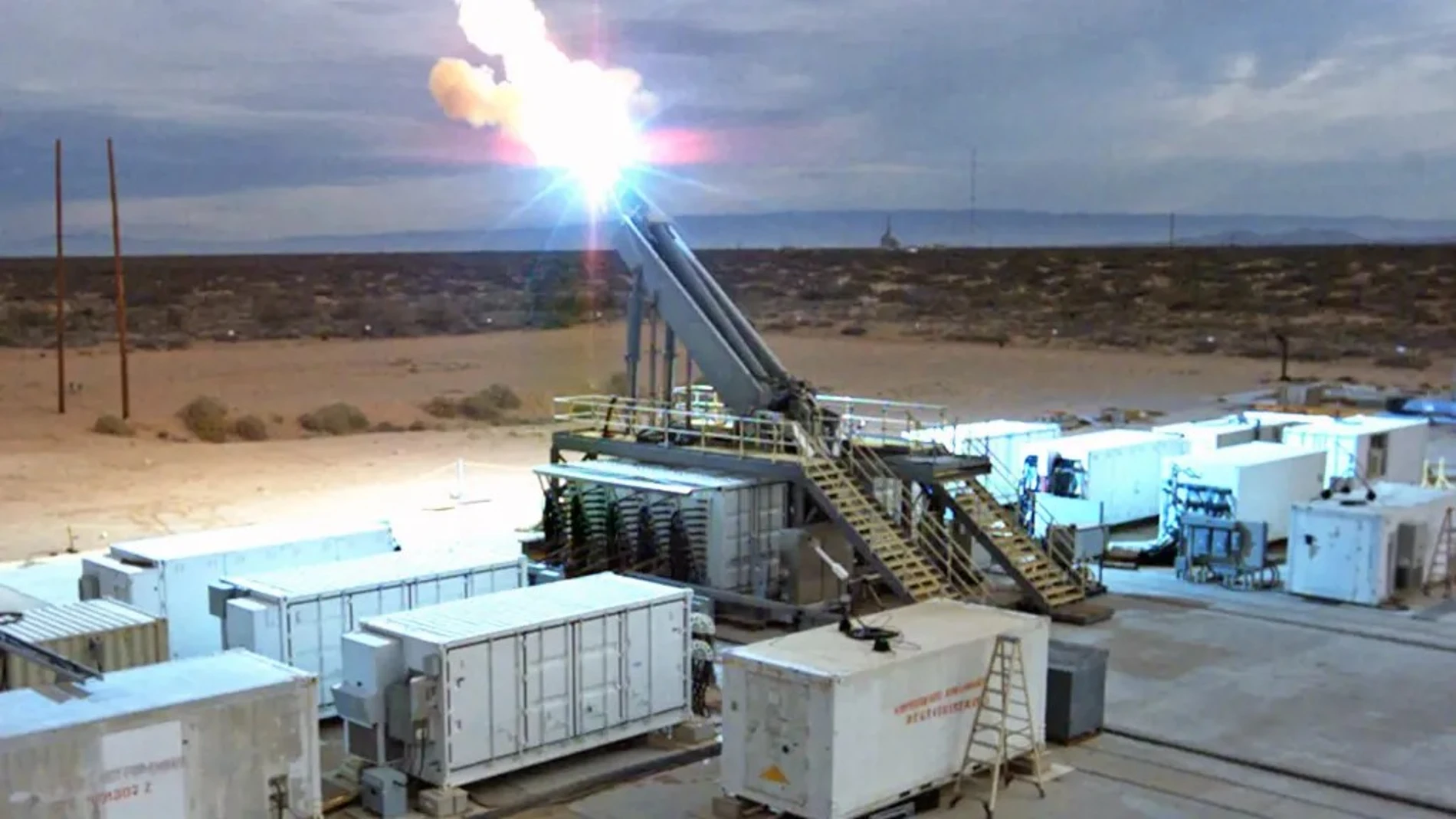
The US Navy has discreetly resumed live-fire testing of its prototype electromagnetic rail gun. The tests in White Sands, New Mexico, reflect that interest in this high-speed weapon is still alive, despite the technical problems that slowed down the program and led to it being canceled in 2021. The reasons alleged then were excessive costs, doubts about its operational viability and technical challenges to be resolved. However, other countries such as Japan and China They continued with their programs and have already introduced experimental ship-mounted electromagnetic cannons, which has probably influenced the US military’s change of heart.
Electromagnetic railguns are advanced weapons that employ powerful electrical currents, instead of chemical propellants, to launch projectiles along parallel rails at hypersonic speeds of Mach 6 to 7, that is, about 7,400 to 8,600 km/h.
The latest tests have collected data on high-speed projectile launches as part of work to support the Joint Office for the Transition of Hypersonic Technologiesbelonging to US Department of Defense and that seeks to accelerate the development of hypersonic technologies. This indicates that efforts are continuing to develop electromagnetic launch technology for future naval capabilities, The War Zone reports.
Already in 2025, General Atomics presented plans to reactivate its electromagnetic cannon, proposing it for the anti-missile defense plan Golden Dome of the Pentagon, including reinforced protection for the US base on the island of Guam.
Tests are reactivated
Originally, the US Navy’s prototype electromagnetic rail gun had been installed at a ground test center operated by the Naval Surface Warfare Center, Dahlgren Divisionin Virginia, before being transferred in 2019 to the test range of White Sandsin New Mexico, for new trials, picks up TWZ.
Plans to test the weapon at sea were repeatedly delayed and ultimately never carried out. In 2021, the United States Navy announced that it was closing the program and stored the remaining hardware, preserving the system for possible future use.
New information indicates that the cannon It was used again during a three-day test campaign in February 2025although the exact purpose of the trials remains unclear. The cannon could have served as a high-speed launch platform for experimental payloads during testing, the outlet reports.
Interest in this technology could also be linked to plans for the proposed Trump-class ship, known as BBG(X). These large warships are expected to carry missiles, conventional naval guns and directed energy weapons. Defense contractors such as BAE Systems and General Atomics had previously been involved in electromagnetic cannon development efforts. The following video shows tests of the electromagnetic cannon carried out in 2016.
Why the US abandoned the electromagnetic cannon
Historically, electromagnetic cannon technology has faced significant technical challenges. require large amounts of electrical power and advanced cooling systemsespecially if they are designed to fire multiple rounds rapidly, which often results in bulky installations that rely on large energy storage systems and cooling equipment.
Additionally, firing projectiles at hypersonic speeds causes significant barrel wearwhich over time reduces range and accuracy and poses potential security risks.
Despite these difficulties, an operational and practical electromagnetic gun, which can be rail or coil, could offer great advantages on the battlefield. The weapon could engage a wide range of targets at sea, land and air at long ranges. It could also intercept very fast-moving threats, including hypersonic missiles.
Compared to traditional missile systems, electromagnetic cannons offer increased ammunition capacity and lower operating costssince their projectiles are smaller and cheaper than those of guided missiles.
Japan is the country that has advanced the most with this technology. In 2025 a prototype was installed on the test ship JS Asukacapable of firing hypersonic projectiles against moving targets. In the tests carried out, the system achieved speeds close to Mach 6 and exceeded 200 shots per cannonsuggesting improvements in both resistance and performance.