
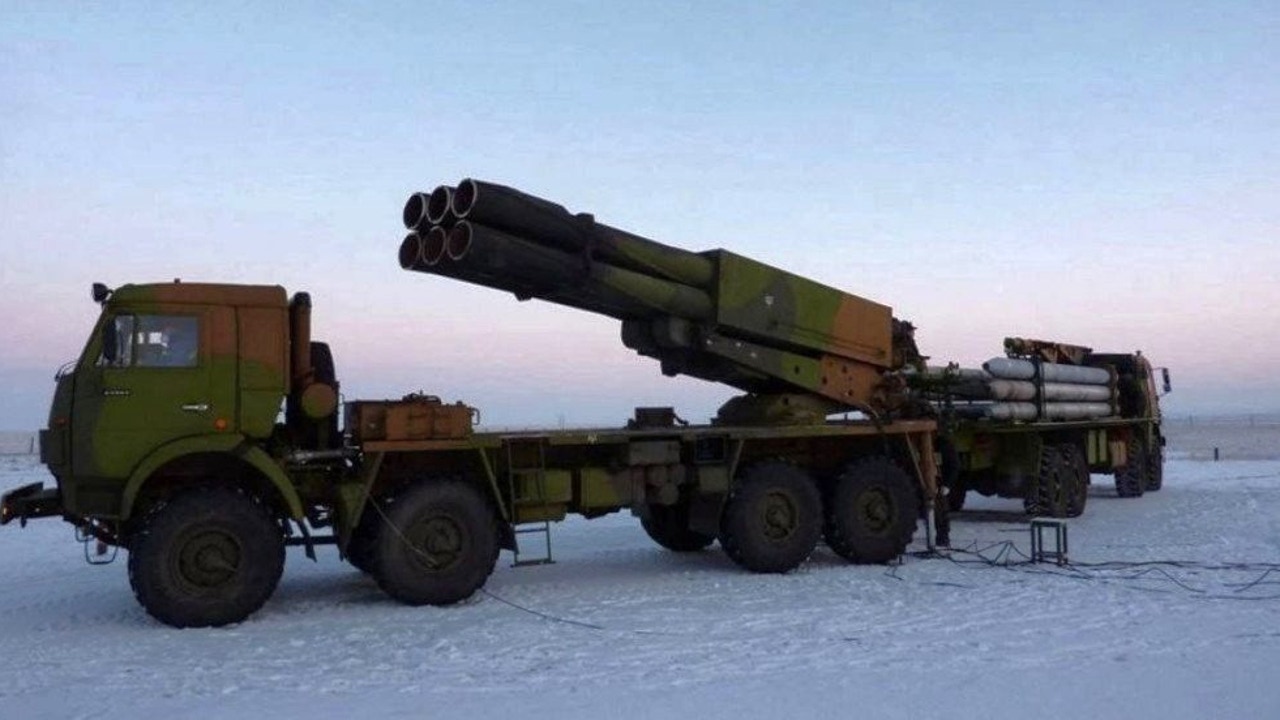
Until next February 12th it is taking place in Riyadh he World Defense Showan international defense fair organized by the General Authority of Military Industries of Saudi Arabia. There he has shown Russia this Monday its new multiple launch rocket system Sarma MLRS (initials for Multiple Launch Rocket System) 300mmwhich is already being tested by the Russian Army in the area of the ‘special military operation’, as the invasion of Ukraine is euphemistically called, according to the Russian state agency TASS.
The Sarma is mounted on an 8×8 military truck KamAZ-63501a configuration designed to gain speed and mobility on the road and to deploy quickly. Compared to heavier tracked systems, the logic here is that of ‘shoot and move’an expression that refers to arriving at a location, firing, and leaving before being exposed to counterbattery fire. The thrower carries six 300mm rockets and is operated by a small crew from an armored cabin, designed to protect against shrapnel and light weapons.
Mobility characteristics include an estimated weight of approximately 24 tonsa maximum road speed of up to 90 kilometers per hour and operational autonomy around 1,000 kilometers. The overall dimensions are approximately 11.2 meters long, 2.5 meters wide and 3.15 meters high.
One of the keys to Sarma is in its fire control architecturemore modern than the rocket artillery inherited from the Soviet era. Its automation (target acquisition, navigation and launch preparation) seeks to cut reaction times and improve precision. According to Russian sources, the system will be able shoot 300mm ammunition already available and also futureboth high explosive and guided. With current guided rockets, the maximum range that is managed is around 120 kilometerswaiting for longer range munitions to be developed.
Operationally, the Sarma fits with a broader trend in Russian artillery to achieve increased precision, survivability and mobility. Where classic MLRS relied on volume, with big salvos and massive fire, this system is sold as the opposite by taking fewer, but more precise shotsand with the crew less exposed thanks to the ‘shoot and move’ doctrine.
The Russian industry is also presenting it as an option. cheaper against Western wheeled rocket launchers, with an eye primarily on export markets in the Middle East and other regions.
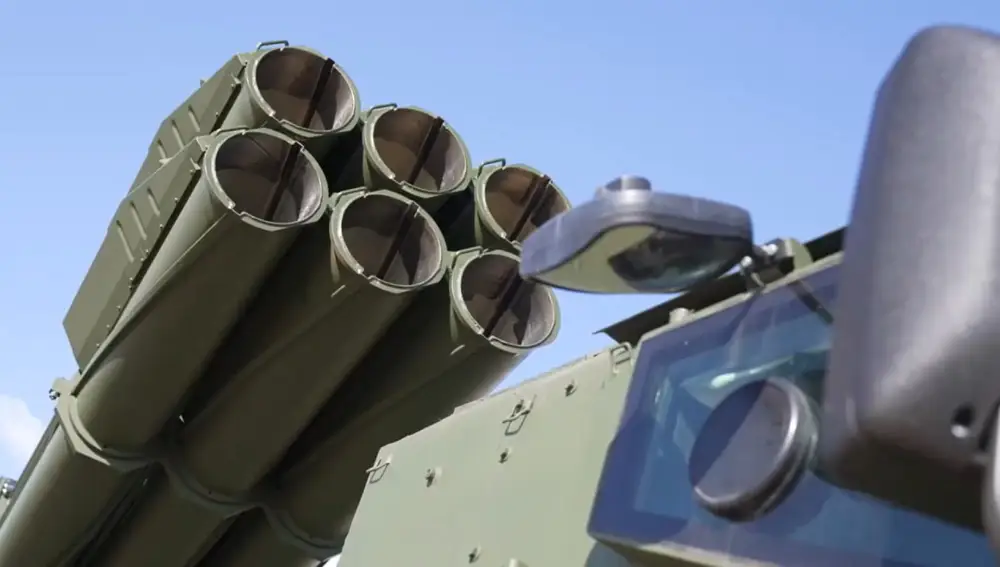
Altogether, the Sarma 300mm MLRS represents an evolution rather than a revolution. Its relevance lies in combining already established rocket calibers with improvements in mobility, automation and crew protection. Russia thus adapts its long-range fire capabilities to the conditions of the modern battlefield and the demands of the international market..
The system is designed to operate closer to the front line than legacy heavy MLRS platforms. According to defense media Army Recognition, Sarma is expected to enter service in limited quantities, potentially within operational zones, during 2026to complement, not replace, the units Tornado-Sheavier.
Russian media and analysts have presented Sarma as a possible rival to Western systems such as the HIMARS American, especially in terms of mobility and precision of fire, although direct comparisons of performance are disparate and depend largely on the specific type of rocket used and battlefield conditions.