
Since Elon Musk began putting his Starlink satellites into orbit, his company SpaceX has practically single-handedly dominated the internet market in low orbit. Since his project began, Musk has launched more than 10,000 satellites and around 8,600 are currently active in low orbit offering connectivity. But it’s just the beginning of Musk’s great plan to give internet to the entire planet. Starlink has approval to deploy up to 12,000 satellites and plans for an even larger constellation: possibly more than 30,000 satellites in the long term with the aim of offering fast, low-latency global internet coverage.
However, that hegemony seems to be encountering an unprecedented challenge: Jeff Bezos and Amazon have fully entered the space race with their own constellation of satellites, Amazon Leo with the aim of changing the rules of the game.
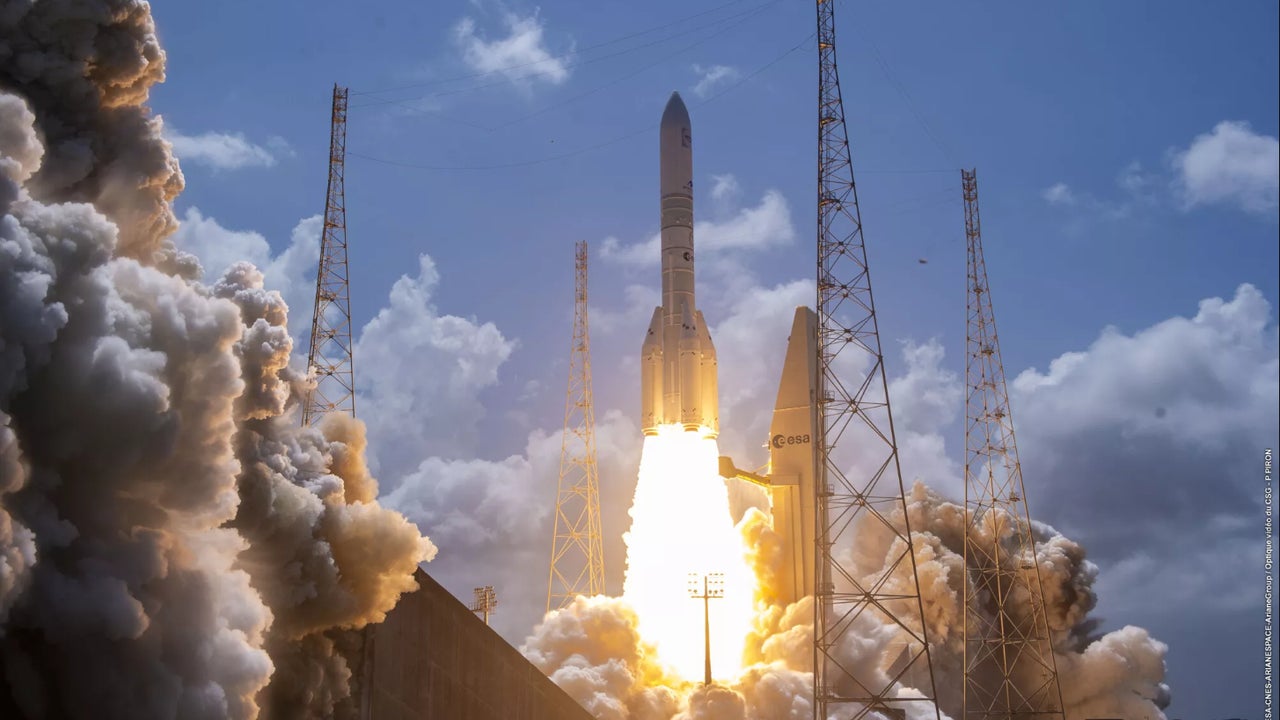
From the Kourou Cosmodrome in French Guiana, the European Ariane 6 spacecraft took off with a load of 32 new satellites on board, marking a milestone for Bezos’ project. But it’s not just any release: This is the first major deployment of Amazon’s satellite constellation from a European rocketin this case the most powerful configuration of Ariane 6, known as Ariane 64, capable of putting more than 20 tons of cargo into low orbit.
For Musk, competition is not to be feared. Still. Amazon Leo has launched just over 200 devices into orbitbut plans to expand and launch about 3,236 in the coming years. But the most recent launch symbolizes more than just numbers: it represents Bezos’ entry into the dispute for dominance of near-Earth space, a key segment for global communications.
Amazon’s official press release states that the objective is to offer fast, reliable and accessible internet to communities in remote areas and with little coverage, expanding access beyond what traditional networks offer. The satellites will be located at about 465 km high and the mission called VA267 (LE-01 for Amazon Leo), took “just” 1 hour and 45 minutes and is the first of 18 Ariane 6 launches reserved to support the deployment of the Amazon Leo constellation.
The fact that these satellites have been launched from Europe is another strategic component that distances Bezos from Musk. The collaboration between Amazon and the European launcher Arianespace (supported by the European Space Agency, ESA and around twenty countries) puts Ariane 6 at the center of the new commercial space economy, as Europe seeks to consolidate its own space access capabilities.
In terms of hardware and basic function (providing internet connectivity from low orbit), both Starlink and Amazon Leo operate under the same technological principle: satellite constellations in LEO that relay data between terrestrial users and with ground stations.
However, Starlink’s deployment has been much faster and more massive, thanks to the regular use of reusable Falcon 9 rockets and, in the future, the new Starship’s ability to launch even larger modules or in greater numbers per mission.
Amazon Leo, for its part, is developing its own terminals (for example, the Amazon Leo Ultra antenna, designed to be more durable and resistant to environmental conditions) and proposes a satellite network that will communicate both with ground stations and between satellites through laser links.
Amazon Leo’s first commercial services are expected to be available around late 2026 or 2027, especially for enterprise and government customers before expanding to general consumers. But as the official website shows, The antennas that will act as receivers are already visible, at least in design.
The development of specialized terminals and the use of optical links between satellites aim to make the network more competitive in terms of speed and latency, although the deployment is still much more modest than that of Starlink. But Bezos has already taken the first step.