
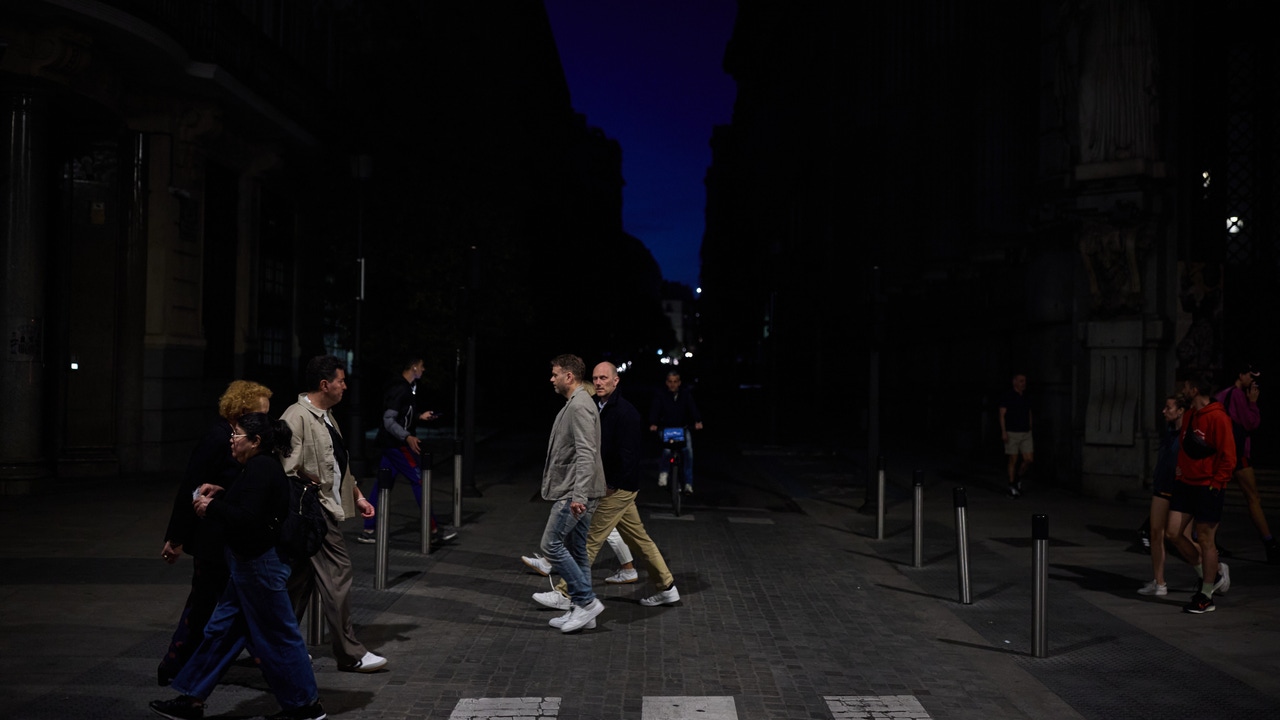
That fateful April 28 of this year, peninsular Spain as a whole and Portugal experienced an energy blackout for hours that the Group of Experts of the European Network of Electricity Transmission Network Managers (Entso-E), created to investigate the incident, described as an “unprecedented phenomenon in the European electricity network.”
To date, this committee has published a factual report a little over a month ago with the aim of reconstructing the evolution of the electrical systems of the affected countries and the restoration process that was carried out, although to find the specific causes, about which quite a lot is already known – according to experts – we will have to wait for the final report that Entso-E will submit in 2026.
There are several proven facts, such as that at the moment before the collapse, voltage and frequency oscillations were recorded between 12:03 and 12:07 and between 12:19 and 12:22 noon. Furthermore, a few seconds before ‘zero energy’, an increase in voltage was recorded in southern Spain along with a slight drop in frequency, which caused a series of automatic generation disconnections and the separation of certain interconnection lines.
What do we know about the causes
According to Jorge Morales, industrial engineer and general director of Próxima Energía, “what there was was a voltage control problem and this exceeded the established limits, which led to the plants operating within the foreseeable and being disconnected. What we do not know is why the ranges were exceeded, since Red Eléctrica has tools to prevent this from happening. The plants that are supposed to control this did not do so. There are many problems here, it is not evident who was to blame; in addition, oscillations were recorded throughout of Europe, which also caused countries like France to make disconnection decisions that could aggravate our situation.”
The aforementioned report does describe as one of the most relevant circumstances the loss of local generation in seconds (several gigawatts) and the inability of the system in force that day to maintain stability.
Without a doubt, the oscillations were the main cause, regardless of the reasons that precede this fact. In the words of Santiago Arnaltes, professor of Electrical Engineering at the Carlos III University, “A unique phenomenon occurred because it spread throughout all networks. There are usually local overvoltages, but the fact that they expand is something that was known the other way around; that is, voltage drops. Here what is called voltage collapse was in the opposite direction.” In this sense, the professor stressed that this overvoltage occurred because the lines were “very discharged and behave like capacitors, which causes the tension to resolve; However, the question is whether these oscillations are interareas that appear as grid modes or are they oscillations forced by renewable plants. There is a dispute there. In any case, when these oscillations appear, the system operator (Red Eléctrica) has certain tools to dampen them, although that task is not his or her responsibility; rather, it is the operators themselves (the companies that must exercise control) that should be able to mitigate these oscillations. In short, it is most likely that it was the response to the oscillations that were recorded on April 28 that caused actions to be taken that led to the collapse.”
Following the thread of what he commented previously, and in line with Professor Arnaltes, Morales emphasized that “We must think that the system cannot depend on a single person responsible because it would be a very weak system; This is not like that, it does not happen. The problem is that the centers that should supervise operation and errors, which charge a fortune, did not do so. “We’ll see if the plants complied and it was Red Eléctrica that did not call more plants to cushion the surge.”
What the experts are saying is that voltage control resources were lacking, either due to a lack of programming on the part of the system operator or because those who should have acted as controllers of this type of incidents did not do their job; maybe for both.
Renewables and regulations
This collapse has given rise to all kinds of interpretations with which to open a political front through the energy park that exists in Spain and, incidentally, to establish a kind of war between the commitment that must be made by the authorities for one type of energy or another. Renewables, in depending on which forums, have once again been in the spotlight as a possible cause of this event, or at least as an aggravating factor of it.
Sending a response to the relevant report, “it does not attribute any direct responsibility to renewable energy, although it does determine that the episode in question took place in a context of high renewable penetration and low synchronous generation,” commented David Ramos, professor of Electrical Engineering at Carlos III, who emphasized that “from a technical point of view, renewables are not responsible for the incident, but their high penetration and electronic nature can amplify the sensitivity of the system to rapid disturbances. The underlying problem is one of coordination and robustness of the system, not of a specific technology.”
In sync, the rest of the experts agree with Santos in their assessment. For example, Morales was clearer when he stressed that “objective facts must be separated from economic interests. Firstly, renewables produce more voltage oscillations than the rest, because the primary energy created by electricity is much more variable. Does this mean that we have gone beyond making renewables? No. When renewable plants are created, more control plants must be available, but curiously the renewable plants themselves also have the capacity to control these oscillations; in fact, the new regulations in this regard enable this to be the case and that the renewable plants themselves control this. The system has the capacity to assume all this, but we must put the tools we have to work. The regulations that we had on April 28 are from 2000. Red Eléctrica had been requesting its change for at least 10 years and in June it was already known that there was an oscillation problem and that it could occur.
Solutions
The regulations to which Morales refers are those relating to the Operation 7.4 procedure, which will operate until January, at least, to clarify whether it has been, is and will be effective as a guarantor of the necessary mechanisms so that events of this type are not repeated. What’s more, the Spanish photovoltaic association UNEF issued a statement whose objective was to emphasize the use of photovoltaic energy as a mitigator of the problem if regulation allowed it.
Santiago Arnaltes insisted: “Renewable energies are not regulating the voltage, it is the conventional generators that do it and the relationship that there may be is that there were few generators regulating voltage at that time. The reinforced mode of operation that currently exists consists of there being more synchronous generators regulating voltage, but that means that these generators, to be regulating voltage, have to be generating and limit the penetration of renewables. This has a cost because in the end they are generators that do not fit in the adjustment market due to technical restrictions and have to generate, They have to operate at their technical minimum to be able to regulate voltage. Possible solutions? That all generators, both renewable and conventional, regulate voltage;
To conclude on this point, Ramos added a couple of issues that could help prevent collapses of this type: “rstrengthening interconnections and defense algorithmsto reduce the risk of separation and speed up restoration and perform eDynamic behavior testing and validation of parks and transformers against real disturbances. Overall, the event does not question the viability of the renewable system, but rather highlights the need to adapt operating rules and protection schemes to an increasingly electronic and decentralized network.”