
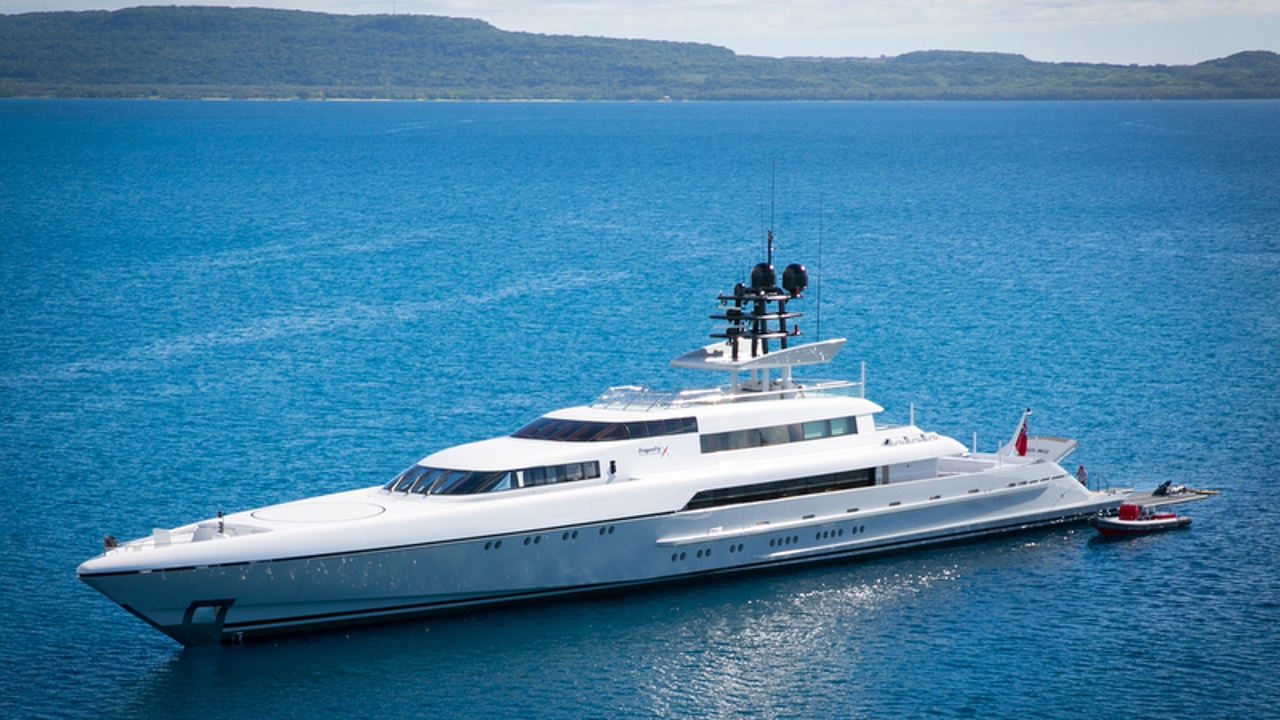
The arrival of the Dragonfly to the Port of Malaga marked a before and after in the city’s megayacht traffic. At 142 meters in length and with a displacement of 9,408 gross tons, the vessel surpasses even the Kaos, the $300 million yacht of Walmart heiress Nancy Walton Laurie.
As soon as it docked, Dragonfly went on to top the list of the most valuable private vesselslarge and complex that have set foot in the port.
Designed and built by the prestigious German shipyard Lürssen, the megayacht is not simply a pleasure vessel, but a self-sufficient marine system comparable to a small cruise ship.
Works like a mini cruise
The Dragonfly’s huge tonnage means it works with industrial systems normally found on passenger ships:
- Commercial Grade Refrigeration
- Water treatment and desalination plants
- Complex internal electrical network
- Hydraulic elevators
- Professional kitchen
- Industrial laundry systems
Once moored, the main engines are shut down, but everything else continues to operate. The auxiliary system takes control to keep all the services that make this floating palace habitable operational.
The biggest energy guzzler: the air conditioning system
On a modern superyacht, the HVAC system is the true energy giant. In the Dragonfly, maintaining dozens of rooms with precise temperature and humidity represents a colossal expense.
Even in the mild climate of Malaga in November, the humidity control works tirelessly to counteract the constant influx of sea air every time a door is opened.
Experts agree
Pools, hot tubs and water systems
The Dragonfly has multiple pools, jacuzzis and spa areas, whose systems require:
- Filtration pumps in permanent operation
- Continuous heating cycles to compensate for heat loss
- Desalination systems to produce fresh water
- Industrial boilers to supply the crew and guests
Each of these elements adds up to energy consumption only found on research vessels or boutique cruise ships.
How much energy does it really consume?
Industry data indicates that megayachts between 120 and 150 meters consume between 300 and 1,000 kilowatts at rest.
Given its scale and complexity, the Dragonfly probably operates at the higher end.
With an estimated consumption of 700 kW in steady state, the daily energy amounts to:
- 16,800 kWh per day, equivalent to what 580 average American homes consume.
While moored, the Dragonfly is, in energy terms, a small city connected to Malaga’s electrical grid.
An exorbitant daily expense just on electricity
The energy rates of the Port of Malaga turn this consumption into an astronomical figure.
Depending on local prices, a large yacht consuming 7,200 kWh per day pays between €1,650 and €3,600 for electricity.
Applied to the Dragonfly: 16,800 kWh = between €3,864 and €8,400 per day
And that doesn’t include:
- Maintenance
- Berths
- Crew
- Fuel
- Provisioning
On the whole, The yacht’s annual costs can exceed $30 million.