
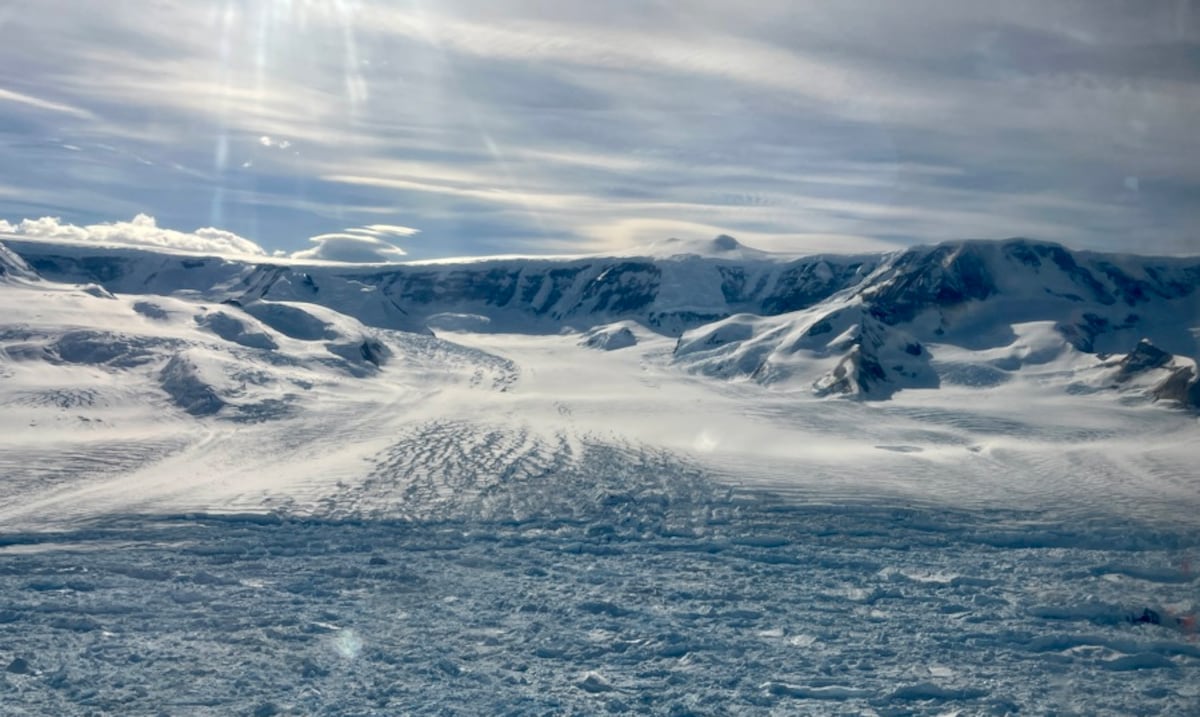
Science Editorial – There is no record of anything like it since the Ice Age: almost half of the Hektoria grazer, in eastern Antarctica, collapsed in just two months, losing 8.2 kilometers of ice, according to a study published this Monday in the journal Nature Geoscience.
This disintegration process has occurred at a speed ten times higher than the average previously documented for a terrestrial glacier.
The team of researchers from the University of Colorado that made the discovery came to it almost by chance, when they were studying the area surrounding Hektoria, using satellite and remote sensing data.
1/16 | In images: an avalanche after the collapse of a glacier buries a town in Switzerland. A large fragment of the Birch glacier, located above the town, broke off and caused the landslide. – JEAN-CHRISTOPHE BOTT
They wanted to understand why sea ice had separated from the glacier a decade after an ice shelf collapsed in 2002.
While analyzing data from the glacier between February 2002 and August 2023, they realized that its surface, which was about 115 square kilometers, had been reduced by half in just two months.
“When we flew over Hektoria at the beginning of 2024, I couldn’t believe the immensity of the area that had collapsed, even though I had already seen the satellite images, seeing it in person surprised me”says one of the researchers, Naomi Ochwat, from the University of Colorado Institute of Environmental Sciences (CIRES, for its acronym in English).
The researchers’ goal then focused on trying to understand why it had collapsed so quickly. To achieve this, they turned to satellite data to study the glacier at different time intervals and create a solid picture of its topography and retreat.
Many of the glaciers in Antarctica are tide glaciers, which rest on the seabed and end with a tongue of ice in the ocean, which then gives rise to icebergs.
The topography under these glaciers is usually varied. They can sit on deep canyons, underground mountains or large flat plains, as is the case with Hektoria, the glacier rested on an ice plain, a flat area of bedrock below sea level.
Researchers had already discovered that between 15,000 and 19,000 years ago, Antarctic glaciers with ice plains were retreating hundreds of meters a day, helping the team better understand Hektoria’s rapid retreat.
Several earthquakes beneath the Hektoria Ice Plain caused a large portion of the glacier to suddenly float, resulting in the ice rapidly breaking off.
As it floated, it was exposed to the forces of the ocean, which opened cracks from the bottom of the glacier, which in turn joined with the cracks exposed from the top, causing half of the surface to break away and break off.
“Hektoria’s retreat is shocking: this type of ultra-rapid retreat would really change the predictions for other larger glaciers in Antarctica. If collapses of these dimensions occurred, it could greatly accelerate sea level rise,” adds Ochwat.