
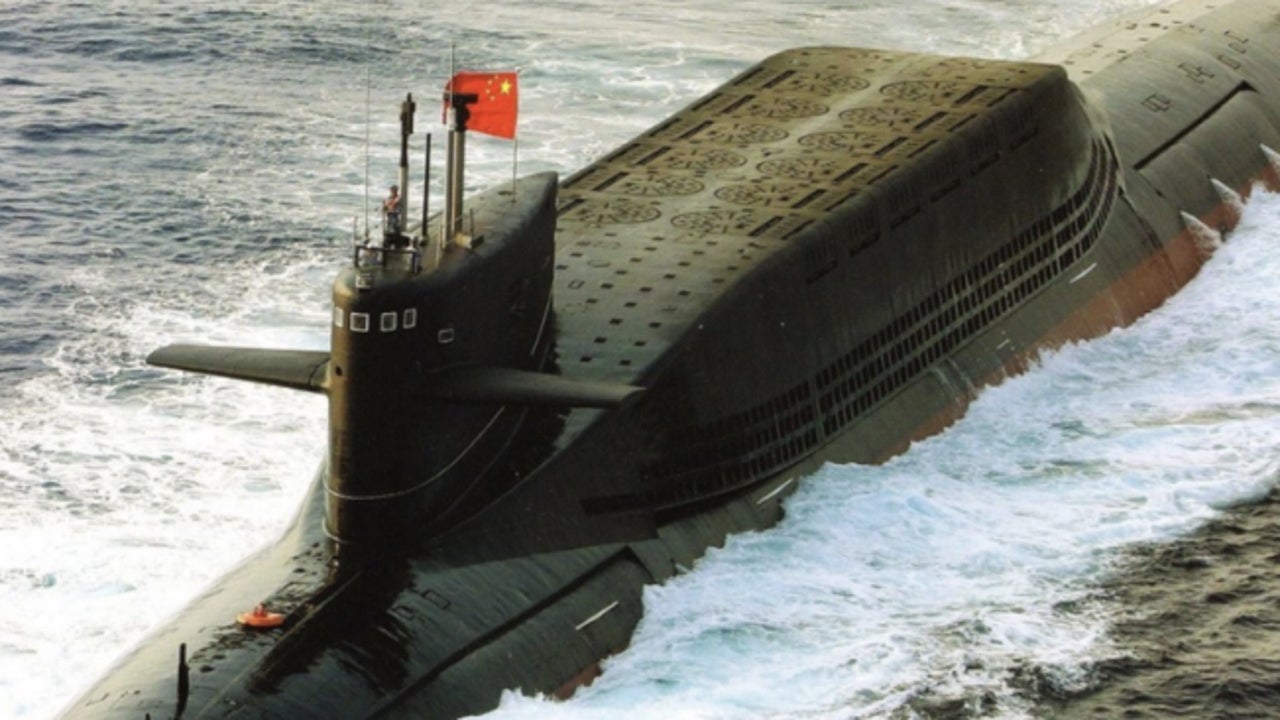
The main armies of the planet have at least one five years using artificial intelligence both in the field of defense and in attack strategies. Now, a new study of China’s defense industry suggests that AI could soon make it difficultalmost unable if we limit ourselves to statistics, the survival of submarines in future naval conflicts.
The study, published in Electronics Optics & Control, and led by Meng Hao, of the Institute for the Research and Development of Helicopters of China, presented for the first time an advanced anti -submarine war system (ASW for its acronym in English) promoted by AI, capable of even detecting the quieter submarines by making intelligent decisions in real time.
According to the study, The new ASW system could reduce the probability of escape from a submarine to just 5 %which means that only one in 20 submarines would probably escape detection and attack.
The results suggest that the era of the “invisible” submarine, for a long time a pillar of naval deterrence, could be coming to an end. The key to advance is that, instead of relying on the old search patterns, The AI system acts as an intelligent commander in the ocean.
As in the movie BattleshipAI uses Data from sound buoys thrown from helicopters, submarine sensors, radars and even the ocean temperature and salinity levels to generate a live image of what happens under the sea.
Then, quickly decide where to search, how to adjust your team and How to answer when a submarine tries to escape zigzaging, silenced or emitting false signals To mislead the search engines.
In computer simulations, this system of Ia was able to find and track enemy submarines approximately 95% of the timeregardless of how much they strive to hide. Even when the submarines used high -tech or drones lures to distract search engines, the AI followed them.
Submarines have been considered for a long time as the definitive asymmetric weapon: capable of launching nuclear attacks, collecting intelligence or sinking groups of aircrafts, remaining virtually undetectable.
To give us an idea of the important advance, In the traditional anti -submarine war, a silent submarine equipped with advanced lures has a probability of survival of up to 85 %. But AI could become obsolete this strategy. The system operates with a three-layer architecture: perception, decision-making and man-machine interaction.
First, the AI fuses real -time data of the sound, radar, magnetic anomalies detectors and oceanographic sensors to generate a dynamic image of the submarine environment. It takes into account changing variables such as water temperature, salinity and background noiseconditions that traditionally hinder the effectiveness of sounding.
Then, in the decision stage, a multiagente reinforcement learning model Face “hunter” agents, such as helicopters and Sonoboyas, with “prey” agentssuch as submarines and unmanned underwater vehicles.
Through thousands of simulations, the AI learns optimal tactics, such as the formation of sound barriers, the execution of coordinated sweeps or the concentration of sensors in high probability areas. The AI Not only detect submarines, but anticipates its behavior. In the simulations, he recognized evasive tactics such as the “silent march” or the maneuvers in Zigzag and adjusted the search patterns accordingly.
Even when the submarines deployed lures or operated in complex acoustic environments, the AI maintained a high detection rate, according to the researchers. The project team too He built assistant interfaces based on large language models to coordinate the interaction of different AI agents with human operatorstranslating complex data of sensors and strategies generated by the recommendations in simple language.
Meng’s team states that this technology could be improved even more. Future versions could collaborate with drones in the air, ships on the surface and Undemanized vehicles, creating a complete three -dimensional search network. To that we must add that AI could also continue learning during real missions, becoming smarter with each deployment.
The future objective is also install lighter and faster versions on smaller combat robotswhich would allow more platforms to make quick decisions without sending data to a central base.