
Our brain has close to 86,000 million neurons. One of the most advanced microchips on the planet, the Wafer Scale Engine 2 brains, reaches 2.6 billion transistorspopularly known as digital neurons, the parts of the microchip that process the information. But, despite having many more transistors, computers do not imitate the processing capacity of the brain.
For decades the objective of scientists has been Reproduce human brain capabilities in a microchip. Now, a team of Chinese scientists has presented a supercomputer with an architecture similar to that of the brain of a monkey.
Called Darwin Monkey or “Wukong”, the system has More than 2 billion artificial neurons and more than 100 billion synapseswhich places it practically with the neuronal structure of a macaque.
Those responsible for the progress, scientists from Zhejiang University, hope Serve as a simulation tool for neuroscientistswhile representing a step towards general artificial intelligence (IAG), an artificial intelligence system (AI) with intelligence and reasoning similar to humans.
Unlike traditional artificial neuronal networks, which The principles of classical computing follow and process data through binary values In constant change, neuromorphic systems such as Darwin Monkey are based on neuronal peak networks (SNN).
SNN They mimic the transmission of signals between neurons in the brain of mammalsresponding to electrical signals to process and transmit data through bursts (or peaks) of intermittent activity.
A biological neuron triggers an electric pulse when the signals it receives from other neurons reach a level intense enough to trigger an answer. Artificial neurons in second -order neural networks mimic this mechanism, shooting only when they have accumulated sufficient electric entrance.
While software -based neuronal networks are a set of automatic learning algorithms designed to emulate the human brain, second -order neural networks physically replicate the way information moves between biological neurons. This configuration Allows second order neural networks processing data in parallelwhich potentially makes them more powerful than conventional supercomputing architectures.
To that we must add that they would also be more efficient energy: artificial neurons enter a short rest period after each peak, during which they cannot respond to new entries. This limits the activation frequency, which helps reduce the total energy consumption.
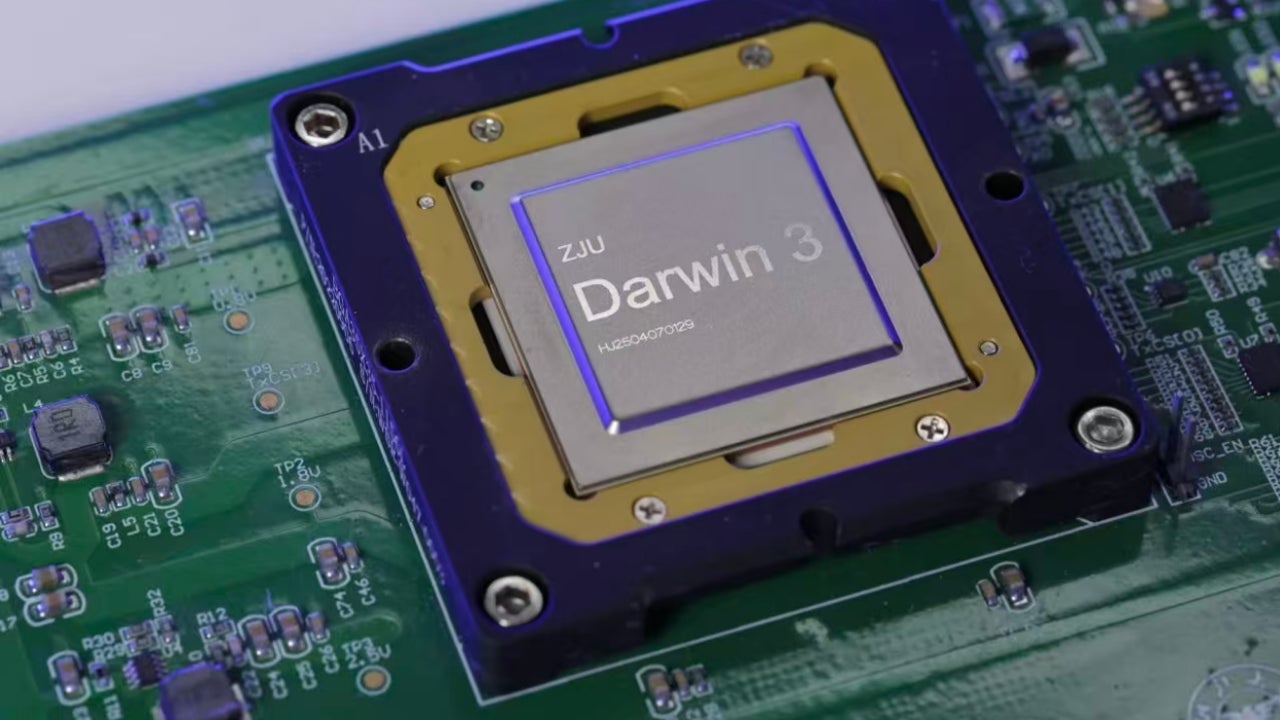
Those responsible for the advance claim that Darwin Monkey consumes only 2000 energy watts (Approximately as a hair dryer), despite being fed by 960 Darwin III neuromorphic chips, each of which admits up to 2.35 million active neurons.
The previous record in neuromorphic computing was held by the system Hala Point de Inl, composed of 1150 million artificial neurons and 128 billion artificial synapses distributed in 140 544 processing cores.
At that time, Intel said his system was capable of performing 20,000 billion operations per secondor 20 petaps. However, since there are very few neuromorphic computers, and that they process the data differently from supercomputer, it is difficult to compare them in a homogeneous way.
In A statementDarwin Monkey’s team said The platform had already demonstrated its capacity in cognitive tasks such as logical reasoning, content generation and mathematical problems resolving, using a model developed by the Chinese Startup of the Deepseek.
The system is also used to Simulate animal brains with different levels of neuronal complexitysuch as zebra fish and mice, as part of broader initiatives to support research in neuroscience.
Darwin Monkey was designed by researchers at the University of Zhejiang and Zhejiang Laba research institute established jointly by the provincial government of Zhejiang and Alibaba Group, a Chinese technological conglomerate.