
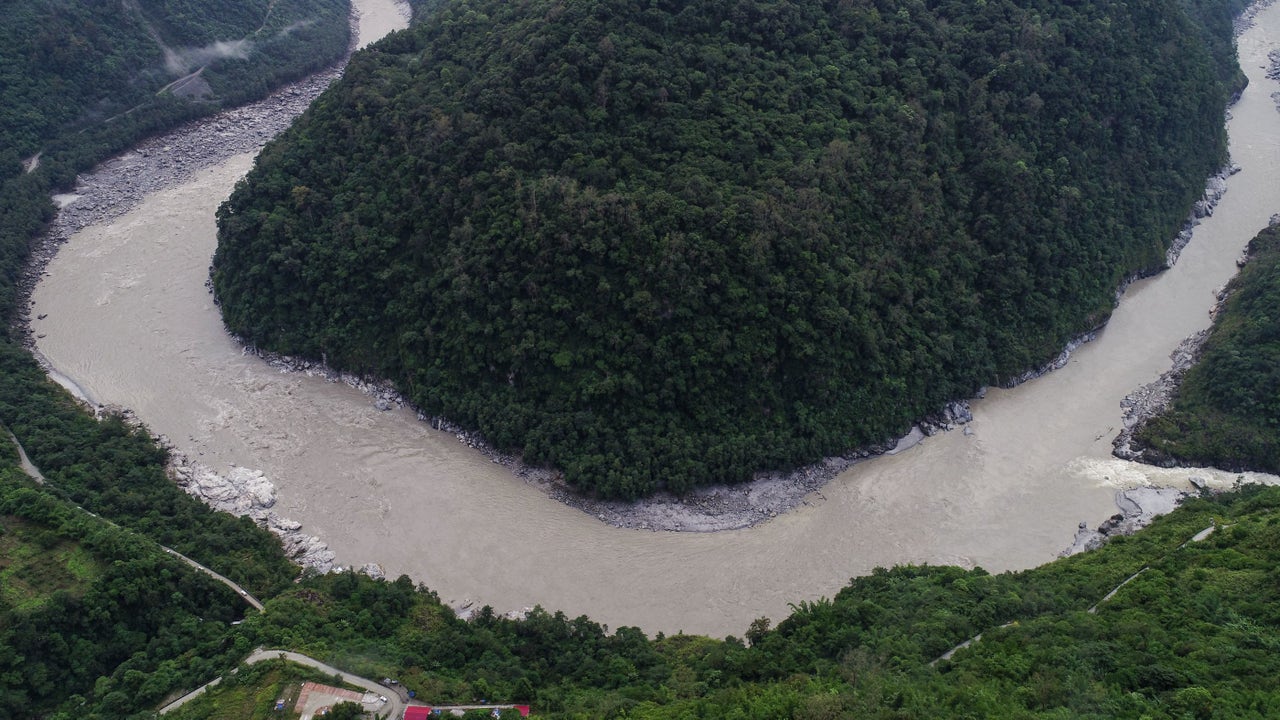
In the heart of the remote gorge of the Yarlung Tsangpo River, in Nyingchi’s Tibetan Prefecture, China has started a work that challenges the limits of modern engineering: the world’s largest hydroelectric dam. With a colossal investment of 137,000 million dollars, this project in Metog County, one step away from the disputed border with the Indian state of Arunachal Pradesh, promises to triple the capacity of the legendary prey of the three throats. Located in the longest and larger river cannon on the planet, this technological wonder will redefine the Asian energy market, but also raises environmental and geopolitical challenges of epic proportions. For construction professionals, this megaproject represents a milestone of innovation and a test field to overcome technical, logistics and ethical challenges in one of the most inhospitable regions.
The high price of ambition
The Yarlung Tsangpo, known as Brahmaputra when crossing India, winds through a cannon three times deeper than the Grand Canyon of Colorado. It is there where the Chinese state giant Yajiang Group is building the dam that will take advantage of the immense strength of the river, generating 300,000 million kWh a year, enough to illuminate entire provinces and feed the voracious industrial centers of the second world economy. The megaproject is a key piece of the “West-East” energy transmission, designed to channel electricity from the Tibetan Plateau, rich in resources, to coastal megacities. With annual income estimated at 2,744 million dollars, it could also revitalize the Tibetan economy, creating jobs and fighting water shortage in a region severely affected by the decline of glaciers due to the fearsome climate change.
This is not a common prey. Its two main structures, which require massive tunnels to divert the flow of the river, represent a triumph of engineering. Its scale exceeds even the aforementioned prey of the three throats, which produces 100,000 million kWh per year. By tripling that capacity, the Xi Jinping regime is about to consolidate its world leadership in renewable energy, accelerating its transition to a low carbon future. For a country that demands a quarter of the global supply, this megapate is a strategic pillar, reducing coal dependence and strengthening energy security.
However, the economic and environmental price is high. The Grand Canyon of Yarlung Tsangpo is a biodiversity sanctuary, home of the highest trees in Asia and an extraordinary concentration of great felines, such as Las Nieves and Tigres Leopard. Ecologists warn that this construction could devastate this unique ecosystem, altering the flow of sediments that are essential for the fertility of the Delta del Brahmaputra, vital for agriculture in Bangladesh. In addition, the region is prone to earthquakes, adding a critical risk: a structural failure could trigger a catastrophe of incalculable proportions, with floods that would irremediably devastate entire communities downstream.
Geopolitical storm
Beyond its environmental impact, this construction is a geopolitical lightning. The Yarlung Tsangpo is the vital artery that runs through the heart of southern Asia, holding 1.3 billion people in India and Bangladesh. This imposing river drives agriculture, fishing and livelihoods, but now it is the epicenter of a geopolitical storm.
With a simple movement, Beijing could strangle the river flow, plunging the downstream communities in devastating droughts. Worse, in a conflict, a sudden release of water could unleash catastrophic floods, with a human cost that could reach hundreds of thousands of lives. Pema Khandu, Chief Minister of Arunachal Pradesh – the Indian state downstream – qualifies it as a “huge threat.” His lament points out that this is not just about water, but about survival.
India does not stay with crossed arms. In an bold play, New Delhi is accelerating the construction of its own 11,000 MW megarepress in Arunachal Pradesh. But this career of Titans has a cost: experts warn that the Indian project could cause environmental damage as serious as the Chinese. What is unleashed is a fierce competition for the control of one of Asia’s most vital resources, with Brahmaputra as a trophy and potential victim.
The lack of data on its environmental impact or mitigation plans is a wall of silence that Beijing raises in front of India and Bangladesh. Although the Chinese Ministry of Foreign Affairs promises “responsibility” and dialogue, its opacity appeas suspicions: this “project of the century” could be a weapon of coercion, capable of suffocating the flow of the river or unleashing devastating floods. Chinese-Indian relations, barely stabilized after border agreements in 2024, are staggered. Bangladesh, with 60% of his agriculture anchored to the Brahmaputra, faces a catastrophic economic risk: an altered river could sink its food security and shoot the food import costs.
From an economic perspective, water control is the new oil in southern Asia, where water resources are a strategic asset. India recently broke a 65 -year -old treaty with Pakistan on the Indo River, dynamiting decades of cooperation. The Treaty of Ganges with Bangladesh, next to expire in 2026, falls apart under accusations of breaches. Analysts warn: “The erosion of water diplomacy not only destabilizes the region, it also threatens global climate security.”
Water: The new oil of Asia
This Goliath will channel electricity to Chinese provinces with chronic deficits, reinforcing the national network and consolidating Beijing leadership in the transition to a decarbonized future. From an economic prism, the project positions the Asian power at the head of the market, capturing economies of scale and attracting foreign investment towards its vision of energy supremacy. But this movement unleashes a domino effect. India and Bangladesh, whose agriculture and subsistence depend on Brahmaputra, are forced to counterattack, accelerating massive investments in hydroelectric, solar and winding to mitigate their vulnerability to the Chinese control of the flow. This investor frenzy, although necessary, stresses national budgets and raises debt risks in emerging economies. At the local level, the dam promises to transform the Tibetan economy with projected income that could finance regional development. However, the social cost is a time bomb. Projects such as the three throats, which displaced 1.4 million people, or ganguo, which unleashed stifled protests, warn of a worrying history.
It is therefore a bet dared by energy leadership, but also a dusty that could trigger an environmental and geopolitical crisis. In order for this investment to fulfill its promises, transparency must be prioritized, involved local communities and forge agreements with India and Bangladesh. Without a collaborative approach, this hydroelectric giant will redraw the energy map, and could light a regional conflict of unpredictable consequences. In the roof of the world, where water is power, the next movements will be decisive.