
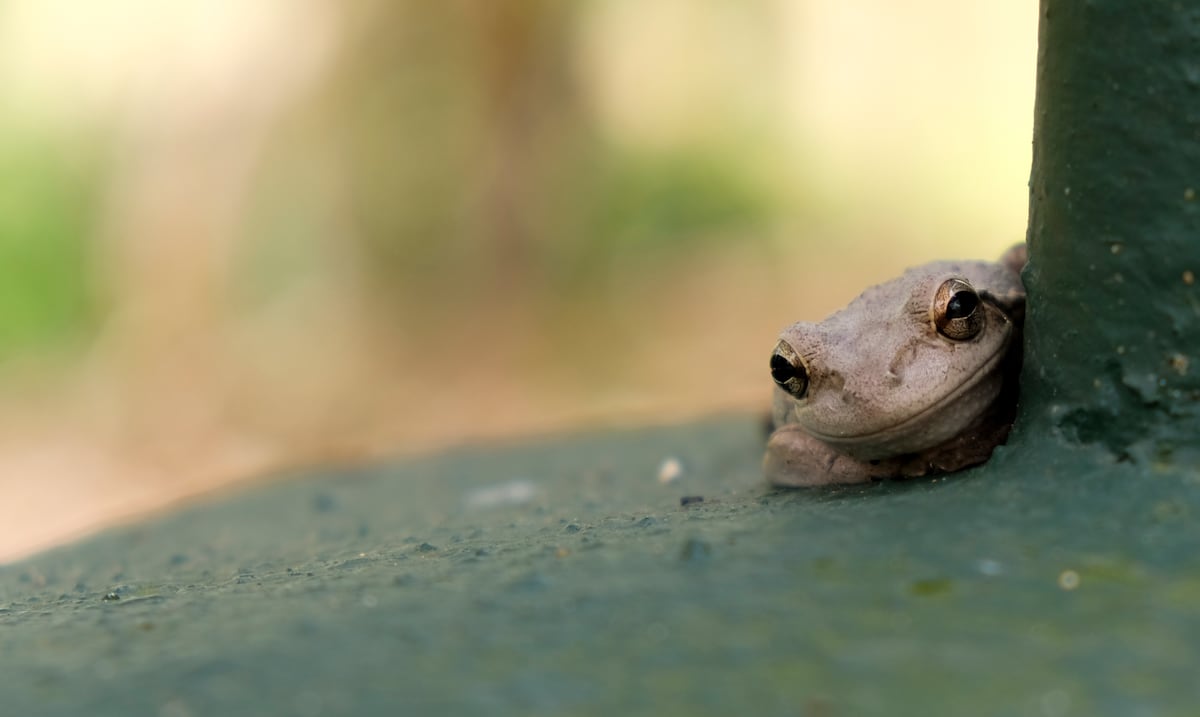
The fame of Coquíes As the best known frogs of Puerto Rico is only matched – although not for a good reason – for the Cuban frogs, a Invasive amphibian which has threatened several endemic species since its introduction on the island, in the 1950s, specifically on the coasts of Aguadilla.
It is likely that Cuban frogs have arrived in Puerto Rico through tropical plants trade since Cuba to the state of Florida, and later by boat to the island, according to the doctor Timothy ColstonProfessor of Biology and Director of the Collection of Genomic Resources of the Mayagüez University Campus (Rum) of the Puerto Rico University.
“I wouldn’t even dare to guess how many Cuban frogs are in Puerto Rico”He commented on Colston. “It must be to the hundreds of thousands.”
One of the reasons why this invasive species has prospered is the lack of natural predators in the local ecosystem. When animals like birds, cats or dogs – which usually feed on amphibians – try to eat them, spit them. In some cases, dogs even spuap by the mouth. This is due to a chemical reaction caused by toxins present in the skin of frogs.
Although these toxins are not poisonous for humans, Colston warned that precaution should be manipulated without gloves. After touching them, it is important to avoid contact with your eyes and wash your hands well.
Currently, research is carried out to better understand both the behavior and the chemical composition of this species. Under the supervision of Colston, the master’s student YeisSette Burgos-Amonal Investigate the toxins present in your skin.
The team seeks to identify its composition and determine if they are produced by the frog itself or by bacteria that inhabit their glands.
From the ecological point of view, Cuban frogs represent a significant threat. They are generalist predators, which means that they can eat virtually anything that fits in their mouths, including other Cuban frogs.
This wide diet allows them to compete for resources with native species, affecting their survival by limiting access to food and reproduction sites.
Another evolutionary advantage of this species is its great reproductive flexibility. They are able to reproduce throughout the year, especially in rainy seasons, and can do so in any amount of stagnant water. This facilitates its expansion and population growth, said the expert.
According to Colston, an effective strategy to control its population is to intervene during the egg stage. These eggs have the appearance of floating black spots, uniformly distributed. They can be grouped into small quantities or large masses, depending on the level of disturbance of the environment.
In their adult stage, Cuban frogs can be identified by their large size (between three and four inches), palmated feet, and a yellow touch near their hind legs. His eyes are remarkably bulbous and separated by bone structures that are only micro-pulled from their wet skin. This need to keep wet skin makes them take refuge in shaded places, such as vehicles.
During the night, they usually meet near bodies of water to reproduce. After fertilization by males, eggs become reborn in approximately a week, and a week later complete their metamorphosis. His life expectancy varies between three and five years.
Colston also highlighted the importance of citizen participation in the investigation. A large part of the data used by your laboratory come from observations shared by people through Facebook groups or through application Inaturalistwhere users can publish photos of the species they find.
“We are always open to collaboration. There are many questions and few people investigating the Cuban frogs,” Vacston concluded.