
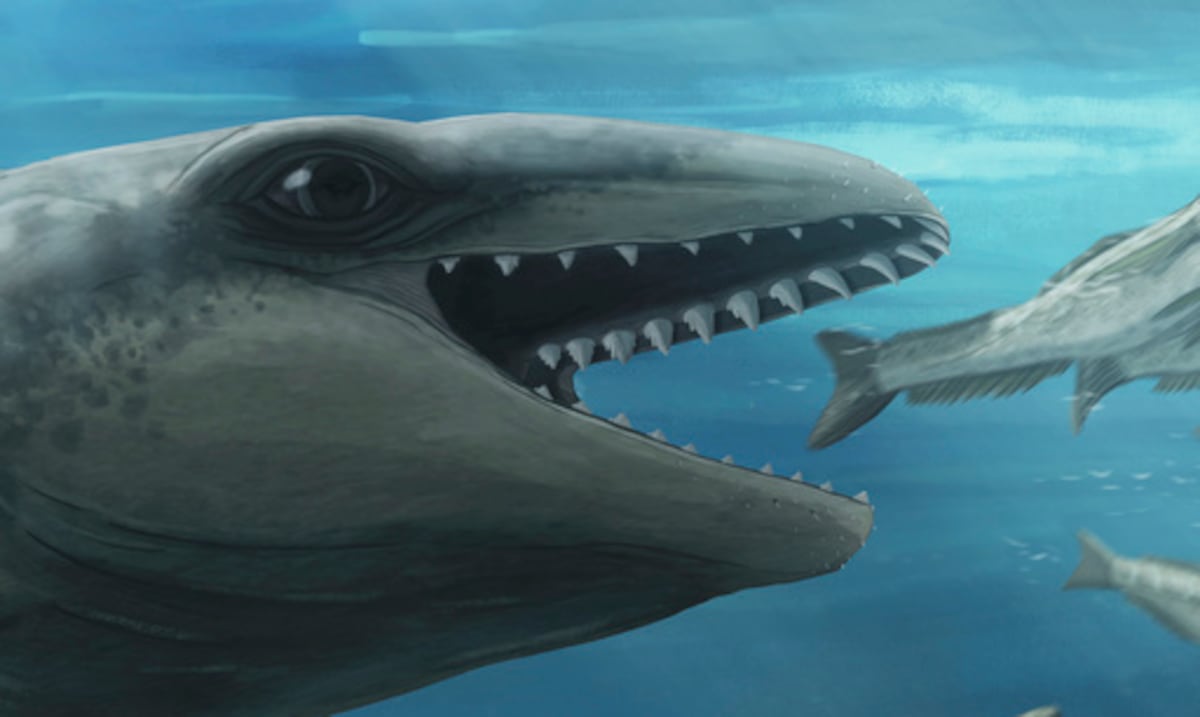
Wellington – Long before the whales were majestic and gentle giants, some of their prehistoric ancestors were small, strange and wild. The fortuitous discovery of a fossil of 25 million years in an Australian beach has allowed paleontologists to identify a new and rare species that could reveal mysteries of the evolution of the whales.
Investigators officially appointed Janjucetus Dullardi this week, a caricaturesca creature with jumping eyes of the size of tennis balls, in the Zoological Journal of the Linnean Society. Unlike current whales, the youth specimen was small enough to fit in an individual bed.
However, this rarity of the ocean, which has diabolical teeth and a snout similar to that of a shark, was unpleasant, petty and was made to hunt.
‘It was, let’s say, misleading’Said Erich Fitzgerald, the main paleontology curator of the Museums Victoria Research Institute, and one of the authors of the article.
“It could have seemed like a strange mixture between a whale, a seal and a Pokémon, but they were very his. ‘
The rare extinct species was a strange branch in the family tree of whales. The rare discovery of the partial skull, including the bones of the ear and the teeth, was made in 2019 in a section of Costa Rico in fossils throughout the state of Victoria in Australia. Jan Juc Beach, a crib for some of the rarest whales in history, is becoming an access point to understand the early evolution of whales, said Fitzgerald.
Few genealogical trees seem strange than that of Janjucetus Dullardi, only the fourth species never identified in a group known as Mammalodontids, primitive whales that lived only during the time of the Oligocene, between 34 and 23 million years ago. That marked the point in the middle of the known history of the whales.
The small predators, who believe they grew up to 3 meters (10 feet) long, were an early branch in the line that led to the great bearded whales of today, such as humpbacks, the blue and the minke. But dentudos ancestors with powerful jaws would have been radically different from any modern species.
“It is possible that they had small pieces of legs that stood out as stumps from the body wall,” said Fitzgerald.
That mystery will continue to be temptingly without resolving unless a specimen is discovered with more of its intact skeleton, which would be a kind of miracle. Even the partial skull that allowed the initial identification this week was an amazing discovery.
For an amateur paleontologist, an obsession with life paid off. Janjucetus Dullardi was appointed by researchers in honor of an amateur fossil hunter who does not care in the least of his appearance.
‘Literally they have been the most important 24 hours of my life,’ said Ross Dullard, who discovered the skull while looking for fossils in Jan Juc Beach. After the confirmation of the new species on Wednesday, the director of the school walked like a rock star on the campus with ‘crashing the five to right and left,’ he said.
His friends and family probably feel relieved to have finished.
“That’s all they have heard of me for the past six years,” he said.
Dullard was in a regular search for low tide in Jan Juc the day he saw something black that stood out from a cliff. When touching it, a tooth got rid of.
He knew enough to recognize that it was unlikely to belong to a dog or a seal.
‘I thought, Caramba, we have something special here, “he said. Dullard sent photos to Museums Victoria, where Fitzgerald saw them and immediately suspected a new species.
The findings of ancient whales are rare but significant. Confirming the finding was another matter. This was the first Mammalodontid that was identified in Australia since 2006 and only the third registered in the country.
Fossils of sufficient quality, with enough correct details preserved to confirm singularity, are not common.
‘Cetaceans represent a quite lowercase population of a lifetime,’ said Fitzgerald. Millions of years of erosion, scavengers and ocean currents also charge a price in whale skeletons.
“They are only the chosen ones, the great minority of all the whales that have lived and killed in the oceans for millions of years, which are really preserved as fossils,” he added.
Findings such as Janjucetus Dullardi can reveal information on how they ate, moved, behaved and evolved prehistoric whales. The researchers said that discoveries also helped understand how the old species of cetaceans adapted to the warmest oceans, while studying how current marine life could respond to climate change.
Meanwhile, Dullard planned to organize a fossil party this weekend, with thematic games of cetaceans and candy -shaped sweets in the jelly, to celebrate his nightmare muppet finding, finally confirmed.
“That has taken my concentration for six years,” he said. ‘I had insomnia nights. I have dreamed with this whale ‘(https://www.example.com).