
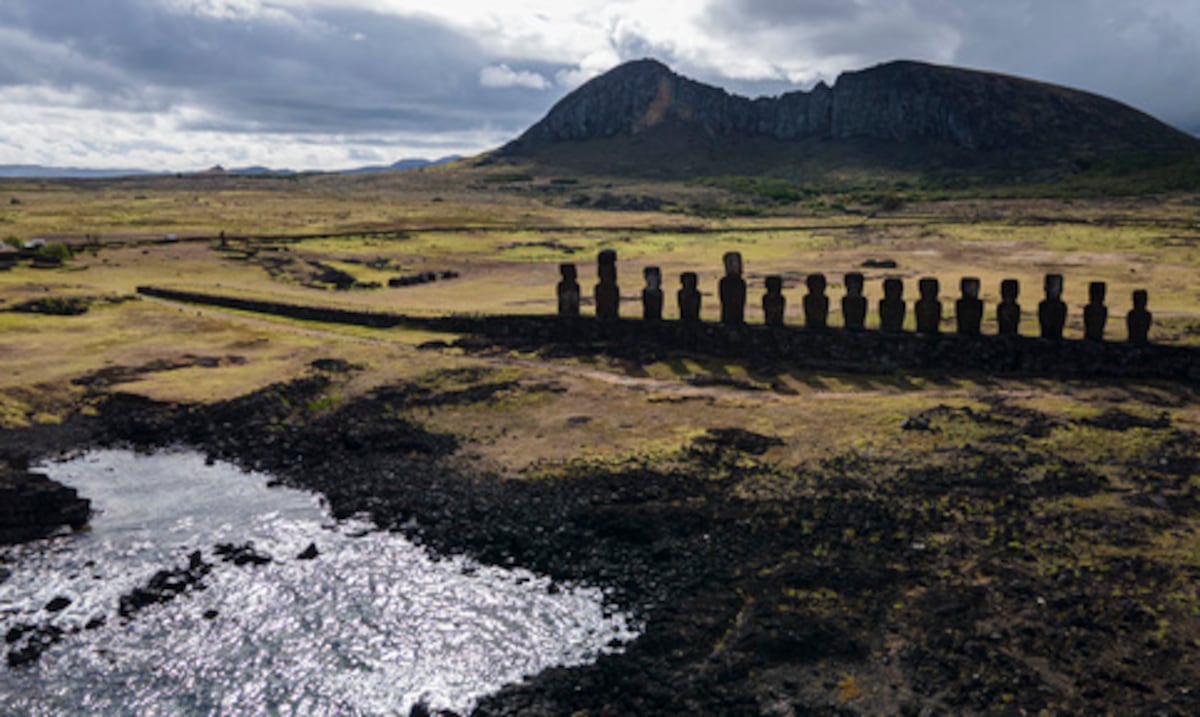
By the end of the century, the Increase in sea level could push powerful seasonal waves towards the 15 iconic Moai statues of the Easter Islandaccording to a new study published in the Journal of Cultural Heritage. Around another 50 cultural sites in the area are also at risk of flooding.
“The increase in sea level is real,” said Noah Paoa, principal author of the study and doctoral student in the School of Oceanic and Land Science and Technology of the University of Hawaii in Manoa. “It is not a distant threat.”
Paoa, who is from Easter Island, known for his indigenous people as Rapa Nui, and his colleagues built a high -resolution “digital” twin of the east coast of the island and executed computer models to simulate future impacts of waves under several scenarios of increased sea level. Then they superimposed the results with maps of cultural sites to identify which places could be flooded in the coming decades.
The findings show that the waves could reach Ahu Tongariki, the largest ceremonial platform on the island, as soon as in 2080. The site, home of the 15 imposing Moai, attracts tens of thousands of visitors every year and is a cornerstone of the tourist economy of the island.
Beyond its economic value, AHU is deeply intertwined with the cultural identity of Rapa Nui. It is located within the Rapa Nui National Park, which covers much of the island and is recognized as a World Heritage for the UNESCO.
The approximately 900 MOAI statues throughout the island were built by the Rapa Nui people between the 10th and 16th centuries to honor important ancestors and bosses.
1 /18 | Do we lose our beaches? Images of how the sea touches the door of many constructions. On Buyé Beach, in Cabo Rojo, where you can see constructions that are practically on the edge of the beach. – Teresa Canino Rivera
The threat is not precedents. In 1960, the largest earthquake ever registered, of magnitude 9.5 off the coast of Chilisent a tsunami that devastated the Peaceful. Rapa Nui hit and dragged the Moai already knocked down more inside, which damaged some of its characteristics. The monument was restored in the 1990s.
While the study focuses on Rapa Nui, its conclusions echo a broader reality: cultural heritage sites worldwide are increasingly in danger due to the increase in sea level. A UNESCO report published last month found that around 50 world heritage sites are highly exposed to coastal floods.
A UNESCO spokesman said that relevant experts were not immediately available to comment.
The possible defenses to Ahu Tongariki range from shielding the coast and building breakwater to relocate the monuments.
Paoa expects the findings to bring these conversations about now, instead of after irreversible damage.
“It is better to look forward and be proactive instead of reagent to possible threats,” he said.