
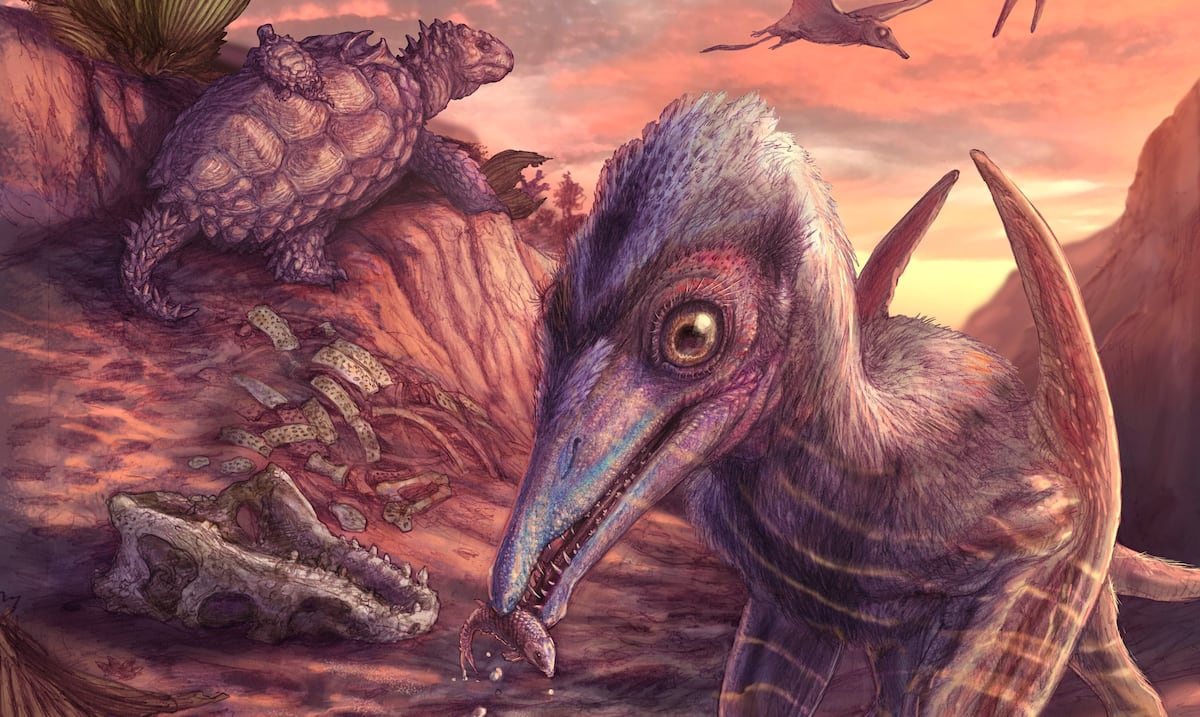
14 years ago a team of researchers entered the Petrified Forest National Parkin Arizonain search of fossils of the ancestors of mammals; Instead, they found a single Triassic site where they have discovered the oldest known pterosourium in North America.
The fossil, the size of a seagull, It corresponds to a winged reptile type that lived alongside dinosaurs 209 million years ago, and It was one of the first vertebrates to develop the propelled flightas described an article in the magazine Proceedings of the National Academy of American Sciences.
The researchers, led by the paleontologist Ben Kigman, of the National Museum of Natural History of Smithsonianthey present the fossilized jaw of the new species, and describe the pterosour, along with hundreds of other fossils, including one of the oldest in the world, one of turtle, in the National Park Park of the Petrified Forest.
That natural space of Arizona, which visually looks like a desert painted by its colorful concentration of petrified wood, has become a reference oso site of the end of the Triassic period, about 209 million years ago (according to the dating of the minerals it contains).
Coexistence of animals of different ages
Researchers have seen that excavation shows “a dynamic ecosystem in which older groups of animals, such as giant amphibians and old relatives of crocodiles, lived with new evolutionary groups such as frogs, turtles and pterosaurs,” says Kigman in a Smithsonian statement.
“The site captures the transition to more modern vertebrate communities, in which we began to see groups that prosper later, in the Mesozoic, living with these older animals that did not survive the Triassic,” adds Kigman.
The researcher affects that these findings “help fill a vacuum in the fossil record before the Triassic extinction, about 201.5 million years ago, when volcanic eruptions associated with the rupture of the supercontinent Pangea drastically altered the global climate and ended approximately 75 % of the earth species.
These changes raided the way for new groups, such as dinosaurs, diversifying and dominating ecosystems from around the world.
This part of the northeast of Arizona was in the center of the Supercontinent Pangea and just above Ecuador 209 million years ago.
The semi -arid environment of the area was crossed by small river channels and was probably prone to seasonal floods, which dragged sediments and volcanic ashes towards the channels.
The researchers believe that some of those floods had to bury the creatures preserved in the deposit.
The home of the most diverse creatures
In total, The team has discovered more than 1,200 individual fossils, including bones, teeth, fish scales or fossilized droppings of 16 different groups of vertebrate animals.
The fossil remains indicate that the intertwined rivers of the region were full of fish, fresh water sharks or ancient amphibians, some of which reached two meters in length.
While the surrounding environment was “the home of fearsome reptiles that evolved at the beginning of the Triassic, including acorazed herbivores and dentudos predators that resembled giant crocodiles,” the authors point out.
Together with those creatures they lived a variety of more familiar animals, including relatives of the first frogs.
A turtle with bang of spikes
The researchers also described the fossils of an old turtle with a shell with spikes and a shell that fits inside a shoe box. This animal lived in the same time as the oldest known turtle, whose fossils were discovered in Germany.
“This suggests that the turtles were quickly dispersed by Pangea, which is surprising for an animal that is not very large and that it was probably walking to a slow pace,” says Kigman.
For its part, the new species of pterosour that the team discovered is one of the oldest species of those found outside Europe: “Winged reptile would have been small enough to perch comfortably on a person’s shoulder.”
His worn jaw revealed that the pterosour possibly fed on the fish of the site, many of which were covered with armor similar to armor.
The team has baptized the new species of pterosour as’Eotephradactylus mcintiree‘, which means’ goddess of dawn with ash wings’ in reference to the volcanic ash of the site, to the position of the animals near the base of the evolutionary tree of the pterosaurs, and to the surname of its discoverer.