
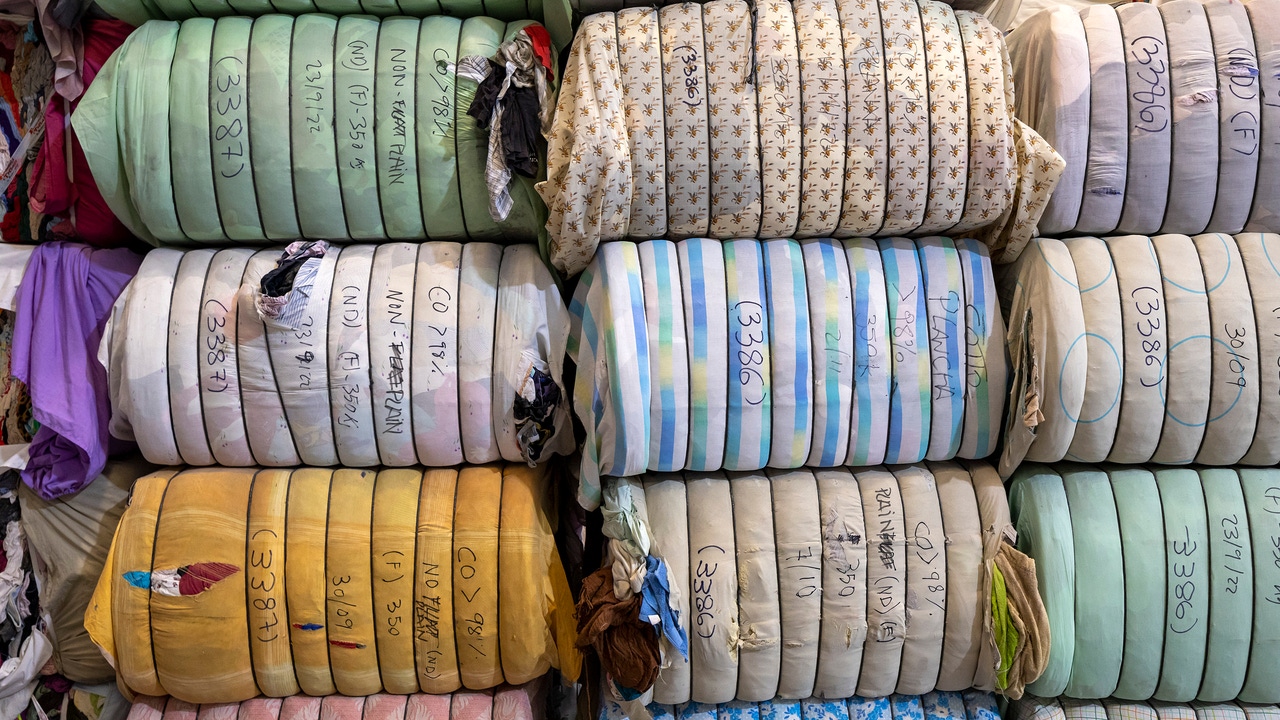
After years of research of various projects, the textile sector in Spain demonstrates that the Union is strength and has taken a decisive step to transform its production and consumption model. With the creation of Re-Viste, the industry joins and addresses the challenge of sustainability, with which, it seeks to manage waste efficiently, allowing to redesign the future of textile from a circular perspective. Driven by Law 7/2022 on contaminated waste and soils for a circular economy, and aligned with European guidelines, this project has a clear objective: support the transition to a model where reuse, recycling and waste reduction are the norm, and not the exception.
The initiative is constituted as the first Collective Expanded Responsibility System of the Producer (SCRAP) Specific for domestic textile waste in Spain. Under this framework, the main companies of the retail decided to join forces and founded the association in 2023. Today, they are part of it, companies such as: Decathlon, El Corte Inglés, Grupo Mayoral, H&M, Ikea, Inditex, Kiabi, Mango, Primark, Sprinter/JD and Tendam.
Transforming the system
The passage from theory to action has already begun with the implementation of the pilot project in San Miguel de Abona (Tenerife).This town will be added six other municipalities nationwide, through which it is planned to reach more than 300,000 inhabitants, covering urban, rural and semi -urban areas.
Among the key actions, the installation of a specific collection network, both in public and private spaces. Containers are included in public roads, municipal clean points, participating businesses, shopping centers, parishes and other community spaces. All the material collected will be transferred to selection plants, where it will be distinguished between reusable products (destined for donation and second -hand stores) and materials susceptible to recycling according to their composition. The technical monitoring will bet on transparency, will be constant and will be in charge of the Monitoring Committee, composed of representatives of the Spanish Federation of Municipalities and Provinces (FEMP) and Re-Viste. The following project will be inaugurated in the coming months in Saragossaunder the same guidelines.
A circular textile economy
One of the strategic objectives of Re-Vel is that this system becomes a replicable model nationwide.
In addition, it aims to contribute to a cultural transformation around textile consumption. To do this, it will promote citizen awareness campaigns, aimed at informing and raising awareness about the life cycle of textile products and ways to reduce their impact. “The challenge is not only technical, but also social,” They affirm from the Directorate of Re-Viste. «It is essential to provide citizens with tools that allow them to actively participate in this process of change. Each well managed garment is a step towards a more equal, fair and sustainable industry, ”they add.
An unpublished alliance
The uniqueness of Re-Veso also lies in its governance: large competing companies in the market have decided to collaborate to address a common challenge. This co -responsibility logic is precisely what allows us to think about a structural transformation of the sector.
The alliance between public and private actors, the incorporation of environmental criteria in the value chain, and the promotion of a truly circular economy position the project as a reference in the European context of this mode, Re-Viste represents the opportunity to change the rules of the game, with a system thought not only to manage waste, but to reimagine the role of textiles in a society that demands coherence, sustainability and action.