
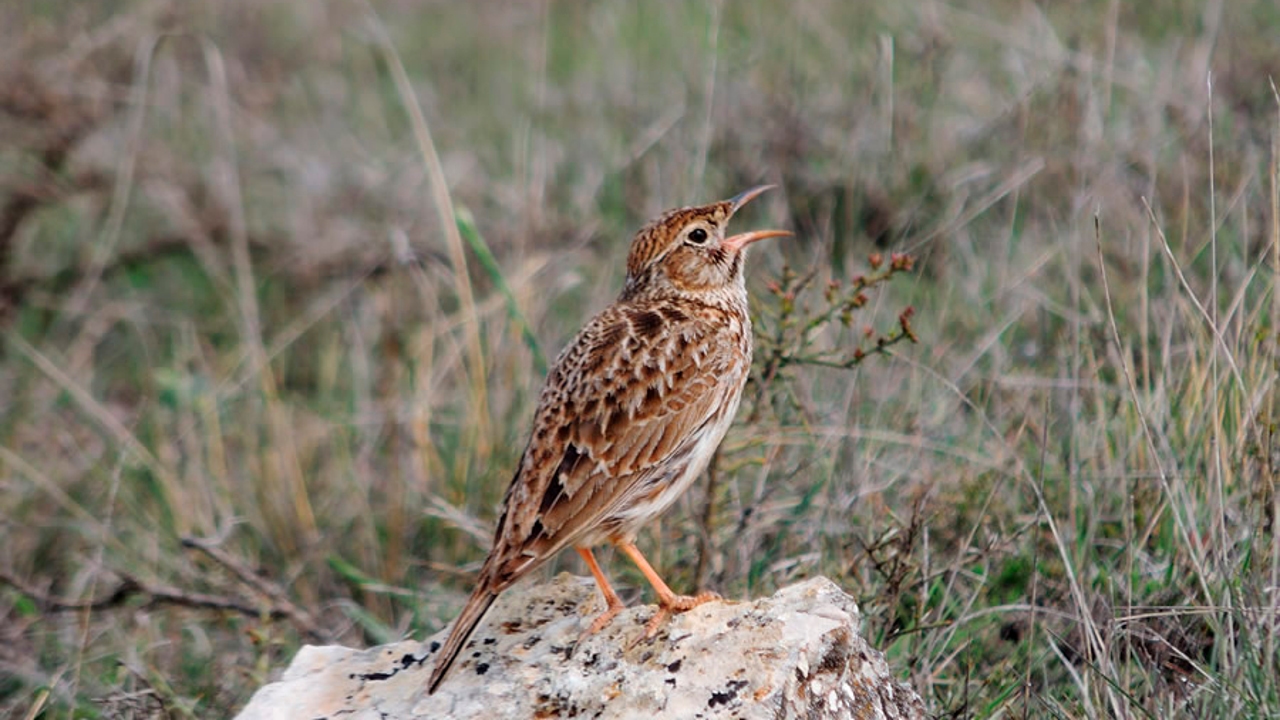
The Ricotí, Chersophilus duponti, is a tiny bird. It weighs 40 grams, it fits in the palm of the hand and still left over space, it passes most of its life on the ground, among the thickets of the moors in which it lives where it is possible to hear its song before the dawn or after the twilight. It is one of the most threatened birds in Europe, in fact it is vulnerable in the IUCN red list (International Union for the Conservation of Nature), and in danger in the Spanish catalog of threatened species. And, precisely, in Spain is the only population of these alls that remains in Europe, with 4,000 individuals. The rest is distributed in northern Africa.
It has not always been like this: the population of Alondras Ricotí in Spain has suffered a decline of 30% in the last 15 years, according to a study by the Autonomous University of Madrid. Its distribution area has also been reduced by 35%. There are less and in less places.
Reversing both situations, increasing the population and increasing and improving the surface of their habitat,-with the objective of favoring the translocation of specimens to the areas with the lowest population and their connectivity-are the objectives of the Life Connect Ricotí project, which is being developed in territories of Castilla y León, Castilla-La Mancha and Catalonia from 2021 and until 2026.
This project, with a budget 5,485,479, of which almost four are financed by the European Union through the Life program-, is a continuation of the previous Life Ricotí, and among its partners are the Autonomous University of Madrid, which coordinates it, the regional governments of Castilla-La Mancha, Castilla y León and Catalunya, the CTFC of Catalunya and the Foundation of the Natural Heritage of Castilla y León.
Less sheep, less rich
The progressive abandonment of traditional livestock and its grazing is the main cause of the weak situation of these birds, due to the loss of their habitats. The data provided by the Professor of Ecology at the Autonomous University of Madrid and project coordinator, Juan Traba, say everything: in 30 years Spain has lost nine million sheep. That, in large part, they are the ones that maintain the steppe ecosystem in adequate conditions for these birds ». A high density of cattle, “reduces the height of plants, favors the presence of invertebrates from which it feeds and hinders that of small vertebrates and larger birds that are their predators.”
Without cattle, the Páramo is transformed very quickly and there can no longer survive the Ricotí lark. That is why sustainable grazing is a key tool to expand the parameras surface. To do this, as Prada explains «we have made many alliances in the territory, among others, with farmers who bring to their herds a certain number of days to the areas of action of the project. They are Environmental Services for the maintenance of vegetation and supply of excrement naturally because of them obtain financial aid ».
Apart, there is an important series of essential tasks for the restoration of U or translocation habitats, which require professional services. How to make wooded cuts, scrubland plantations, fenced to save the sheep, installation of fences, improvement of ships, aim, parideras or roads, conditioning of drinking fountains, transportation, etc. «All are works that are hired with local companies, so that the economic costs of these operations remain in the territory. In short and approximately, around two million euros will be the ones that this Life disseminates among professionals, companies, etc., that collaborate with the project.
Thus, the conservation of the Ricotí Alondra, in addition to preserving traditional landscapes and uses, which house a huge biodiversity and are a heritage, it is also an aid for rural populations where these small birds live.