
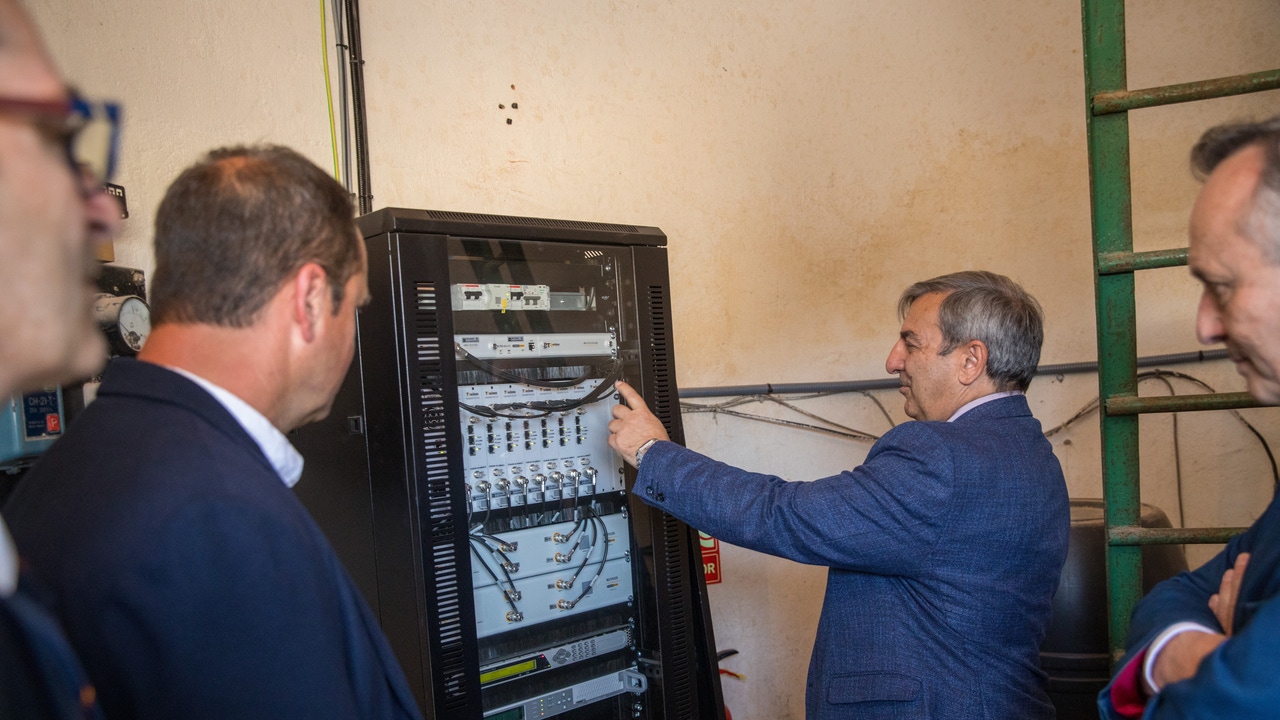
The Minister of Mobility and Digital Transformation, José Luis Sanz Merino, On Tuesday the Segovian municipality of Sanchonuño has visited to verify the advances of the agreement signed between the Junta de Castilla y León and the Provincial Council of Segovia in order to Improve the reception of digital terrestrial television (DTT) in different locations of the rural environment, such as Caballar, Sanchonuño and Navafría.
The Board maintains a network of 648 TDT issuing centers that serves more than 350,000 citizens, with an annual maintenance cost of 5.4 million euros listed entirely by the regional administration for more than a decade.
In the province of Segovia, there are 26 issuing centers with a cost of 222,000 euros per year. To this is added an additional effort in 2024, with the granting of aid near the million euros to facilitate access to HD sat-tdt receptors after the end of SD emissions, with up to 2,322 beneficiaries throughout Castilla y León.
In Sanchonuño, the agreement has allowed the installation of a new emitter center, as well as the adaptation of a new location in the water tank of the municipality. This center is already in service and covers approximately a thousand people, solving a poor reception situation of the DTT signal. In this infrastructure about 50,000 euros have been invested.
The actions in Sanchonuño, and also in Caballar, have been carried out through agreements with the municipalities, which received financing from the Diputación and assumed the direct execution of the works, as well as the future management and maintenance of infrastructure.
In addition, in the province of Segovia it has also acted in Navafría, where the issuance of MPE4 and MPE5 has expanded benefiting between 6,500 and 9,000 people from 66 population centers. And soon an action requested by the City of Fuentidueña is proposed.
The counselor indicated that the Board has requested in writing three times to the Ministry for Digital Transformation and Public Function Specific budget allocation to improve DTT coverage in the rural environment, without having received a response to date.
In February 2024, the Board and eight councils signed a manifesto on access to digital television, demanding the central government financial involvement to guarantee access in equal conditions.
Also allegations have also been presented to the new TDT technical plan approved in March 2025, which implies a migration to the European DVB-T2 standard. The adaptation of the 648 autonomous issuing centers will involve a cost of more than 30 million euros, without the allegations of the Board having been taken into account in the final text.
This visit is produced after the publication of the 2024 Broadband Coverage Report, prepared by the Ministry for Digital Transformation and the Public Function, which figure in the 86.86 % FG coverage in Castilla y León, well below 95.76 % of the state average.
Also, in the field of fiber optics (FTTH), the community is also in a clear disadvantage position, with a coverage of 90.79 % compared to 93.88 % of the Spanish average, despite the important effort made in recent years. Although the gap with the national average has been reduced, Castilla y León continues to lag in the main indicators of digital connectivity.
“These data confirm lto the urgent need for greater involvement of the Government of Spain to guarantee digital connectivity In the rural environment of our community, ”warns the counselor, who reaffirms the Board’s commitment to guarantee access to basic communication services in equal terms for all citizens, regardless of their place of residence.