
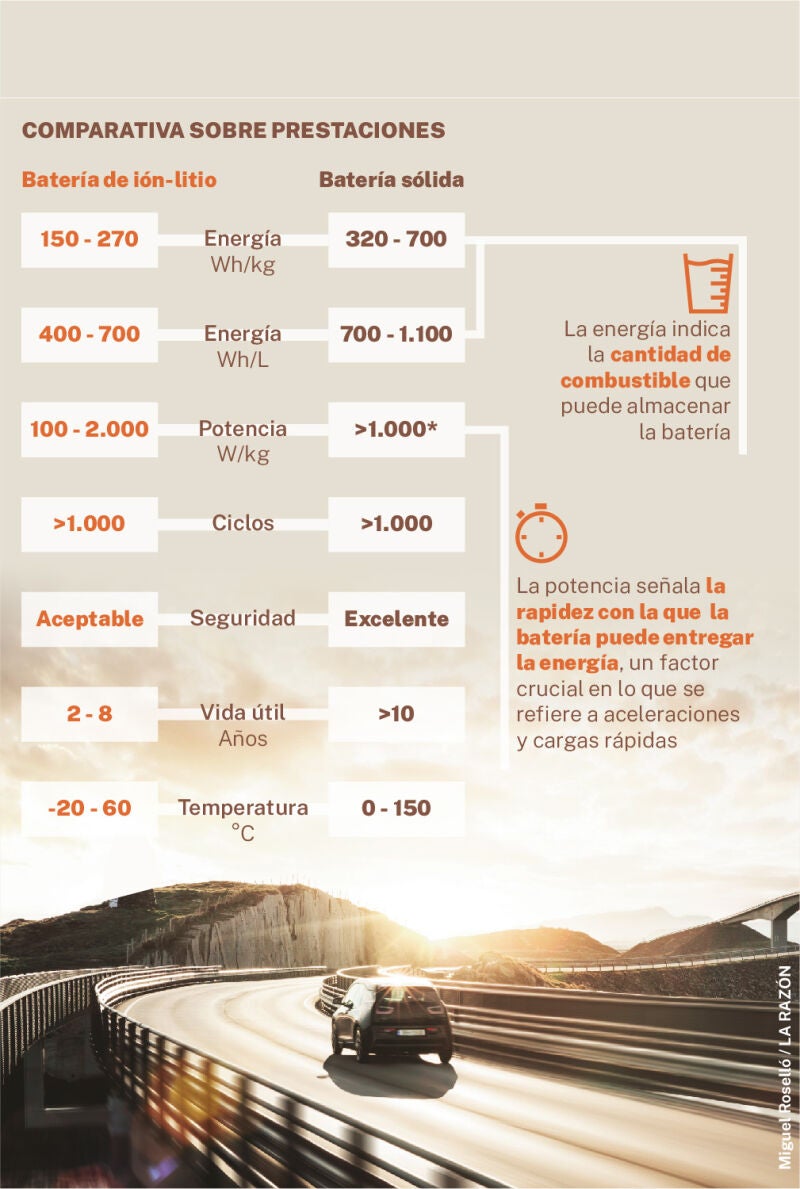
Electric cars traveling 1,500 km without “reposting.” Is it possible? It is the promise of the so -called solid state batteries, the new Holy Grail of the automotive. Faster recharge times, lighter and less flammable batteries would be the added advantages of these new developments in which many brands are working. MG wants to release the first units at the end of this year. They will install them in the IM L6 and hope it will travel without recharging 1,000 km. In addition, with only 12 minutes of plug could with another 400 km. The Stellantis group points to 2026 as the release date of its development and the same thing says. The energy density of the Chinese group batteries is 600 Wh/ kilo (the measure indicates how much fuel or energy can store the battery) and Autonomy would be 1,500 km.
The autonomy of the batteries continues to appear in the list of reasons why the electric has little market share – together with the lack of recharge points or the price. Right now they represent around 6% of the park, according to the latest data of the Association for Electric Mobility (AEDIVE). You just have to think that the models that manage to travel more distance, around 500 km, cost more than 40,000 euros. So, has the lithium ion been overcome? The current lithium ion batteries of the cars, which we can also find in a reduced version in mobile phones, are built based on cells that inside have an anode and a cathode. These are submerged in a conductive liquid called electrolyte. The battery is recharged when lithium ions flow from the positively loaded electrode or cathode, to the negative electrode or anode. In a lithium ion battery, The electrolyte is composed of lithium salts dissolved in liquid. That electrolyte in the new batteries would be solid, in some cases it is proposed to use polymers, ceramic materials or a combination of the two. «Brands bet on solid state batteries because they offer greater security, more energy density, which translates into more autonomy for electricity, faster load times and a longer shelf life, because it gets contact between solid materials to function well for many cycles. In addition, by eliminating the flammable liquid, the risks for transport and storage are also reduced, ”says Antonio García, a researcher at the CMT-Clean Mobility & Thermofluids Institute, of the Polytechnic University of Valencia. The researcher, however, warns that there are pending challenges such as manufacturing them reliably and economically on a large scale. Something that coincides with the CEO of Catl, the largest battery manufacturer, which these days stated in media that these solutions will take at least 10 years.
This career to find the next generation of batteries not only has to do with the autonomy or the benefits of the car, but also with the minerals used to manufacture them. Lithium, nickel or cobalt extraction cause environmental problems and are minerals that may suffer price volatility due to geopolitical tensions. According to the latest critical mineral report from the International Energy Agency, published in May: «Critical mineral markets have been concentrated more, especially in regard to refining and transformation. In the case From copper, lithium, nickel, cobalt, graphite and rare earth elements, the average market share of the three main producers increased to 86% in 2024 From about 82% in 2020, with almost all the growth of the offer from the only supplier: Indonesia for the nickel and China for all other minerals. Lithium demand increased almost 30% by 2024, significantly exceeding the annual growth rate of 10% observed in the 2010s. Meanwhile, investment in critical minerals barely grew 5% in 2024 and the exploration activity stagnated ». In addition, 70% of the cobalt is extracted in the Democratic Republic of the Congo.
In this career, solid state batteries are as Enrique García-Quismo, a titular researcher in the IMDEA Energy Electrochemical Processes Unit (Madrid Institute of Advanced Studies), says, “a high-risk commitment that, if it resolves the challenges it has, can offer substantial advances and have a great impact. The market to ten years will continue controlled by the lithium ion, but it works from the 90s in small modifications at anodes or cathodes or in the composition of the electrolyte. There are also engineering or packaging improvements of cells. These developments do not have so much space in the media, but thanks to them an increase in the autonomy of the electric ones that have gone from 200 to 500 km ». The researcher explains that there are more mild improvements such as raising nickel proportions with respect to those of elements such as manganese and cobalt and others more substantial as is the case in the so -called LFP (iron and lithium or lithium or lithium phosphate), leading technology in recent years. «These were invented in 1996 at the University of Texas, and although this chemistry has a worse capacity to store energy, it provides security and stability for electrodes and, in addition, iron is abundant on Earth and has a relatively low cost. In the future it is likely not to see only a technology, but a variety of them depending on the final application. In general, the energy storage sector implies a balance sheet between aspects such as safety, cycling, power, price of materials ».
Sodium ion
There is a type of battery, those of sodium ion, which could be positioned very well in the short term. They use sodium, an abundant metal in nature (it is found in sea salt or in the earth’s crust) instead of lithium. In fact, The IEA says they offer diversification potential. The agency asks politicians to develop diversified supply chains. «Sodium ion batteries presents a potential supply safety opportunity due to its upstream upstream chain, with the US and Europe already playing key papers. However, the downstream supply remains dominated by China ». Dens are studies that talk about developments that also offer an advantage over lithium. «One of the handicap of lithium Ion batteries is that they cannot be downloaded at all and need greater security measures during transport (and, therefore, increase logistics spending). Sodium are more stable, ”Matizes García-Quismo.
A future with a variety of batteries
The future appears loaded with different types of battery: «Betting to use less lithium, cobalt or nickel (or replace them with more sustainable materials) is a clear priority for the industry. In this sense, both sodium and solid state batteries represent an important step: they reduce critical materials and improve security, which is key to sustainable electrification and large scale. Today, the most feasible short -term are those of sodium ion for stationary storage and solid state hybrids for automotive. And of course fuel batteries, which have potential in concrete sectors such as heavy or long route, but the batteries remain the most efficient option, especially for light vehicles and energy storage, ”says Antonio García, of the UPV.