
An old acquaintance returns. At the beginning of the year, NASA projected that the maximum risk of collision of asteroid 2024 YR4 with our planet would be 3.1% in its next orbital approach, in 2032. It is about A body of more than 50 meters, a size that according to the space agency places it in the spectrum of annihilator of quidades. The alarms were reduced with the weeks and the risk became decimal. And we forget him.
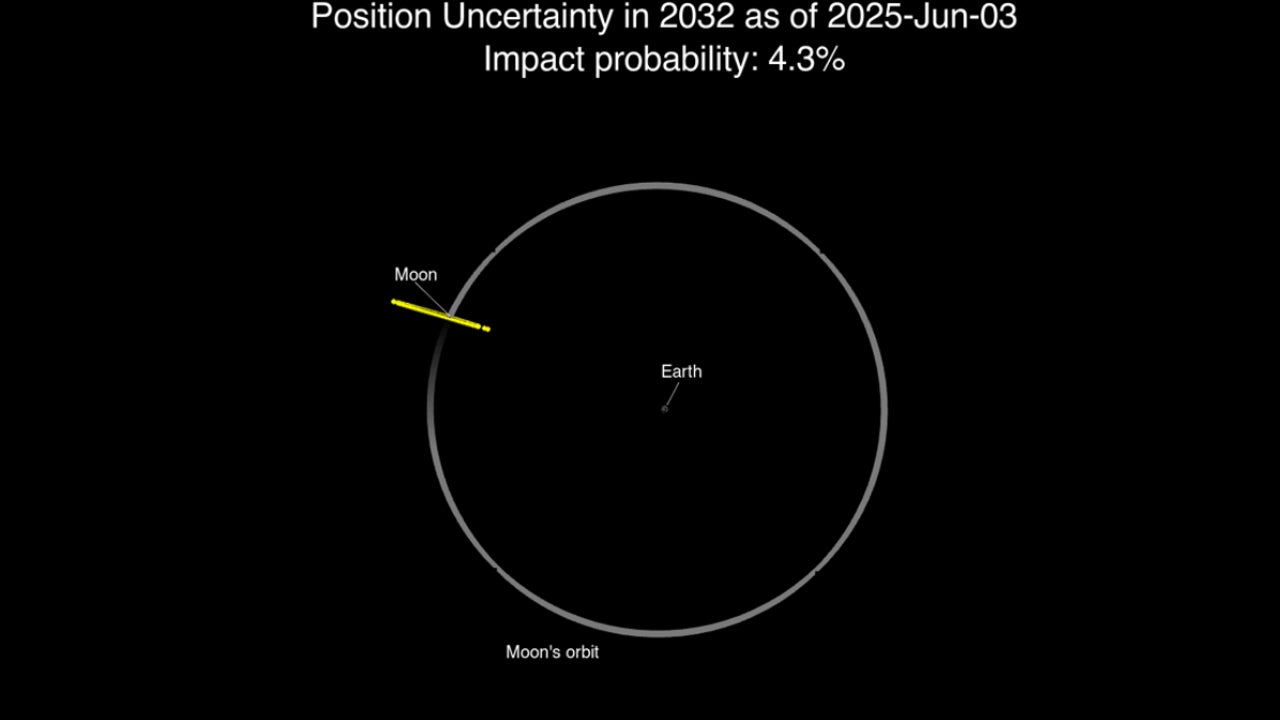
Now, NASA has increased its potential for Impact to 4.3%, the highest to date. The good news is that it would not be with the earth, but with the moon. It is not a particularly high level, of course. But it is high enough to point out some alerts. This impact would not destroy the moon or affect its orbit; But it would be scientifically interesting to observe the training process of a great crater.
The initial calculations of his career indicated that he could collide with the Earth in December 2032. The risk was not huge, but 3.1 % is still alarmingly high for an event that could destroy a city: The rock fragment measures between 53 and 67 meters, comparable to the size of the asteroid that devastated Tunguska in 1908.
Thanks to new observations of the James Webb space telescope obtained in May 2025, astronomers led by Andy Rivkin, from the Johns Hopkins applied physics laboratory, They have reached the new figure of 4.3 %.
That is probably not the last word about it; Trajectory of an asteroid requires repeated observations, and 2024 YR4 is now too far so we can see it.
This rocky body passes near the earth every four years, so astronomers will have Another opportunity to observe it closely in December 2028. We will know more accurately the probability that the piece of space rock impacts our satellite and offers us an incredible show and a great opportunity for scientists.