

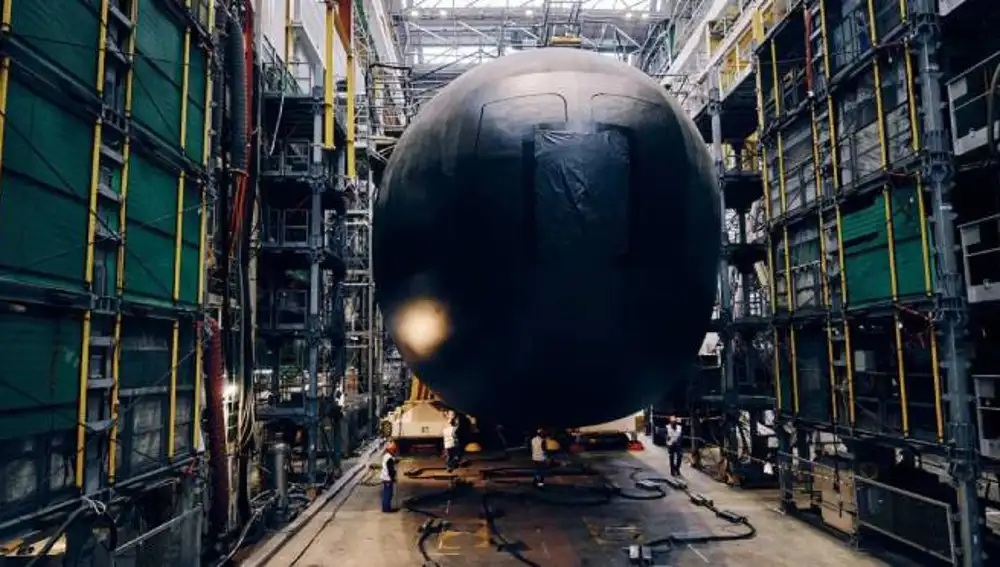
The Marine French announced on Tuesday The end of the assembly phase of the new nuclear propulsion attack submarine Of Grasse (S638). De Grasse has been transferred from the construction ship of Naval Group in Cherburg to the floating launch platform located in the Cachin basin, about 300 meters, in which it will take place Its equipment and systems integration.
Of Grasse, named in reference to the Admiral François Joseph Paul de Grassean outstanding historical figure of the French Navy in the 18th century, is the room of the series of nuclear submarines of barracuda class attack, also known as Suffren class. The Barracuda program, which contemplates having delivered 6 submarines for 2030has a budget of 10,000 million euros and is led by the General Directorate of Armament (DGA) in collaboration with the Aomic Energy and Energy Commission (CEA) of France. The goal is replace the old Rubis class submarines that entered service in the 80s and 90s.
Naval Group He is the main contractor; is in charge of design, construction and maintenance and collaborates with Technicatome In the development and integration of the Nuclear Propulsion System (NSSS), a key component. Around 2,500 people, including 800 subcontractors, participate in the program, reflecting its size.
Pierre Éric PommeletCEO of Naval Group, has pointed out that ‘the launch of Grasse is an important milestone for the Barracuda program. This success reflects the excellence of the French naval industry and its contribution to national sovereignty‘.
Barracuda class: a generational jump
The barracuda class represents a generational leap in French underwater capacities. Each unit displaces 4,700 tons on surface and even 5,200 tons In immersion. Measures 99 meters of length and 8.8 of manga Its design prioritizes stealth, autonomy and multirrol flexibility.
The propulsion system is hybrid, based on a nuclear reactor K15 of 150 MWderived from class Balistic submarines Triomphant and of the aircraft carrier Charles de Gaulle. It also understands two 10 MW turbogeneraders and two 480 kW semi -style semi -desitic generators. Propulsion is carried out through a pumping system that Improves acoustic discretion. The platform allows speeds higher than 25 knots (46.3 km/h) submerged and up to 14 knots (25.9 km/h) on surfaceand is designed to maintain Continuous operations for more than 270 days a yearusing a double crew rotation model.
Grasse’s weapons includes torpedoes F21 Artemis With a 50 -kilometer range, anti -burst missiles EXOCET SM39 MOD 2Cruise missiles MDCN of MBDAcapable of achieving land objectives at more than 1,000 km, naval mines FG29 and the autonomous submarine vehicle D-19 for the deployment of special forces and underwater autonomous systems.
The presentation of Grasse remains the commissioning of the Suffren (2020), Del Duguay-Touin (2023) and the Tourville (2024). The evidence at the Sea of Grasse will begin in 2026after the systems evaluations in port.