
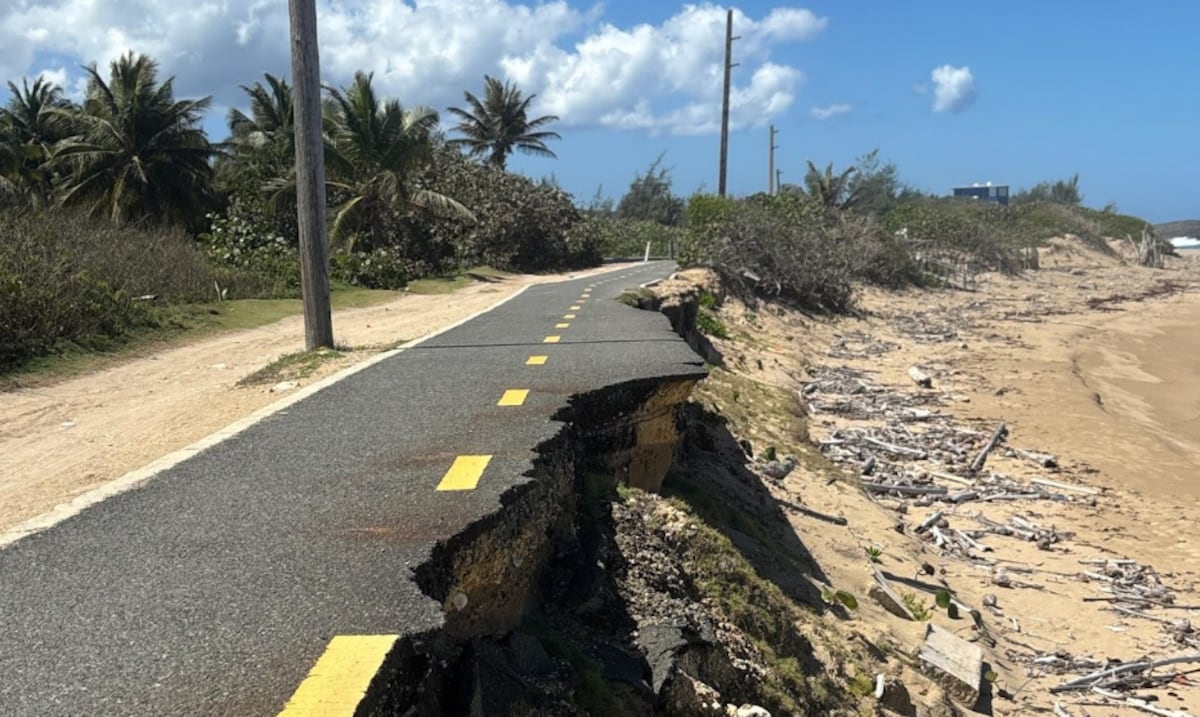
The accelerated impact of Climate change and the lack of proper planning have left significant traces in the Puerto Rico Litoral. In municipalities such as Loíza, San Juan, Arecibo, Hatillo, Rincón, Aguadilla and Isabela, numerous coastal structures have collapsed or, in some way, affected the accesses to beaches, the safety of people and the ecological balance, according to expert voices.
In Isabellaprecisely, there is one of the most recent examples of collapse. It is a linear walk that was built in the Mabodamaca Community Natural Reservecrossing the beach the swallows. Before the collapse, the mayor Miguel “Ricky” Méndez It has a reconstruction project on agenda, whose preliminary design, according to the community, does not consider the ecological impact. The community decided, then, to present a different proposal from the mayor.
“We hope the mayor moves in our favor”he said Héctor “Tito” VarelaPrograms Manager and Community Organizer of Surfrider Foundation Puerto Ricoin an interview with The new day. “The mayor is very optimistic, excited about the idea and the project.”
The proposal was presented to Méndez during a meeting last Monday. Varela stressed that the municipality has had an openness in the discussion of the matter, delivered the plans of the project to the community and accepted the meeting.
According to Varela, the plan presented by the municipality, which would be paid with funds from the Federal Agency for Emergency Management (FEMA, in English), proposes the placement of rocks on the coast, the construction of containment walls and the asphalt application.
However, experts in environmental engineering, marine ecology and daily users of the area – including surfers, corridors, walkers and residents – have Expressed concerns about the possible adverse effects of this proposal, including the acceleration of sand loss, alteration of marine currents and disappearance of the beachin addition to direct impacts on the waves and the coastal ecosystem, according to the data collected by the organization and presented to the municipality.
“Faced with this scenario, the community has worked collaboratively to develop a proposal supported by principles of ecological restoration and citizen security”Varela stressed.
The community proposal includes:
- Total removal of concrete and asphalt debris currently at Las Golondrinas beach.
- Relocation of the Cyclist Walk inland, protected by the existing coastal forest.
- Coastal area reforestation with native vegetation to strengthen the ecosystem.
- Ecological Dunas Restoration (sand mounds).
- Creation of access and wood viewpoints, integrated into the natural landscape for the enjoyment of the community.
“At the outset, it is a great proposal, innovative”Méndez told this media, in an interview after the meeting. He added that the proposal will be part of the discussion he expects to have soon with FEMA officials and the Central Office of Recovery, Reconstruction and Resilience (Cor3, in English).
The mayor, however, was cautious around what will be the final design used for reconstruction, and said that the ultimate determination will depend on the meeting – without date still – with FEMA and COR3 to discuss the project and the use of funds.
“The most advisable thing is to get away from the coast, because climate change is a latent something, so getting away is a sensible alternative. I think we are all on the same line, I know that there will be a good result and we are going to make the greatest effort to present the best alternative”Méndez said.
He acknowledged that, in principle, other proposals of the municipality considered rebuilding “what there was”, taking into account restrictions for access to FEMA funds. Now, however, the conversation is aimed at accessing mitigation funds. “When you enter mitigation, then you bring a different alternative to what there was,” he said.
As part of the new proposal, the municipality would have to acquire – through purchase or expropriation – a small plot that is in private hands. The mayor indicated that the owner has already been preliminary and that, in “any project that has to do with FEMA, there is always an alternative to acquire properties.”
Commitment to the Reserve
The area impacted by the Linear Paseo is a careful space for the community. “There, there were dunes of around 100 feet. According to the Natural and Environmental Resources DepartmentIt was the place where the largest number of sand dunes existed in Puerto Rico, ”Varela said.
The dunes, however, were extracted and then the construction of the walk, which was divided into three phases. The first occupied the coastal space from the Villa Pesquera to the Middles beach – one of the most famous for surfing in Puerto Rico – the second extended to the swallows and the third, to the Jobos beach. The project was inaugurated by phases, as of 2010. Varela said that the community made efforts to achieve a project that was ecologically viable and went directly to the then mayor, Carlos Delgado Altieri.
“We made some observations for the walk to move it south of the road in the areas where it was attached to the beach, because the intention was to do everything closest to the beach. At that time, the mayor, in the first phase, listened to us and made the edition”he said. However, in the second phase, the result was different and the walk was built on the main road, bringing it closer to the beach.
“Over the years, climate change, Cyclonic swellthe Hurricanesthe coast of Isabela begin to whip hard and one of the most affected areas was phase two, where the walk did not move to the southern area of the road and is the one that eventually collapsed, ”Varela said.
For more than two decades, the community has worked on the restoration and conservation of the area.
“The place has incredible value for us. We begin the restoration of dunes, we work restoration of Mangleswe have sown more than 20,000 endemic or native coastal plants and today the place is respected as a reserve, although it still does not have the designation (official) ”he said.
With the reconstruction design that the community proposes, Varela said, “all people could enjoy this space, moving to a success story with what is known today in environmental aspects as nature -based solutions.” In that direction, he stated that the community aims to serve as a model to follow for other municipalities and mayors, mentioning as an example the controversy for the development proposal of a bike path on the Coast of Rincónwhere there have been recent protests.