
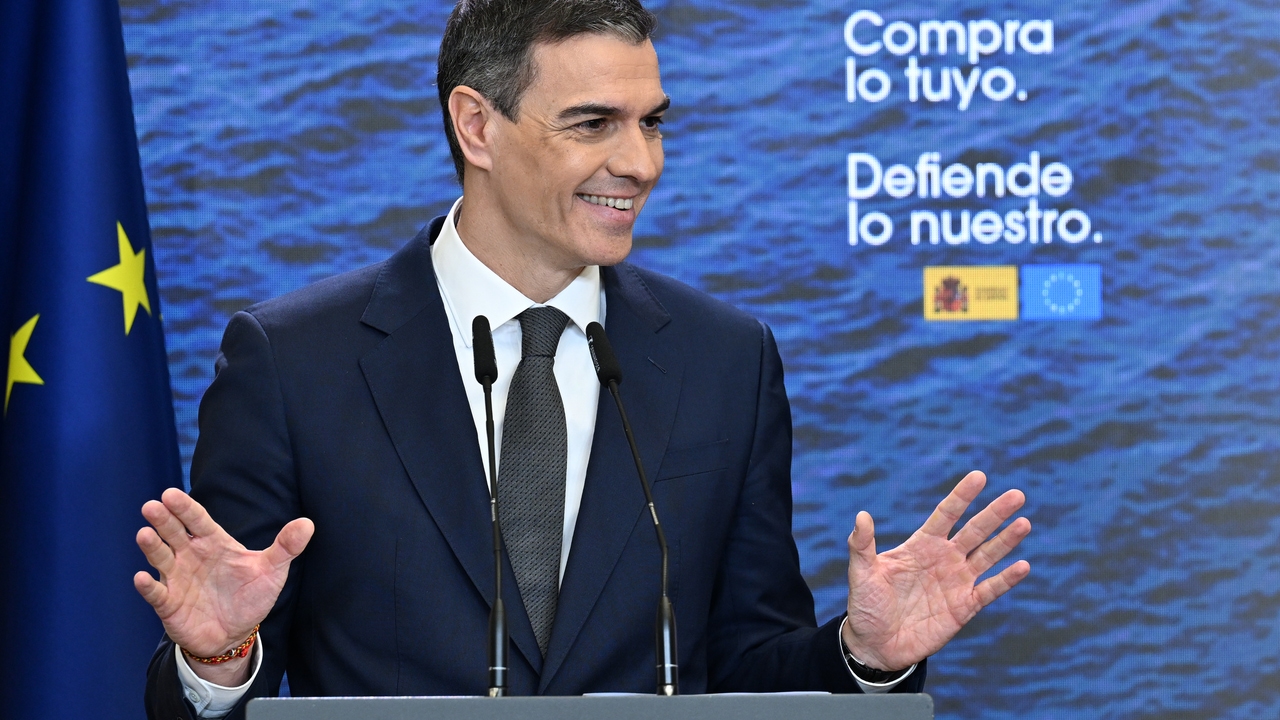
A plan scripted with the same protagonists who represented the plans for action in the pandemic, with the war of Ukraine or with the Dana: a shield with more financing than direct aid. This will be the “response plan and for commercial relaunch,” the grandiloquent name with which the president of the Government, Pedro Sánchez, baptized yesterday the contingency shield that the Government will activate to “protect the Spanish companies and workers.” The president will face the tariff war declared by Donald Trump with the mobilization of 14,100 million euros and the activation of “a double umbrella, that of the Government of Spain and that of the European Union.” Sánchez specified in a speech prepared to the millimeter and without uncomfortable questions, that this plan has been designed to “mitigate the negative impacts of the commercial war, which will act as a shield that protects the economy in case the storm ends up unleashing.”
As detailed, the total amount that this program will have will be used to “modernize our economy, protect employment, sustain our companies and help seek new markets and new commercial partners for Spain.” However, everything that shines is not gold. More than half of these grants correspond to financing, 7.4 billion that companies would have to return if they resort to them. Sanchez said that two lines of guarantees and intermediate financing of the ICO will be launched, equipped with 6,000 million euros, to “facilitate companies accessing financing and meet their circulating needs.” Additionally, a Fund for Support for Productive Industrial Investment will be promoted, endowed with 200 million euros, to give “loans and participation in capital to modernize or install new productive plants.”
He also noted that another 6.7 billion of this plan will be allocated to two objectives: to activate protection support instruments for companies and workers, and reorient the Spanish productive capacity, looking for new markets “under the prism of strategic autonomy”, although the president did not detail what these instruments and measures would be. In addition, he said that another 5,000 million euros of the European funds of the recovery plan will be “recanalized”, which will be destined to “transform and reorient productive capacities towards new sectors with high demand for industries and companies whose activity can be reduced by tariff shock”, which will be joined by another 2,000 million in credit insurance and risk coverage to export; 500 million for the internationalization of small and medium enterprises, and a specific ICEX plan to help the sectors affected by the new commercial scenario to strengthen their position in the United States, although it did not detail the money destined for the latter Sanchez has taken advantage of the presentation to add the MOVES II Plan, endowed with 400 million, which was already approved in the Council of Ministers this week on the margin of the tariff He said, “stimulate the automobile sector.”
In labor matters, the mechanism of the ERTE Red will be activated for the sectors that need it and that will allow “maintaining templates and helping employees of the companies most beaten by the commercial war until their activity recovers.”
Along the same lines, he announced that he will ask the European Commission for emergency measures, among which he will claim the activation of a special framework of state aid, “which provides greater flexibility to national support measures”, and the creation of an aid fund to the affected sectors, “financed with the collection of community tariffs that are put as a counterpart to the US”. It will also ask for the review of some community regulations to support the productive fabric.
After knowing this plan, the leader of the PP, Alberto Núñez Feijóo, demanded that the chief of the Executive a “country strategy” with the autonomous communities to respond with “unity”, while demanding that he report to the EU of his trip to China, warning him of the “error” of changing as a priority partner to the United States by the Asian giant. Feijóo insisted that an “urgent response” of the government is necessary with the autonomies and the affected sectors. The Popular Economic Vice Secretary, Juan Bravo, met with the Minister of Economy, Carlos Body, which he detailed in depth the government’s plans. Body will direct the Interministerial Commission that will execute all phases of the Plan.