

Spain needs to add 19,300 ultra -grape recharge points for equate the service of electric vehicles to gas stations traditional This is one of the main conclusions of the report “Impulse to green mobility: present and future of the recharge infrastructure of the electric vehicle in Spain”, which Payment Innovation Hub and AFI have presented this morning, in Madrid, in collaboration with Caixabank, Visa and Arval.
The analysis quantifies the evolution of the sector and the current challenges it faces, detecting a wide margin of Improvement regarding user experience. In addition, the “urgent” need to approve a national shock plan that accelerates the demand for electric vehicle and promotes the deployment of recharge infrastructure.
During the event, these aspects were abounded through two round tables, in which expert voices of leading entities in the electromobility sector, such as Anfac, Repsol, Kia Spain, Aedive, Mobi.e and Custos Mobile participated.
The report detects a growth of the electrical modality in Spain, which shorten distances with the European average. At the end of 2024, the fleet of electric vehicles reached 420,000 units and the public recharge infrastructure added about 39,000 points, exceeding the average growth in the continent.
In addition, the Distribution of recharge points per inhabitant is homogeneous Among Spanish municipalities of different sizes, with a national average of 0.80 points per 1,000 inhabitants. However, Silvana Churruca, CEO of the Payment Innovation Hub, points out that “despite the growth of the recharge infrastructure network, there is still a margin of improvement in the adoption of the electric vehicle.”
The report is relevant “to enhance recharge points to the growing demand for electric vehicles” in the Mediterranean arch, Madrid and Canarian and Balearic archipelagos. On a second level, it considers it necessary to reinforce the points before a «Low density of recharge points» in areas such as Andalusia and the Galician coast. Finally, he finds a low dates and a small electric park in the peninsular center.
The recent regulations affirm (Infrastructure Regulation for alternative fuels) establishes a common regulatory framework in Europe to boost electric mobility. Among its key measures, it requires a Greater endowment of ultra -grape recharge points (> 150kw) in the Transport Transport Network (TEN-T), in addition to improving accessibility in payments, with the installation of card readers in fast loaders (> 50kw) and the recharge option without the need for registration or contract signature.
The report highlights that more than 50% of the TEN-T network in Spain already reaches the objectives of the regulation by 2030and with just 200 additional points the established goal would be met. However, the document states that, to achieve a user experience similar to that of current gas stations, greater acceleration is needed in the deployment of an infrastructure aimed at promoting a more efficient, accessible and sustainable ecosystem.
Facilitate contactless card payment
A critical aspect, according to work, goes through improving the Payment ease at recharge points. Although the current regulations require that the recharge points installed from April 2024 have a card reader, in Spain, only 9.1% of the operating points in October 2024 had one, and only 4.6% were equipped with a contactless card reader, according to data from the Ministry for Ecological Transition and the Demographic Challenge (MITECO).
This hinders card payment and does not respond to the current needs of consumers, since a visa study shows that 80% of users believe they should be able to pay by card. Eduardo Prieto, general director of Visa in Spain, emphasizes that “the standardization and interoperability of payments at recharge points are key aspects to boost digital and sustainable mobility.”
Collaboration between administrations, companies and the financial sector is essential to guarantee an effective transition towards electrical mobility. Eugenio Solla, Sustainability Director of Caixabank, emphasizes that «of the more than 100,000 million euros that we want to mobilize in sustainable finances In the next three years, a part will be destined to clean mobility and includes investment in recharge infrastructure to contribute to its development and expansion ».
Manuel Burdiel, commercial director of Arval, added that «Spain is a world power in car manufacturing and load points. We have to take advantage of the opportunity and collaborate among all the actors to boost electrification in our country ».
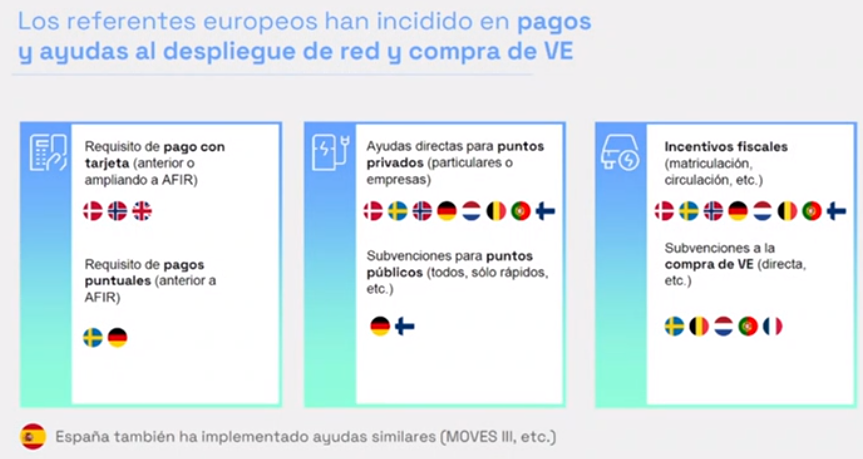
The report also analyzes the regulations implemented in leading European countries in the adoption of electric vehicles, such as Portugal, the Netherlands and Denmark, with the aim of inspiring the development of the Spanish market. Portugal, for example, has achieved a great advance in electric mobility, from 50,000 to 200,000 electric vehicles in four years, with a registration fee of more than 30%, thanks to a interoperable payment system and a wide scheme of fiscal aid.
Diego Vizcaíno, Socio-Director of Applied Economics of AFI, points out that “Spain must advance in the installation of recharge points to match other countries in our environment, comply with the objectives of the regulation affirmed by 2030 and ensure a user experience without friction.”
In conclusion, Spain has a great opportunity to advance electric mobility by improving its recharge infrastructure. With appropriate strategies, innovation and effective regulation, the country can accelerate transport electrification, make the load of electric vehicles more accessible and strengthen its leadership in sustainability. Betting on more ultra -grape recharge points in the main road corridors and a better user experience will be key to a rapid and effective energy transition.