
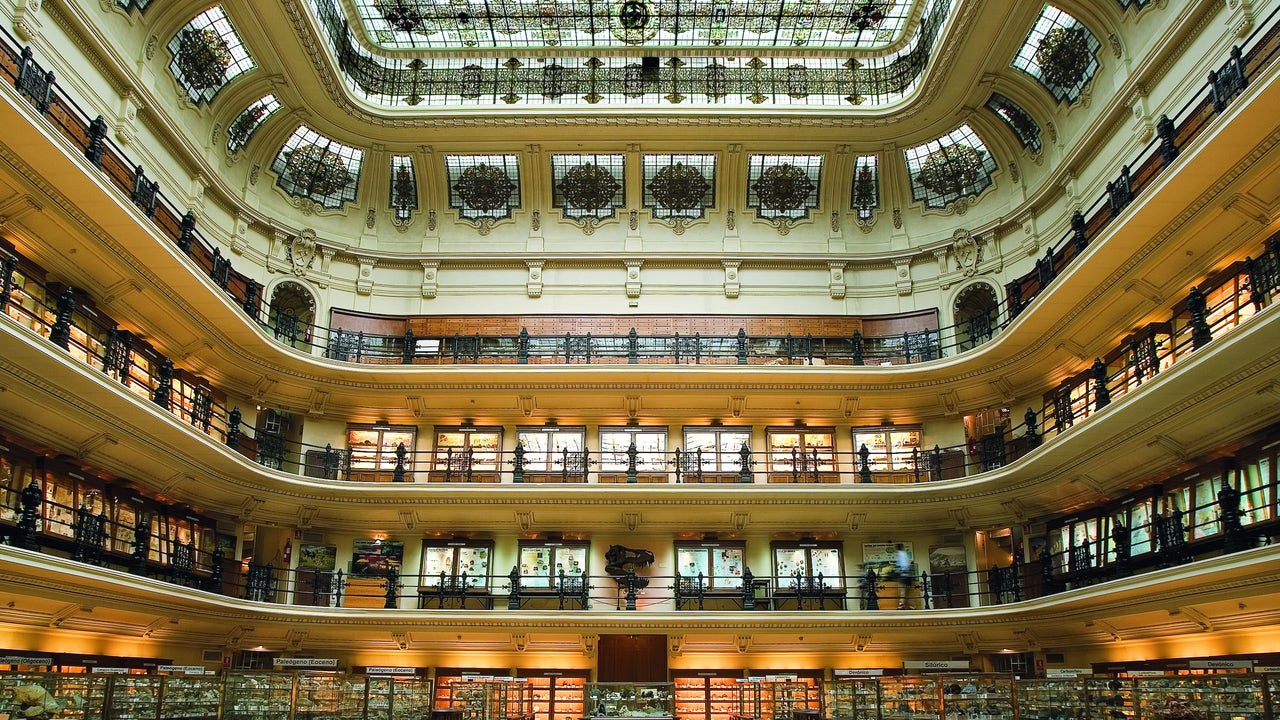
I play the background of the sea 470 million years ago. Thus, with bare skin. One hand, mine, continues in the 21st century the traces of the passage of a trilobites that lived at that time. Neither he, not even a while ago we imagined that this encounter was possible. This converge in time is not something exclusive and only mine, it is possible only to approach one of our great science museums. The Geological and Mining Institute of Spain (IGME) counts in the center of Madrid with A collection of 6,000 minerals, 13,000 fossils, rocks and meteorites In a room, that of the Geominero Museum, conceived as the curiosities of the curiosities of yesteryear.
But it is not all past what is cooked between these halls and offices. The IGME is engaged in full ecological transition. One of his current work is to work to Locate critical minerals. “European regulation requires that all countries present a national exploration plan. Simply know what we have, where and in what quantity, what is far from exploiting. Roughly, in fact, of every hundred points that are explored, only one can end up becoming a mine, ”he says Ana María Alonso Zarza, director until A couple of weeks ago from the institute. And continue detailing, while opening a very current debate: “We want mobiles, which need a lot of minerals and rare earths, but we don’t want a mine in our house. However, we do not care that these minerals come from Congo or wherever, in questionable working or environmental conditions. There is a very negative vision of mining farms, but really if there were no mining, we could not have mobile phones. What you have to try is for things to be done well, reasonably, and if possible, it is a proximity mining and in adequate working conditions. In addition, in European regulation it is prioritized the recycling of the ancient mining dumps, That is, before exploiting a new mine we are obliged to see what is in all those ancient dumps. There are two reasons to do this. The first, that the materials that did not interest before now and, the second, that technology has allowed progress so that the low concentrations of some minerals are now seen with interest, ”continues Zarza.
The trajectory of this institute making maps comes from afar. In fact, its origin as a public institution dates back to 1849 with the “Commission for the Geological Charter of Madrid and General of the Kingdom”. The first cartographies, carried out by mines engineers, did not include Portugal or the continental platform as the last one carried out in 2015. Nor did raw materials such as lithium, one of the leading minerals of the electrification of mobility. “Study techniques have changed a lot and also dating techniques. All this allows you to better characterize minerals. In addition, what is sought is changing. 50 years ago nobody was looking for lithium, ”says Zarza.
The IGME also allocates part of its resources to study the quality of groundwater or The state of wetlands or how to prevent risks in case of flooding or earthquakes. It also analyzes the seismic activity of volcanoes such as Palma, the possibilities of geothermal use and water sowing and harvesting. “Something that has been done regularly in Sierra Nevada, for example,” Zarza clarifies. Of all their activity and their 175 birthday speak in an open exhibition to the public in the museum and in the documentary “The Secrets of the Planet” available on YouTube.
A warehouse of the center of the Earth
One of the most impressive funds that custody the IGME is the Peñarroya Litoteca. This installation is like a stones library that has some 13,600 poll samples performed throughout the Spanish geography. It was built in 1988 to recover, conserve and classify witnesses, samples and grants obtained during the research campaigns carried out by the Institute, as well as those that other companies could yield. “The most highlight polls are the coming from hydrogeology research and those from metal mineral investigations. These represent approximately 82% of the total. ”